What I wrote at Lib Dem Voice

July 08, 2006

Oxford Labour: environmentally clueless

A provocative headline… let me explain it.

A couple of weeks ago, at Oxford city's Full Council meeting, Labour put forward a motion urging the County Council and Oxfordshire Waste Partnership "to exclude incineration in the tenders for future waste treatment". My Lib Dem colleague, Jean Fooks, proposed amending this to: "Choose the least environmentally damaging option for the final disposal of residual waste."

The local Labour spin machine then whirred into action - with what has sadly become, since being defeated in May's local elections, their customary disregard for the truth - claiming "the new Lib Dem administration appears to support building incinerators round Oxford".

Absolute rubbish, of course, and typical of the cheap debate which overly partisan party politics provokes. Incineration is an emotive topic, and one which should be examined seriously. It's depressing that Oxford's Labour group have come to see the environment as no more than a political football.

All of which begs the question: can incineration ever be justified as the "least environmentally damaging option"?

Richard Tomkins, the Financial Times's Consumer Industries editor, has written a fascinating article, published today, examining the recycling industry. Here's what he has to say about incineration:

… environmental cost/benefit analysis explains why, paradoxically, it can sometimes be better to incinerate waste than to recycle it. The Industry Council for Packaging and the Environment, which speaks for companies in the packaged goods industry, supports recycling of most materials. However, it points out that some waste materials - crisp packets, yogurt pots, microwaveable meal trays and the like - are simply not worth recycling because it takes a disproportionate amount of energy to collect, clean and transport them. Far better to incinerate them in power-generating, energy-from-waste plants: that way, each unit of energy released from the waste creates an equivalent reduction in demand for electricity generated from fossil fuels.

Paper presents another paradox. "The argument as to whether you should recycle or burn paper has been going on for 25 years," says Professor Roland Clift of the Centre for Environmental Strategy at Surrey University. "The answer isn't simple. It depends on the background energy economy of the country where you're operating."


To understand why, you need to know two things: first, that incinerating paper, trees and other biofuels is seen as carbon neutral because living matter sucks up as much carbon dioxide from the air while it is growing as it emits when it is burned, and second, that the main newsprint producing countries of Europe (Sweden and Finland) use mainly non-fossil fuels for power generation.


So, as Clift explains, if you are in a country such as Britain where less coal is burned when the demand for energy falls, it makes sense to incinerate used paper in an energy-from-waste plant and import fresh paper from northern Europe, because less coal will get burned overall. "And so it turns out that the net effect is a reduction in carbon dioxide emissions."

If there's one phrase in Mr Tomkins' piece, I'd like to pick out, and invite Oxford's Labour group to reflect on, it is this: "The answer isn't simple." Incineration might sometimes be the "least environmentally damaging option", other times it won't be. The public deserves to hear all the facts to ensure the best, most appropriate, and greenest, decision is taken. Spoon-feeding them puerile propaganda betrays politicians' duty to frame the debate responsibly.

I have, by the way, exempted Oxford's Green group from this critique. They, too, are against incineration, at all times - but at least it's on principle, as the Green Party believes economic growth to be unsustainable. Their answer to excess waste is to impose restrictions on consumer demand, no matter that this would lead to economic recession and a lower standard of living.

The Lib Dems, in contrast, believe society should harness technology to enable environmentally sustainable growth, while shifting taxation away from people's productive activities (ie, their work) and onto their destructive consumption (eg, air travel).

July 07, 2006

Why John Prescott should resign

I guess I have to own up to some level of responsibility for John Prescott becoming Deputy Prime Minister: I voted for him in 1994 to become Labour’s deputy leader.

When Mr Prescott was last assailed by his critics, I stuck up for him. Whether he has had one extra-marital affair, or simply worked his way through the Labour Party’s membership list, is a matter for Mr and Mrs Prescott to resolve. It has no bearing on the Deputy Prime Minister’s pitiful failure ever to get to grips with his ministerial duties, whether at transport, environment, housing or local government.

Those now-infamous political bloggers giving Mr Prescott so much gyp, Iain Dale and Guido Fawkes, like to claim there is some public interest underpinning their gossip. It’s utter toss, and I’m sure they know it. Let’s just accept we English relish a good snigger at ‘down below’ activities, and the more self-important the VIP publicly embarrassed the better.

But my sympathy for Mr Prescott - and the unpleasant snobbery meted out to him by our ugly right-wing press and their attack dog pundits - has been exhausted by his decision to stay at the ranch of Philip Anschutz, the owner of the Dome who wants to be allowed to set up Britain's first super casino on the site.

Fortunately for Mr Prescott, he has been acquitted by the BBC’s political editor, Nick Robinson, the foreman of the commentariat-jury:


His defence - and, for now, it seems to be a pretty solid one - is that all times he got his permanent secretary's approval - and that he separated himself from decisions about the casino bid. Until someone proves that he knew something or that he was lying, I think he is on safe ground.
Just as the Daily Mail’s attempt to blacken Mr Prescott’s character with a thousand smears is too try-hard, Mr Robinson’s plea of mitigation lets the Deputy Prime Minister off-the-hook too easily. Paragraphs 1.3 and 1.5 (f) of the Ministerial Code of Ethics (Part I) could not be clearer:

[1.3] Ministers are personally responsible for deciding how to act and conduct themselves in the light of the Code and for justifying their actions and conduct in Parliament. The Code is not a rulebook, and it is not the role of the Secretary of the Cabinet or other officials to enforce it or to investigate Ministers although they may provide Ministers with private advice on matters which it covers.

[1.5 (f)] Ministers must ensure that no conflict arises, or appears to arise, between their public duties and their private interests.
There is no wriggle-room in the Code for Mr Prescott to hide behind the skirts of his permanent secretary: it is Mr Prescott’s responsibility, and his alone, to ensure that no member of the public - and no business rival to Mr Anschutz - could reasonably infer a conflict of interest might have arisen. Our Deputy Prime Minister treated this bond of trust with contempt.

In his revealing
interview with John Humphreys on BBC Radio 4's The Today Programme, yesterday, Mr Prescott defended his seventh meeting with Mr Anschutz:

JP: He knew I was in America and he said would you like to come and see a cattle ranch, which I was very much interested in, and also I said I wanted to talk to farmers, which I did, about the Doha, the negotiations, sugar beet industries, agriculture subsidies. … And so that is why I took that opportunity, probably not only to look at a working cattle ranch but to visit one, I'm curious about it, I saw the cowboy films over my young years, didn't you? I was interested to have a look at it.

JH: Why should the British taxpayer pick up the bill for you, and indeed your officials, going to stay with a very rich man to indulge your interest in cattle and cowboys?

JP: Well, I didn't say it's, er...as to whether the charity money should be used, that's a legitimate point made, and um, I, I never got into the details of it, I just assumed all those matters of paying for accommodation wherever they were made was cleared and arranged by the department and that's what happened, and you're quite right to raise that question, but in fact it wasn't one that was put to me.
The faux-jokey blokeyness (“I saw the cowboy films over my young years, didn't you?”) is plain embarrassing; the displacement of personal responsibility (“you're quite right to raise that question, but in fact it wasn't one that was put to me “) utterly breathtaking. To fail to declare the trip in the Register of MPs’ Interests, until the story broke, should have triggered Mr Blair to call time on his deputy’s booze-up in the last chance saloon.

Mr Prescott should, quite simply, have known better: enjoying the hospitality of Mr Anschutz might not have been improper; that does not mean it was right. I don’t expect Mr Prescott to have 20/20 hindsight, but 20/200 foresight would be nice.

The Deputy Prime Minister has shown himself to be a rank hypocrite; and anyone who thinks that verdict unduly harsh should imagine what Mr Prescott would have said about this story if it had involved a Tory. Actually, we don’t have to imagine. Here’s how he barn-stormed the 1996 Labour Party conference:
They are up to their necks in sleaze. The best slogan he could think up for their conference next week is, 'Life's Better Under The Tories'. Sounds to me like one of Steven Norris's chat up lines. Can you believe that this lot is in charge? Not for long, eh? Then after 17 years of this Tory government, they have the audacity to talk about morality. Did you hear John Major on The Today Programme? - calling for ethics to come back into the political debate? I'm told some Tory MPs think ethics is a county near Middlesex. It's a bit hard to take: John Major - ethics man. The Tories have redefined unemployment they have redefined poverty. Now they want to redefine morality. For too many Tories, morality means not getting caught.Morality is measured in more than just money. It's about right and wrong. We are a party of principle. We will earn the trust of the British people. We've had enough lies. Enough sleaze. (Hat-tip: Iain Dale.)
Enough, John. Enough.

Dropping the dead tree press

Two months ago, I blogged-up the current exhibition being hosted by the British Library, Front Page: 100 years of the British newspaper, which runs until 8th October.

Sadly, and somewhat surprisingly, my fave - the then-broadsheet Indy's blank 'Whitewash?' splash on the Hutton Report - failed to make the cut.

Tim Gardam* has reviewed it in the TLS, observing the transformative effect wreaked by teh internets:
How quaintly self-important the newspapers of the twentieth century now appear. As the click of the mouse allows us to snack on random news in a world of ambient information, one realizes how the internet has changed for ever the way we assimilate what happens from hour to hour and day to day.
But it was this passage which especially struck home:
The exhibition demonstrates how fundamentally the Sun in the 1980s, as the Mirror in the 1900s, and the Express and Mail in the 1930s, changed the idiom of the press. In 1970, the Mirror, on Decimilisation Day, could still exhort its readers in the earnest collectivist rhetoric reminiscent of the Second World War: "Keep your cool. Take your time. Don't panic". The Sun's 1992 assault on the European Union, "Up Yours Delors" starts with a sentence that could come from the St James's Chronicle of the 1780s: "The Sun today calls on its patriotic family of readers..." before leaping into the puerile demotic [Kelvin] McKenzie so enjoyed: "... to tell the feelthy French to FROG OFF. They insult us, BURN our lamb, FLOOD our country with dodgy food and PLOT to abolish the dear old pound". Both now seem very dated. The pure silliness of the Sun is today reserved for football; the journalism of xenophobia has taken an uglier form since 9/11.
(* he's my boss, btw.)

July 05, 2006

Property snakes 'n' ladders

Sifting through my post backlog this evening four items caught my attention.
  • Two were from local estate agents (Oxford Apartments and Finders Keepers) suggesting I contact them because "the market for apartments is incredibly strong at the moment";
  • One was from Inside Track, inviting me to a free introductory workshop, where I can "experience an exciting insight into the world of property acquisition and investment";
  • And the fourth was a request for money from Shelter, who noted: "Every day in Britain, more than one million children wake up in squalid, temporary or crowded accommodation. Bad housing is making our children ill, robbing them of a decent education and damaging their future."
Which got me thinking - as did this article over at Jock's Blog.

What do defections mean?

Honestly, I go away for a week, and what happens? I return to find that a second Lib Dem councillor in Oxford has decided to defect from our group, this one choosing to 'cross the floor' to Labour. (The other is currently ploughing his furrow as an Independent.)

Now, according to the Oxford Mail - which I've just caught up with - this has plunged the city Lib Dems into "chaos", journalistic hyperbole which I suppose we can indulge in the circumstances. So what's really going on?

The truth, I'm afraid, is surprisingly dull.

The Lib Dem group is not in the throes of despair. In May, the Lib Dems won the highest level of support of any political party across the city. We became for the first time the largest political group on Oxford City Council (though for how much longer depends on an impending by-election).

In fact, the group is pretty much united on all the big issues currently facing the city, with no-one voicing any dissent from the policies agreed when our manifesto was being drawn up, and mapped out at recent Executive Board and Full Council meetings.

This second defection is frustrating and a shame, that's all: no more, no less. Defections happen in all groups at different times; they rarely portend anything politically significant. I've no complaints that the Labour group in Oxford is happily spinning this as a major setback for us - I guess we would too in the same situation. Such is politics.

The Lib Dems are in minority control of Oxford City Council: we have 17 councillors and Labour have 17 councillors, with 13 shared between others (no Tories, of course: this is Oxford). We cannot win a vote in Full Council without the support of at least one other group - a position we knew when we took on the mantle of running the city - and that remains the case. It's not an easy position, but as the Lib Dems are committed to a 'fair votes' electoral system, we can hardly complain at not having a majority when that's not what residents voted for.

I'm not going to make any personal comments about those who defected - sorry to disappoint, but that's not what I do. But I will make two observations which apply generally:

1. Defections are almost never for the reasons stated.

On the 'Yes, Minister' principle ("never believe anything until it is officially denied"), never believe a press release announcing a defection. Whoever is welcoming the defector back into the fold will claim it is because of reason X, Y or Z - in the hope that this will get reason X, Y or Z into the newspapers. (And, because a defection is news, it usually does.)

They may also claim that "the party has left me, I've not left the party" - this is almost without exception untrue, however much the defector may choose to believe it.

2. Politicians nearly always over-estimate their own importance.

You need to have a bit of an ego to choose to run for election, at whatever level: your name gets emblazoned on leaflets and on posters, people start to know who you are, sometimes they recognise you, they place their trust in you by marking an 'X' against your name on the ballot paper - their one true expression of representative democracy. It's tempting to start to believe their vote was for you as a person, especially if someone sidles up, and confides, "I've never voted Lib Dem / Labour / Tory before, but I just voted for you."

Most of us who've stood for election have a bit of a personal vote, especially after a few years if we're diligent with our case-work. But we're kidding ourselves if we think it would be enough to get us elected, that we're somehow bigger than the party we stood for.

I know I'd be no-where without the members whose subscriptions help pay for my leaflets, the supporters who help deliver them, the activists who canvass on my behalf, and the voters who haven't a clue who I am but think the Lib Dems are a party which sticks up for them.

June 28, 2006

A last post (for a few days)

No more blogging for a week - I'm off to re-charge my batteries west of the Tamar in good Lib Dem territory.

But I shall have my ear glued to the radio late Thursday night for news from the electoral B&B of Blaenau and Bromley.

Is Cameron bovvered? Yes, apparently

The luminous Simon Hoggart clearly struck home last week when he chided David Cameron for his old-school comedy references:

He declared that the prime minister was wobbling over the new EU constitution, which his own representative on the committee had said was "dead, deceased and no more".

"The government is starting to sound like a Monty Python sketch - so it is time to say, 'now for something completely different'."

Why do politicians always use such whiskery pop culture references? Monty Python was 30-odd years ago. Mr Cameron may need classes in modern televisual references, eg: "Am I bovvered? Does my face look bovvered?" It would give him a tiny bit more cred.

Today he rather tangentially accused Mr Blair of being the "David Brent of Downing Street". No, I didn't get it either. Perhaps the old jokes really are the best.

Shocked and floored

According to thegrauniad, Margaret Becket was more than a little taken aback by Tony Blair's decision to promote the former Tribune and CND supporter, and one-time left-wing firebrand, to the lofty position of Foreign Secretary:

'Fuck, I'm stunned,' new foreign secretary told Blair

Just imagine what the rest of us thought, Margaret.

Beyond Their Ken

Ken Clarke was, of course, the putative Tory leader the Lib Dems really feared; and he proved exactly why again today:

Former Conservative Chancellor Ken Clarke has said David Cameron's plans for a British Bill of Rights are "xenophobic and legal nonsense".

Mr Clarke said the Tory leader would find it difficult to find lawyers who would agree with his plan to replace the Human Rights Act with the new Bill. ... He said he was not saying Mr Cameron hated foreigners. But he argued: "His remarks were anti-foreigner." ...

The Human Rights Act has come under fire in some newspapers, who believe it has put the rights of criminals above those of victims of crime. But Mr Clarke said: "In these home affairs things I think occasionally it's the duty of politicians on both sides to turn round to the tabloids and right-wing newspapers and say 'you have your facts wrong and you're whipping up facts which are inaccurate'."

Nothing wrong with advocating a Bill of Rights - as others have already noted this has long been Lib Dem policy. It's just a shame Mr Cameron is doing so with a dog-whistle clamped firmly to his mouth.

June 27, 2006

Clarke's shoes are made for walking

What is perhaps most damaging about Charles Clarke’s “get angry, get even” attack on his successor as Home Secretary, John Reid, is the way the Labour Government appears now to be wholly fixated on bickering amongst themselves.

It’s pretty much a given that, after a long-ish period in government, any party would struggle to appear always be listening to us, the public. But it would be nice if they could at least talk to us, rather than constantly squabbling about who had the car keys last, or whose turn it is to change the nappy.

Charles Clarke was, of course, wrong to cling to office following the row about foreign prisoners not being considered for deportation on release. He should have announced his exit when his department’s systemic failures became apparent. Had he done so, he would have left with his honour and reputation enhanced. Instead his blast at John Reid - whose über-macho style of attack dog politics will surely be his deserved undoing - comes across as the sulky revenge of yesterday’s man.

This episode spotlights two other issues.


First, Tony Blair’s appalling performance management of his own Government. His reshuffles have all-bar-none descended into farce and chaos: whether abolishing the post of Lord Chancellor without consultation, or the Orwellian re-naming of the DTI as the Department for Productivity.

Let’s remember: Charles Clarke and John Reid are (or were) among the most ardent Blairites in the Cabinet, heavyweight checks to Gordon Brown’s supremacy. To set those two at loggerheads by displacing Mr Clarke in favour of Mr Reid displays Mr Blair’s remarkable reverse Midas personnel touch.

But the second, perhaps more fascinating question is this: why did Mr Clarke pull his punch? Why did he not ‘do a Geoffrey Howe’, and stick the knife firmly into Mr Blair’s back? Indeed, why has the Cabinet not yet staged a coup? After all, there surely cannot be anyone in the Labour Party who now believes Mr Blair is capable of renewing his Government? So what are they waiting for?

The Labour cabinet knows what they are waiting for: a Gordon Brown premiership - and that is why many of them are quite happy to keep waiting. For if Mr Blair’s style of management has too often gone awol, Mr Brown’s never even signed up for duty. Obsessive, brooding and secretive, Mr Brown has rarely troubled to spare his colleagues' feelings.


That those who know the Chancellor best, those who work with him daily, are lukewarm about his accession to the Top Job is a warning to us all. Most of all, it’s a warning to Gordon Brown.

June 25, 2006

Why choice in education works

It’s probably because I went to a single-sex school (for boys, I hasten to add) that I am utterly opposed to single-sex education.

Nothing seems so guaranteed to perpetuate the sex war than to separate boys and girls during their most formative years, only to re-unite them once their ideas about social interaction are firmly fixed. All kids deserve an all-round education that prepares them for their life to come. How some kind of perverse Platonic experiment in social engineering is designed to achieve that has never been clear to me.

Two weeks ago, St Hilda’s - Oxford University’s last single-sex college - finally bowed to the inevitable, and agreed to admit male tutors and students through its doors. Why? Certainly Oxford’s recruitment policies (unlike those of Cambridge) made it more difficult for St Hilda’s to attract high-calibre staff, especially in the sciences. But it was also, and more importantly, because fewer and fewer female Oxford applicants were choosing St Hilda’s as their preferred college. Today’s young women simply do not see why they should need to be segregated from the boys to be able to get on in life.

I work for St Anne’s College, one of the first of the women’s colleges to elect to go mixed, a generation ago, in 1978. Highly controversial at the time, there are still a handful of alumnae (albeit a diminishing number) who have never quite forgiven the College. Yet those with daughters now about to apply to Oxford, are often struck by the bemused indifference with which the prospect of ending up at an all-women college is regarded. The sex-war is by no means over, but sex apartheid is no longer seen to be the relevant battleground.

And with good reason. The single most important educational inequality today - and one which hits boys and girls alike - is social inequality: that is what is most likely to determine success or failure at school.

This is one of the conclusions which appears to have been reached by Professor Alan Smithers, of the University of Buckingham, who was commissioned by the Headmasters’ and Headmistresses' Conference to investigate the world-wide effects of single-sex education on pupils’ attainments. The findings have today been published in The Observer:
“The reason people think single-sex schools are better is because they do well in league tables,” said Smithers, director of the Centre for Education and Employment Research. “But they are generally independent, grammar or former grammar schools and they do well because of the ability and social background of the pupils.” Their success should not be used to argue it is better to separate girls and boys in other settings, he added. Smithers said headteachers made “exaggerated claims” about the benefits of girl-only schools because they were under threat.
Crucial to the success of single-sex schools - whether for boys or girls - is the active engagement of parents in choosing where their child will be educated. Those parents who seek out a school for their child, for whatever reason - whether for religious, sex, ethos or curriculum reasons - are likely to be more motivated to see their child achieve.

The logic is clear. We need a range of schools which cater for the individual and various needs of children so that parents and children, together, can choose the school which best fits their aspirations. Though all schools should deliver the teaching needed for core literacy and numeracy, each school should be able to specialise, to develop ways to add value to the wider experience of its pupils.

Yes, every child should have access to a good local school. But we should recognise that for many children and their parents that is simply not enough any more. Parents want greater choice. And the evidence is that when they have that choice their children perform better.

The divine Divine Comedy

The Divine Comedy - the popular musical beat combo, not Dante Alighieri's epic poem, m'lud - divide music fans and critics alike.

Those who cannot stand them find their lyrics poncy, archly knowing, just too damn clever-by-half; and their music a retro-pastiche melding Scott Walker, the Beach Boys and Debussy. All of which means that those of us who love them can happily agree with those who don't.

Neil Hannon is the Divine Comedy, its musical auteur. His love of language, widely read gawkiness, and raunchy politeness, are never far from the surface. Here's a typical DivCom lyric, exemplifying his fey, punning, lustily aching soulfulness:

I cannot remember
The last time that I saw such a young ballerina
In love with the loveless
In tune with a tuneless old upright piano
Standing en pointe
Going through each position with gentle precision
She measures each movement
Her classical features and elegant waistline
Are going to waste as she pleases her parents

('I was born yesterday', Liberation (1993))

Hannon refuses ever to countenance taking anything too seriously, constantly under-cutting even the most heartfelt emotional agonies. Here's a breathlessly intense journey into the dark soul of a lothario whose life has no meaning except its own momentum:
"You deserve to be horse-whipped
But I've no horse", that joke's so shit
And whips would only make it worse
Don't tempt the lonely and perverse
The casualties of casual sex
The child of three with X-ray specs
The conman low in self esteem
The Casanova in your dreams
I'll scream and scream and scream until
I've made myself critically ill
In hospital, in case you're there
In uniform, intensive care
I know you'll be the death of me
But what a cool death that would be
I'd rather die than be deprived
Of Wonderbras and thunder thighs
('Through a long and sleepless night', Casanova (1996))

DivCom's latest album, their ninth - Victory For The Comic Muse - has just been released, and is another triumph. Hannon has a gift for recognising the lonely sullenness of adolescent yearnings - many of which we never grow out of - and to translate these into touchingly funny universal truths.

The first track from the album, 'To Die A Virgin' - as well as having the best orchestral arrangement you will hear this year - brilliantly recalls a teenage boy's seedy frustration (updating the desperate sophistry so familiar from Andrew Marvell's 'To His Coy Mistress'):
With all the bombs and the bird-flu
We're probably gonna be dead soon
And here we are in your bedroom
Oh did I tell you I love you I love you
I love you
I can feel your heart beating
And your breathing increasing
Your folks are out for the evening
I really hope I'm not dreaming
I don't want to die a virgin.
(Listen to it here.)

Hannon is proof that cleverness and intelligence in pop music are not antithetical. But that the combination is not always welcomed.

June 23, 2006

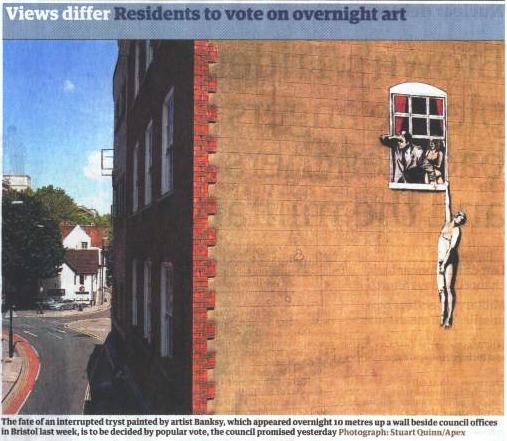
Giving tryst to the people

Graffiti artist, Banksy, has been at it again - this time painting overnight an 'interrupted tryst' 10 metres up a council office wall in Bristol.

Having seen the picture of it in today's thegrauniad, left, I think it looks abso-bloody-lutely fantastic.

Just as good, the Council has promised the issue of whether this work of art stays or goes will be decided by a vote among local residents.

In agreeing to respect the popular will, Bristol City Council is dealing rather better with the issue than some humourless Labour city councillors in Oxford did, back in the 1980s, when they sought to have removed the now world-famous Headington shark.

Designed by sculptor, John Buckley, and commissioned by cinema impresario (and now BBC Radio Oxford presenter), Bill Heine, this 25-foot long fibreglass sculpture was winched into its very domestic terraced setting in 1986.

Commenting on his inspiration, Mr Heine remarked at the time:

"The shark was to express someone feeling totally impotent and ripping a hole in their roof out of a sense of impotence and anger and desperation.... It is saying something about CND, nuclear power, Chernobyl and Nagasaki."

The City Council (including Andrew Smith, now Labour MP for Oxford East, then a city councillor) repeatedly attempted to have the scupture removed, apparently fearing some kind of mass Dr Who-style invasion of 'copy-cat' sharks throughout the city.

The six-year legal battle culminated in the 1992 decision by Michael Heseltine, Secretary of State for the Environment, that it could stay, "having concluded that the shark does not cause such demonstrable harm to visual amenity as to justify refusing consent for its retention". (Though Heseltine also decided that its popularity among neighbours was irrelevant, sniffily intoning: "the case must be decided on its planning merits, not by resorting to 'utilitarianism' in the sense of the greatest good of the greatest number.")

Planning should not seek to impose rigid conformity, still less to stamp out creativity and originality. I hope the residents of Bristol give Banksy's efforts a resounding vote of approval, and demand the Council continues to maintain his graffito as a work of art.

(Hat-tip to Headington.org.uk for the Shark photo and background information.)

Footling memories

One of the more interesting aspects of the current de rigeur meme splattering the interweb - what’s your first political memory? - is finding out how old various bloggers are. Such is the anonymous timelessness of the digital age.

As a silver jubilee baby, born in ’77, the first news story to make an impression on me was the 1981 marriage of Charles and Diana - mainly because my parents bought a new colour telly especially for it. (I can still remember my mum criticising the number of creases in the train of Princess Di’s Elizabeth Emmanuelle dress.)


I was an arch-royalist back in those days - indeed, I even compiled a scrap-book to commemorate the occasion. Aged four is probably about the right time to grow out of it.

My first political memory is kinda sketchy, and hard to date.


For some reason, Michael Foot had made a big impression on me, so I suspect this must have occurred after his controversial sporting of a donkey jacket at the cenotaph in November 1982. I cannot think what else would have motivated me to grab one of the old-fashioned dish-mops in my grandparents’ kitchen, lean out of the window, and shout, “It’s Michael Foot.”

Which was harsh judgment on one of the most distinguished Parliamentarians of our age. But that’s kids for you.

(Two pictures, left, as an aid for younger readers.)

June 22, 2006

Warning: arguing about smoking can damage your health

The Financial Times's Martin Wolf today turns his economist’s mind to analysing the risks of passive smoking, and challenges the authoritarian thinking which underpinned the recent legislation banning smoking in ‘public’ places:

As a life-long non-smoker, I wonder what is driving these assaults. Is it an attempt to improve public health, as campaigners suggest? Or do smokers serve a need every society seems to have – for a group of pariahs that all right-thinking people can condemn? I strongly suspect the latter.

John Stuart Mill himself said that: “As soon as any part of a person’s conduct affects prejudicially the interests of others, society has jurisdiction over it.” The discovery of passive smoking has, for this reason, given the anti-tobacco lobby its success. It has overwhelmed the protests of libertarians. Riding a tide of moral indignation, the government has enacted a draconian law banning smoking even in private clubs.

Now it plans to extend that ban outdoors. So how many lives might this extension “save” (or, more precisely, prolong)? Indeed, how many lives might the ban itself save?

Now here comes the science:

According to a survey [Smoking in Public Places] published in 2003 by the Parliamentary Office of Science and Technology, a mere seven out of 37 studies showed a statistically significant impact of passive smoking on lung cancer. But pooling the results of all the studies indicated that passive smoking increases the risk of death from lung cancer by 25 per cent. This sounds dramatic. But these studies probably contain biased or inaccurate samples: some smokers may, for example, be classified as non-smokers. Moreover, the risk for non-smokers of death from lung cancer is itself only 10 per 100,000. So the increase generated by passive smoking comes to just 2.5 per 100,000.

If every non-smoker were exposed to sufficient quantities of second-hand smoke this would amount to a maximum of 1,000 deaths a year in England, since it contains some 40m non-smokers (both children and adults). Even 1,000 a year would be less than 0.2 per cent of all deaths in the country. In practice, however, the exposure – and so the number of extra deaths from lung cancer caused by passive smoking – must be very much smaller than this. Many people already live in an overwhelmingly tobacco-free environment. Indeed, if that were not the case, studies comparing those having low exposure to tobacco smoke with those having high exposure would be impossible.

All of which might sound like the kind of thing you’d expect an economist to write - it’s perhaps easier to dismiss 1,000 deaths if your trade is academic journalism, rather than competitive politics.

But the fundamental point Mr Wolf goes on to make is resolutely sound: that if those who argue for a ban on smoking in public had the courage of their convictions they would argue for a ban on smoking in the home, the place where children (who are most vulnerable to prolonged exposure) are most likely to be affected. This is the only measure that would have any real impact on the number of deaths from passive smoking.

If the UK government were engaged in a serious health endeavour, as opposed to gesture politics, it would outlaw smoking in the home. This would be perfectly feasible, or at least as feasible as the much discussed possibility of banning smacking. Children could be encouraged to “shop” their parents. Random visits could be arranged. Surely a government that has given us the antisocial behaviour order would find it neither difficult nor, still less, inappropriate to police the behaviour of adults in their homes.

In reality, of course, no political party would ever attempt anything so draconian. Why? Because it would be too unpopular, and because prohibition has never worked anywhere, ever. So, instead, politicians have chosen to sublimate their health concerns by voting into force a law which deliberately fails to tackle the killer issue.

As I said here last year:

I believe that every time governments impose a law designed to compel individuals to improve their health - whether they like it or not - we make the individual less responsible for their own actions. But a functioning liberal society depends on individuals taking full responsibility for their lives.

A ban on smoking in public places will have a negligible effect on the number of deaths from smoking. So we should stop kidding ourselves that this is a serious health proposal. It's not. It's simply a half-hearted gesture. A Silk Cut Ultra argument dressed up as a Capston Full Strength measure.

June 21, 2006

Supermarket sweep

Simon Hoggart reports, rather deliciously, in today’s thegrauniad on David Cameron’s speech championing “the new politics” at the National Family and Parenting institute:

"We have got to big up Asda!" he told us, excitedly. I wondered which Tory leaders would have brought the same message to the people. "Swan and Edgar - Respec'!" Churchill might have said. Or "Let us give due esteem to Sir Thomas Lipton's Emporium of Quality Comestibles!" as Disraeli never tired of saying.
Indeed, supermarkets were big-upped - or is it bigged-up? - no end today. Daniel Finkelstein, who I’m sure used to be called Danny, was unequivocal in The Times:

Every battle for liberty has a front line. In the battle for economic liberty, many of my friends believe that the front line is the rate of tax. And I certainly agree that this is important. But for me the front line is the freedom of supermarkets — big, fat, galumphing, supermarkets with 26 varieties of Coco Pops and large car parks — to conduct their business.
The thing is, I agree with Danny, sorry, Daniel.

Indeed, not to do so would be entirely hypocritical, given almost all my food shopping takes place at my local Tesco, 30 seconds’ walk from my flat. It would be possible for me to buy everything I need (pretty much) at shops other than Tesco. But it would be more inconvenient, take me longer, and cuesta mucho dinero.

Am I guilty of rational self-interest in its most negative form? Perhaps, yet Finkelstein mounts a breathless, slightly glib, but robustly reasonable defence:

Concerned about food prices? Supermarkets drive them down. About inequality? Studies in the US have shown that the creation of superstores (particularly Wal-Mart) has disproportionately benefited those on low incomes. The environment? There is far more chance of persuading the big chains to accept their responsibilities than the old corner grocer. Concerned about pay and conditions for shop workers? Organic food? Labelling? Supermarket chains have raised the bar in all of these areas. And most important of all, they sell things, high-quality items and downmarket items alike, that consumers want to buy.
The ideal is, of course, a diversity of local retailers, so that the small, independent shops can co-exist happily alongside the large chains. Local and national government, in establishing regulatory frameworks, can both help to ensure the high street lions and lambs play happily together.

The larger role, though, is acted by us as consumers. The single biggest reason why local shops close is because fewer people are shopping there. We might lament the fact; but it would be more useful to face it, and understand why.

(I will also parenthetically add that, in my own council ward, Headington, though the large student population is sometimes unpopular with local residents, they are at least regular patrons of the local shops. They are not the ones driving to the out-of-town supermarkets, or ordering their weekly shop via the Internet.)

Supermarkets exist, and are popular, because they are good at giving people what they want. Simply to diss them - see, Mr Cameron, I can get down wiv da kidz’ argot as well - is to miss the point, or deliberately to avoid it. They are a creation of society’s aspirations to have a choice of quality foodstuffs available at reasonable cost whenever we need them.

Have a cheap pop at Tesco or Asda if you want - but at least address how else you would enable people to fulfil that basic want.

June 19, 2006

In his own sweet time

Things are getting bad for Labour - so bad, even Jackie Ashley in today’s thegrauniad is worried:

So low is morale that once-ambitious ministers are heard openly discussing the upside of spending a few years out of government, rebuilding friendships and family links, or simply getting some proper sleep.
The solution, argues Ms Ashley, is simple: the Prime Minister should announce his timetable for an “orderly transition” at Labour’s party conference in September. This sounds right to me. Mr Blair is now a busted flush, his power draining daily.

Where I part company with Ms Ashley is here:

Whatever view you take of Blair, his decision to pre-announce a post-election departure at some unexplained moment now looks like one of the worst tactical mistakes of his career. Downing Street is despairing about the endless speculation but it started right there.
Virtual history always makes for fascinatingly pointless conjecture. But - putting to one side the blindingly obvious that Iraq was Mr Blair’s greatest political, strategic and tactical mistake - this strikes me as misleading 20/20 hindsight.

Consider what might have happened had Mr Blair not pre-announced his departure.

First, would Gordon Brown still be sulkily biding his time; or would he have attempted to force events?

Secondly, would Mr Blair have achieved a healthy-if-wounding 66 seat Commons majority? Surely many Labour voters stuck, reluctantly, by Team Tony precisely because they were reassured his shelf-life was limited?

Thirdly, is it really likely that - but for his pre-announcement - there would currently be no speculation surrounding Mr Blair’s future? There was plenty surrounding Margaret Thatcher in her third term, despite her repeated protestations she would go “on and on and on”.

Fourthly, what more pressure would Mr Blair be presently under if he had not confirmed his departure? Every single scandal, resignation, cock-up and defeat would add to the tumult that Mr Blair should go. It’s hard to get too exercised when the question is not whether, but when.

Finally, I doubt Mr Blair ever expected to serve a full third term. He is a realist with the best political mind of his generation, bar none. By saying he might go on for up to five years, he hoped to buy himself two or three. He’ll probably manage the lower end of his expectations - which seems an apt epitaph for his Premiership.

June 18, 2006

Tough love to end child poverty?

Can Labour deliver its 1999 pledge to halve child poverty by 2010-11? That's the question The Economist posed this week, noting that - though the number has fallen by an impressive 700,000 since then - the Government missed both its 2004-05 targets:
In 2004-05 there were 2.4m poor children, 100,000 above the goal of 2.3m when measured before housing costs, and 3.4m poor children after housing costs, 400,000 more than the milestone of 3m.
This might look like nit-picking - but missing early targets will make it that much more difficult to hit the later ones, especially as public finances are squeezed from 2008 onwards.

Until now, the Government has relied chiefly on the introduction of tax credits to ease the plight of children in poor families. In the future, argues The Economist, they need to incentivise poorer parents back into the work-place, as unemployment is the chief cause of child poverty:
... recent British figures highlight how crucial joblessness is in determining child poverty. In 2004-05, lone parents without work were raising 13% of all children but 31% of poor children. Jobless couples were bringing up 6% of all children but 19% of poor children. Together, the two groups accounted for only a fifth of all children but a half of poor ones.

What this suggests is that the priority should now be to get poor jobless parents back to work. The government has been trying to encourage this by providing extra financial support for working parents. Such help is now among the most generous for low-paid employees in the OECD.

These financial incentives appear to be having some success. The lone-parent employment rate, for example, has risen quite sharply over the past five years. Steep increases in the minimum wage are making work more worthwhile, although there is increasing worry that they may also raise unemployment.

What is crucial now, says Mr Whiteford [of the OECD], is for the state to exert more pressure on lone parents to work while continuing to help them with child care. Britain is unusual in not requiring single parents to look for jobs until their youngest child is 16. Australia, which also has a high proportion of lone parents who are not working, has a similar rule. In most other countries in the OECD, by contrast, single parents have to seek employment much sooner. In July, Australia will change its rule and make new lone parents look for work once their youngest child is six.

Such a reform will seem harsh to many of Labour's supporters. But the Government has invested political capital in its campaign to end child poverty and it will soon have to take difficult decisions. This may be a time for some tough love.
Astute Lib Dem readers will recall just this measure being put forward by Shadow Work and Pensions Minister, David Laws, last March.

As Mr Laws argued then: "To deliver social justice we will need economic dynamism and economic discipline. We need to show how we can create wealth, as well as redistribute it, and make tough choices and not just the easy ones."

Vote blue, own goal

If you've quite finished laughing at France snatching a draw from the jaws of victory, flick over to the BBC's Politics Show website, which is runing a poll to find out the biggest political own goal this season (ie, since September 2005).

When last I voted, the top 3 were:

  • Walter Wolfgang being ejected from Labour conference = 23.30%
  • George Galloway in the Big Brother house = 17.27%
  • Patricia Hewitt 'NHS is enjoying its best year ever' = 17.16%

Me, I voted for Dave Cameron's shoe chauffeur (16.25%) - which reference is all the excuse I need to reproduce this peach of a photo from Bromley Extra:

(Hat-tip: Paul Walter.)

June 16, 2006

When you're in a hole, you don't need a spade

My favourite commentator (probably), the Financial Times's Philip Stephens, published a fascinating article last Thursday, The UN serves US interests, noting the pained emasculation of the USA's ambassador to the UN - the neo-con's neocon - John Bolton:
The ambassador, I have heard a US official observe, is one of those people who calls a spade a spade. The downside, this official lamented, was that to Mr Bolton’s eye almost everything looks like a spade.
The cataclysmic failure of US and British foreign policy in Iraq has, of necessity, altered views in the Bush administration. Slowly, the President and his top advisors are beginning to work out the realpolitik of why America should seek engagement with the UN:
As an official in the state department, [Mr Bolton] epitomised the assertive nationalism that drove US foreign policy during Mr Bush’s first term. Scornful of international institutions and law, he openly celebrated America’s muscular unilateralism.

The administration has travelled halfway back from this position. It has accepted, albeit grudgingly, the value of legitimacy in the exercise of power. It still instinctively favours coalitions of the willing over rules-based multilateralism but has at least begun to make the effort. ...

If the wilder ambitions of Mr Bolton have been decisively checked by Iraq, America remains the indispensable power. How it exercises that power determines the shape and stability of the global system. We can probably expect no more of this administration than its reluctant conversion to pragmatism. But one of these days an American president needs to explain that Roosevelt and Truman were not altruists. They built the UN because, for all its inevitable flaws, it serves American interests.

Perceiving Gordon Brown

That perception is everything (or very nearly) is, I imagine, the most depressing canon for those actively involved in public life. It must be a thought that frequently troubles our Chancellor, and Premier-apparent, Gordon Brown.

Today’s thread over at PoliticalBetting.com poses the question, “What’s Gordon like under fire?” and observes that his likely assumption-without-challenge of the Labour leadership is a potentially dangerous prospect for his party:

If, as is his plan, he manages to move into the top job without having to go through the ardours of fighting a leadership election he will have managed to by-pass, yet again, situations where he would have faced fierce questioning.
At the time of the last Labour leadership election, Mr Brown avoided trial by media by declining to stand. He had read the writing on the wall. It is fascinating now to recall that, when, in May 1994, MORI asked the general public who they thought would be the best Labour leader, Mr Blair had the support of 32%, John Prescott 19%, Margaret Beckett 14%, Gordon Brown 9%, and Robin Cook 5%. Tempora mutantur, nos et mutamur in illis.

For all the controversy of the so-called ‘Granita Pact’, when Mr Blair and Mr Brown are supposed to have reached concord that Mr Blair would be the modernising candidate, there is one simple reason why Mr Brown sat on his hands: Mr Blair would have beaten him.

To understand why this was so, let me quote from Nicholas Jones’s excellent 1996 tome, Soundbites & Spin Doctors:

Aware of criticism that his delivery could be stilted and that he sometimes had a wooden appearance, Brown went to inordinate lengths to inject vitality into his answers. During a hectic round of interviews in the week of the 1992 autumn spending statement, a television studio technician observed the care with which he practised what was obviously the key sentence of his reply, repeating it a dozen times before deciding which words should get more emphasis. Such assiduity had its disadvantages: once he had memorised a soundbite, Brown had a tendency to keep repeating it whatever the subsequent questions. Some programme editors grew reluctant to accept his contributions, claiming they were predictable and repetitive. For a time, producers on the BBC’s One o‘Clock News were told to do their utmost to find other Labour voices: Brown was considered to have become over-exposed.
The appointment of Charlie Whelan as his press officer in January 1994 curbed the worst of Mr Brown’s media obsession. But John Smith’s untimely death triggered a leadership contest at the worst possible time for Mr Brown. As Mr Jones records:

… although [Mr Whelan] had gone some way towards repairing the damage to the shadow Chancellor’s reputation, the leadership contest reopened the debate about Brown’s addiction to soundbites. As the party started assessing the value of the likely contenders, there were powerful voices in the Labour hierarchy who said Brown was too lightweight to become leader.
A lightweight leader addicted to soundbites, eh? Up with that, Labour would never put. Perception, it seems, can indeed change.

Looking through posts on my website, and other political blogs, I’ve been struck by our collective disregard for the man who will be this country’s next Prime Minister. In contrast, screeds have been written about both Ming Campbell and David Cameron. Why this indifference?

First, Mr Brown’s brief is economic policy: much of it is, therefore, concerned with facts and figures: eminently disputable, frequently dull. The Chancellor’s best decision was his first: to declare the Bank of England independent.

By out-sourcing macro-economic policy at a stroke, he helped assure “the longest period of sustained economic growth in this country for over 200 years”. Interestingly, in the USA it is the Chairman of the Federal Reserve Bank who gets the credit for such success: here we still praise the Chancellor.

Secondly, both Sir Menzies and Mr Cameron are new to the leaderships of their respective parties: that novelty makes what they have to say more interesting. Mr Brown’s speeches - though they range more widely than economic policy - can only hint at what his approach as Labour leader would be.

And, even then, most lefty Labour supporters appear to be living happily in a state of self-denial that the man who gave them PFI, the 75p pension increase, and tuition fees is a closet socialist.

By carefully absenting himself from the media during times of trouble, most notably the Iraq war, Mr Brown has allowed people to gaze into the blankness and see whatever they wish. While Mr Cameron says anything to anyone, Mr Brown says nothing to no-one. Both are building up expectations they are bound to disappoint.

The third reason why little heed is currently paid to Mr Brown is simple. I have written two articles devoted to Mr Brown - here
and here - and I cannot think of anything more to say. Indeed, there is so little to say about Mr Brown that I see I was reduced in my second article to quoting a couple of paragraphs from my first article. They still stand:

… when Mr Brown becomes Prime Minister, a flashlight will be shone on his personality and his policies. He will have to make decisions, unpopular ones, and defend them in public. He will no longer be able to use Mr Blair as a lightning rod to earth him from the electric shocks of political opponents' attacks. Nor can he persist in his schizophrenic audience-pleasing. He will have to make choices: is he Atlanticist or socialist, pro-business or trade unionist, anti-European or progressive, liberal or authoritarian? For a man who's been Chancellor for eight years, there are still an awful lot of unanswered questions.

Mr Brown is able, for now, to surf the tide of Mr Blair's unpopularity. But Mr Brown cannot forever define himself by what he is not. At some point, and soon, he will need to show he understands that, to be Prime Minister, you need to be more than just clever, and that range is as important as depth.
The danger for Mr Brown is that the perception of him as a dour, Presbyterian killjoy will stick when he becomes Prime Minister. The opportunity for Mr Brown is that the perception of him as a serious, experienced, successful politician (how different from Mr Cameron) might endure.

Two perceptions, two equal possibilities. The time of reckoning is near.

Small mercies: count 'em

Whatever else might be said about our Prime Minister, Tony Blair, we can at least be grateful he's not George W. Bush.

The President's gauche exchange with LA Times reporter Peter Wallsten has unsurprisingly attracted some adverse comment, not least from the ever-brilliant Daily Show's Jon Stewart. Watch it here. And weep.

June 15, 2006

Reality bites

It's four weeks to the day since I was elected to Oxford City Council's Lib Dem-run Executive Board as portfolio holder for Better Finances. What do I think of it so far? Bloody knackering.

I'd spent the previous two years chairing the City's Finance Scrutiny Committee during a minority Labour administration. In a No-Overall-Control council, scrutiny committees can be influential and have to be taken seriously by the Executive - so most of the issues are pretty familiar to me.

What I wasn't prepared for was the unremitting e-mails needing to be dealt with immediately rather than at the week-end, which is when I used to catch up on paperwork. This hit home last Wednesday, when, at 10.40 pm, I opened a report I needed urgently to approve (or not) , and discovered 41 pages of appendices crammed full of Best Value Performance Indicators with which to familiarise myself.

I'm relieved to be still on top of all my ward case-work (which is of course a very different thing from saying it's sorted). And I'm grateful my ever-understanding employers have continued to be understanding of my commitments. (Or, perhaps more honestly, ignorant. Until they read this.)

But I'm still reading the same novel I was three weeks ago (and I will add that Bret Easton Ellis's American Psycho is not the most relaxing book to wind down with). My plans to learn Spanish before I visit Cadiz in August have taken a back seat. I have also missed both England's World Cup matches owing to meetings: at work last Saturday, and in Council tonight.

I remarked on some of this to a colleague yesterday. He said - and I think he meant it consolingly - "Still, at least you're single so have the time." Cause and effect, was my polite reply (rather than, are you taking the piss?).

Of course, if anyone's thinking of getting more involved in local politics, standing for Council, and one day holding an executive position - I wouldn't want any of the above to discourage you. Perish the thought.

PS: I promise to allow myself only one such whiny post a year.

Ahem...

... my 'proper' website, www.stephentall.org.uk, has made the final four of the New Statesman's New Media Awards 2006 in the Elected Representative category. It's up against three MPs' websites:

David Miliband (Labour)
Derek Wyatt (Labour), and
Jo Swinson (Lib Dem)

You can see all the runners and riders in the various different categories at the Staggers' site here.

That, and a 2-0 win - for what more can a boy ask?

Finally, I want to give a 'blog-up' to my fellow Lib Dem blogger-nominees - Cllr Mary Reid, Lynne Featherstone MP and Peter Black AM.

June 13, 2006

Cameron and the EPP: on the road to nowhere

Nine months ago, back when few had heard of David Cameron, his Tory leadership campaign was spluttering to a halt: all the talk was of a Ken Clarke versus David Davis showdown.

Mr Cameron and his team knew they had to do something, and do it fast. But what? It needed to be a touchstone issue, something which would grab Tory MPs by the short 'n' curlies, a piercing ‘dog whistle’: it had to be Europe - which, to most Tory minds, conjures up dystopian images that would have made even Dante blanch.

Their ruse was to withdraw British Conservative MEPs from the centre-right European People’s Party (EPP) on the grounds that some of its members, such as Germany’s Christian Democrats, support a federalist agenda. Under a Cameron leadership Tory MEPs would sit only with non-federalists.

Then came the Tories’ ‘Pop Idol’ conference, and ‘Dave’ won the audience vote. Indeed, he won it so decisively it soon became clear his concession to those right-wing Europhobic MPs he had earlier been so desperate to court was quite unnecessary. But still Mr Cameron stuck by his pledge: a policy commitment is a policy commitment (especially if it’s your only one).

If it had been quietly dropped, barely anyone would have raised an eyebrow. It is, after all, a technical issue about voting blocs in the European Parliament: it is hardly the Dreyfus Affair. This is something Mr Cameron himself has accepted, albeit tetchily; Rachel Sylvester, writing in today’s Torygraph, recalls:

When Alice Thomson and I last interviewed him, about three months ago, we mentioned, in passing, his commitment to pull his MEPs out of the European People's Party.

In return we got an absolute diatribe. "Can we please not talk about the EPP?" he barked, with genuine anger in his voice. "I'm sick to death of the EPP. It's so boring."
So the warning lights were flashing even then. But still Mr Cameron ploughs ahead with a policy which has split his MEPs down the middle, and antagonised the two centre-right European leaders who are likely to dominate the political stage in the next five years: Germany’s Chancellor, Angela Merkel, and France’s President-presumptive, Nicolas Sarkozy.

He has left his Shadow Foreign Secretary, William Hague, scrabbling around for someone, anyone, who will join with the Euro Tories and ensure they don’t become an impotent, inconsequential irrelevance at the decision-making margins. The most likely candidates, to date, are not the kind of company the supposedly New Tory Party would like to be seen out with: they are ultra-nationalists, often with sexist and homophobic prejudices.

So how has this silly little squabble come to pass? Why has someone as apparently astute as Mr Cameron allowed an unimportant issue like this to sour his current honeymoon? It could be, of course, that Mr Cameron harbours deeply Eurosceptic beliefs, and is simply following his compass.

Philip Stephens, in today’s Financial Times, posits an alternative theory:

I am not sure how deep [David Cameron's] doubts run. What is clear is that foreign policy is not his strong suit. He has not travelled widely and has met precious few political leaders from overseas. It shows. Mr Cameron has been heard to refer to one such meeting as being with the president of “Czechoslovakia”. Gaps like that, though deeply embarrassing, can be filled.

To leave the EPP would display a more profound lack of understanding. The prospect of a European superstate exists now only in the recurring nightmares of the europhobes. The task for serious European politicians during the next five or 10 years will be to forge a new concordat between nation states, the Union and globalisation. Many of the elements of this new bargain will be attractive to Britain. A modern Conservative party, free of the demons of the past, could make a substantial contribution. It is that or the fruitcakes [of Ukip].
Mr Cameron’s EPP kerfuffle is small beer. But it reveals two wider problems, about his leadership, and the Tory Party.

First, this issue - of zero importance to the vast majority of Britons - has already occupied far too much of Mr Cameron’s and Mr Hague’s attention. If they aspire to govern, they need to set priorities that will benefit the country, not spend their first six months sorting out an internal party mess caused by an over-hasty promise by a young man in a hurry.

Secondly, with the EU constitution dormant and forgotten, the Tories have yet to grasp the opportunity to drive the new European agenda in the direction they would wish it to go. Mr Cameron should be using this time to work closely with Ms Merkel (and perhaps Mr Sarkozy) to forge a new consensus which promotes the liberal economy across Europe’s nation states, battling against protectionism and over-regulation. Instead, he has become distracted by his attempts to pacify his own party.

For all the Tories’ present optimism - and for all Mr Cameron’s smoothness - the new leader’s failure to draw the curtain down on this side-show suggests he has yet to work out what his vision of Britain’s role in Europe should be.

The road is going to seem a lot bumpier if he doesn’t know where he’s heading.

June 12, 2006

POLL: favourite 'must read' British political commentator

As trailed last week, I've uploaded a new poll onto m'other gaff, posing the question: "Who is your favourite 'must-read' British political commentator?"

My thanks to those who lobbied to get your favourites included - though in the end I pretty much ignored you all, and went with my own list: a real NuLabour piece of community consultation. But, fair's fair: I allowed only one entry per newspaper, and tried to give a mix of left/right/liberal/authoritarian journalists.

Anyway, enough of such blather: get over there, and get voting...

June 11, 2006

Streets ahead

thegrauniad’s Weekend Magazine last Saturday carried a diverting interview with Mike Skinner, aka The Streets, probably this country’s most brilliantly acute lyricist-cum-rapper. His Mercury award-winning first album, 'original pirate material', declared war on pop pap:

You say that everything sounds the same
Then you go buy them! There's no excuses my friend
Let's Push Things Forward.
As a fan of pop pap myself (Girls Aloud and Robbie nestle alongside the more down wiv da kidz Franz Ferdinand and The Killers on my CD racks), I was relieved and disconcerted in equal measure to read that his favourite ballad is ‘She’s Like The Wind’ from the Dirty Dancing soundtrack.

What marks Skinner out from the urban crowd - and why he has rightly been likened to Eminem - is his ability to speak uncomfortable truths, and then to undercut his knowing crassness with some blisteringly self-deprecating jokes.

The lightest, funniest track on OPM is ‘the irony of it all’
in which he mockingly stages a drugs debate between a boorish boozer, Terry:
I'm a law abider
There's nothing I like more than getting fired up on beer
And when the weekends here I to exercise my right to get paralytic and fight
and a hemp-high liberal wiener, Tim:
… we're friendly peaceful people
We're not the ones out there causing trouble.
We just sit in this hazy bubble with our quarters
Discussing how beautiful Gail Porter is.
The follow-up concept album, 'a grand don’t come for free', took The Streets to another level, earning high praise from a slightly unlikely source, John Sutherland (again in thegrauniad):
Skinner's world, one has to say, is horrible. … It lacks culture, learning, grace, courtesy, spirituality, style, ceremony, direction, aspiration, occupation. All it has is vitality. … There are no doubts about his artistic ability. This second album (as hard to pull off as a successful second novel) should establish The Streets as a significant voice in British music (it's not easy to see a big breakthrough in America).
It’s a rich album crammed with brutal honesty, from the observational comedy of ‘Could well be in’:
I saw this thing on ITV the other week,
Said, that if she played with her hair, she's probably keen
She's playin' with her hair, well regularly,
So I reckon I could well be in.
... to the blokeish detachment of ‘Fit but you know it’:
See I reckon you're about an 8 or a 9,
Maybe even 9 and a half in four beers time.
That blue TopShop top you've got on IS nice,
Bit too much fake tan though - but, yeah, you score high.
and the soul-bearing vulnerability of being dumped, in ‘DRY YOUR EYES’:
Please let me show you where we could only just be, for us
I can change and I can grow or we could adjust
The wicked thing about us is we always have trust
We can even have an open relationship, if you must
I look at her she stares almost straight back at me
But her eyes glaze over like she's lookin' straight through me
Then her eyes must have closed for what seems an eternity
When they open up she's lookin' down at her feet.
But the latest album, 'the hardest way to make an easy living', is the best yet, despite the partial (and boringly inevitable) critical backlash.

All the old Skinner tics are there in abundance: for example, the sweary undercutting of his lifestyle, now as a rich celebrity, in 'Memento mori':
Memento mori, memento mori
It's Latin and it says we must all die
I tried it for a while but it's a load of boring shite
So I buy buy buy buy buy buy
… the faux laddishness:
When you're a famous boy, it gets really easy to get girls,
it's all so easy you get a bit spoilt.
But, when you try to pull a girl, who is also famous too,
it feels just like when you wasn't famous.
… and the smart-arse bon mot:
In spread betting it's easy to draw a small fortune start
With a big fortune and lose into a small fortune.
But it’s the latest single, ‘never went to church’, which is the stand-out track - a soulful eulogy to Skinner’s dad, who died two years ago, and whose influence clearly endures:
I never cared about God when life was sailin' in the calm,
So I said I'd get my head down and I'd deal with the ache in my heart,
And for that if God exists I'd reckon he'd pay me regard,
Mom says me and you are the same from the start.
I guess than you did leave me something to remind me of you,
Everytime I interrupt someone like you used to,
When I do something like you you'll be on my mind or through,
'Cause I forgot you left me behind to remind me of you.
But, despite my fandom, I was a tad perturbed by his closing quote in thegrauniad:
There are two lines on an axis. One of them is creativity and the other is skill. And I think that throughout your life, you are gradually losing creativity and gaining skill. And I think that at some stage, they say it's around 29, that's when it happens; I'm still getting there, still getting better, to the point where they'll meet.
So, another 9 months to go, then it's downhill all the way for me...

June 09, 2006

What the papers say

Enough of thegrauniad: they're on their own today anyway - the other papers are full of praise for Ming Campbell's speech yesterday.

I was especially please to see the Financial Times's warm endorsement of the Lib Dem approach:

... it is good to see tax policy go beyond the tired question of whether tax should go up or down. The Liberal Democrats deserve praise for this. Even better, the rough shape of the new policy makes good sense.

The Financial Times strongly supports the principle of environmental taxes. It is far better to raise revenue by taxing activities that do harm, such as burning fuel, than taxing hard work. The Liberal Democrats propose higher taxes on air travel, and taxes based on the emissions of aircraft rather than on the number of passengers. That makes sense. ...

The main messages of simplification and green taxation are welcome. So is emphasis on the best way to raise taxes, rather than how high they should be. The Liberal Democrats have not worked out the answers. They have asked the right questions.

But the FT was not alone.
The Times also welcomed the move:

Ming is finding his feet. An assured performance on Wednesday [at PMQs] was followed yesterday with the most significant move of his tenure. Sir Menzies talked tax, and instead of the ambiguous waffling of the Conservatives, he talked about cutting taxes. ...

Change was “overdue, necessary and urgent” if the party wanted to be credible. Under his leadership, Liberal Democrats needed to be “bolder, more ambitious and more thoughtful”: no more the luxury of apparently principled but impractical platforms. Government should “regulate less, legislate less and tax less”.

This is robust medicine for a party that, realistically in the past four elections, has not had to concern itself with the prospect of actually enacting generous promises. It is still vital if Sir Menzies and the Lib Dems are to present themselves as plausible partners in power come next polling day. ...

While the Tories’ own recent baggage persuades Mr Cameron that it is hard for him to promise tax cuts and be taken seriously, Sir Menzies has pounced. Taking three million low-paid workers and pensioners out of tax altogether, and rescuing a further million dragged into the top rate of income tax, are eye-catching moves.

Even the
Torygraph found it in themselves to say well done:
... the Lib Dems were against the war from the first, and this entitles Sir Menzies to comment on subsequent developments with a freedom and straightforwardness that are denied to Mr Cameron.

On Wednesday, he embarrassed Tony Blair by asking him at Prime Minister's Questions whether Britain had done anything to aid and abet the American policy of extraordinary rendition, a subject on which many Tories also feel deep unease. As usual, Mr Blair was unable to give anything like a proper answer.

Sir Menzies also regretted, in a grim aside, how often the Prime Minister has to start these Wednesday sessions by sending condolences to the family and friends of British soldiers who have been killed in the past week. ...

It is fashionable to scoff at Sir Menzies because he is not young and hip and groovy, but ... he could yet turn out to be the most astute Liberal leader for generations.

The Indy also made nice, but of course it's pointless linking to their firewalled website. Even The Sun managed to report it accurately, so there's hope for thegrauniad yet.

Not thegrauniad's bit on the side

thegrauniad has taken to being rather scratchy about the Lib Dems in recent weeks. Ten days ago its editorial unfairly dismissed Ming Campbell’s impressive speech on crime without seeming to have troubled to read it. Today, it is just as sceptical about the priorities for a liberal Britain Ming yesterday outlined:
What - and whom - are [the Lib Dems] for? Hunting for a maturity justified by the 6 million votes won at the last election, the party risks blunting its brave edge, especially with the loss of the 50p top rate. … Sir Menzies wants a reputation for clear thinking and authority. He will need to fill in yesterday's blanks and make it clear his party cannot cherry-pick his plans if they are to be seen as something more than a bribe for the votes of middle England.
What is interesting is to compare thegrauniad’s disdain for Ming’s “hunting for maturity” with what the newspaper has previously argued the Lib Dems should be striving to achieve.

For example, in its absurdly wet and hand-wringing leader article in May 2005, justifying re-electing Labour on a “don’t mention the war” ticket, thegrauniad praised the Lib Dems’ anti-war stance, and our vigilant tenacity in sticking up for civil liberties. But, ultimately, it argued the Lib Dems were not yet fit for government:
There is too much that is unconvincing about Liberal Democrat thinking on too many important subjects. The party needs to stare more unflinchingly at the possibility and reality of power than it has yet done.
Six months previously, in September 2004, thegrauniad's editorial commended what it termed “the emergence of a new tougher and more market-oriented approach on economic and social policy, notably on tax and public spending”. It continued:

The old tendency to fall back on big government solutions, embodied in the post-1997 criticism of Labour for not spending enough on health and education, has been rethought. Mr Kennedy has simultaneously reasserted his leadership, encouraged a new generation of spokesmen (not enough women at the top), and has worked hard to have the party cohere around him. This week will be a big test of whether the activist grassroots can learn to love the new Lib Dem party that the leadership is fashioning.
I think the phrase is: damned if we do, damned if we don’t.

What perhaps thegrauniad should realise is that the Lib Dems do not exist to salve its political conscience, allowing a supposedly progressive newspaper to feel better for continuing to support this monstrously illiberal pro-war Labour government.

We are not their ‘bit on the side’, available for easy pleasure without the fear of commitment.

What Ming and the rest of the Lib Dems are seeking to be is a forceful political player, a mainstream party, with serious policies and serious leadership. thegrauniad will just have to get used to it.

June 08, 2006

Ask Ming...

Liberal Review is offering you the opportunity to put a question direct to Ming Campbell following today's well-received keynote speech - click over here to to find out how.

Here's what I asked: "Three ingredients seem, to me, to be crucial in helping deliver successful public services: decent funding, local autonomy, and competition between providers. Do you agree?"

(Y'see, I thought I should steer clear of anything controversial...)