skip to main |
skip to sidebar
One of the questions that’s - quite reasonably - asked by recycling-sceptics is: prove it’s more environmentally friendly to recycle than to throw away, given the respective consumption of energy in both processes. So I was particularly interested in a long feature in this week’s Economist, The truth about recycling. It’s worth reading in full, but I thought I’d fillet it a bit… First, here comes the science:… the Technical University of Denmark and the Danish Topic Centre on Waste conduct[ed] a review of 55 life-cycle analyses, all of which were selected because of their rigorous methodology. The researchers then looked at more than 200 scenarios, comparing the impact of recycling with that of burying or burning particular types of waste material. They found that in 83% of all scenarios that included recycling, it was indeed better for the environment.
Based on this study, WRAP [the Waste & Resources Action Programme, a non-profit British recycling company] calculated that Britain's recycling efforts reduce its carbon-dioxide emissions by 10m-15m tonnes per year. That is equivalent to a 10% reduction in Britain's annual carbon-dioxide emissions from transport, or roughly equivalent to taking 3.5m cars off the roads.
The question then to be asked is: if it’s worthwhile doing, is this something which can be supported by the market? (Ie, is there a profit which will enable a company to benefit society while benefiting its shareholders.) The answer appears to be: no.… most kerbside recycling programmes are not financially self-sustaining. The cost of collecting, transporting and sorting materials generally exceeds the revenues generated by selling the recyclables, and is also greater than the disposal costs. Exceptions do exist … largely near ports in dense urban areas that charge high fees for landfill disposal and enjoy good market conditions for the sale of recyclables.
So, we have here a system which reduces Britain’s carbon dioxide emissions, but which cannot turn a profit - something I guess most of us would regard as market failure, and, therefore, a candidate for government action.Then there’s the question of China - does all our hard recycling work simply end up in Chinese landfill? This seems harder to assess. On the one hand, Pieter van Beukering, an economist who has studied the trade of waste paper to India and waste plastics to China: “as soon as somebody is paying for the material, you bet it will be recycled.” In fact, Dr van Beukering argues that by importing waste materials, recycling firms in developing countries are able to build larger factories and achieve economies of scale, recycling materials more efficiently and at lower environmental cost. He has witnessed as much in India, he says, where dozens of inefficient, polluting paper mills near Mumbai were transformed into a smaller number of far more productive and environmentally friendly factories within a few years.
But:… factories in developing nations may be less tightly regulated, and the recycling industry is no exception. China especially has been plagued by countless illegal-waste imports, many of which are processed by poor migrants in China's coastal regions. They dismantle and recycle anything from plastic to electronic waste without any protection for themselves or the environment. The Chinese government has banned such practices, but migrant workers have spawned a mobile cottage industry that is difficult to wipe out … Because this type of industry operates largely under the radar, it is difficult to assess its overall impact. But it is clear that processing plastic and electronic waste in a crude manner releases toxic chemicals, harming people and the environment—the opposite of what recycling is supposed to achieve.
And, finally, there is a sting in the tail for the UK. Perhaps the first product many of us got used to recycling, usually at the local supermarket before kerbside collections took over, was the green bottle - this country is, after all, the biggest importer in the world of wine (1 billion litres a year):But with only a tiny wine industry of its own, there is little demand for the resulting glass. Instead what is needed is clear glass, which is turned into bottles for spirits, and often exported to other countries. As a result, says Andy Dawe, WRAP's glass-technology manager, Britain is in the “peculiar situation” of having more green glass than it has production capacity for. Britain's bottle-makers already use as much recycled green glass as they can in their furnaces to produce new bottles. So some of the surplus glass is down-cycled into construction aggregates or sand for filtration systems. But WRAP's own analysis reveals that the energy savings for both appear to be “marginal or even disadvantageous”.
But as the success of recycling in this country is measured by the Government not by the energy saved but by the total tonnage of recylables collected there is a perverse incentive for local councils to continue to invest in bottle recycling!
This week’s Bagehot column in the Economist carries a pretty fair assessment of the Lib Dem position one year into the Ming dynasty:
Nobody can say that Sir Menzies Campbell has had an easy first year as leader of his party. As poisoned chalices go, the leadership of the Liberal Democrats 12 months ago resembled something rustled up by Lucrezia Borgia on one of her more vengeful days. Yet this weekend many of the Lib Dems gathering in Harrogate for their spring conference sense that they may be closer to real power than at any time in living memory.
It notes the well documented difficulties Ming encountered in his first few months:
- The high-profile so-called scandals which undermined the party’s credibility;
- His first few jittery performances at Prime Minister’s Questions;
- A disappointingly mixed set of local election results.
And then it contrasts this turmoil with the progress the party has made in the last six months:
Since late summer, however, things have slowly got better. Helped by the fact that nobody in his right mind could contemplate the purgatory of another leadership contest before the next election, the Lib Dems put on a decent show of unity at their party conference in September. They also managed to win some positive coverage for the “green-tax switch” that allowed them to drop a damaging commitment to raising the upper rate of income tax to 50% in favour of environment-friendly taxes. With parliament's return after the long recess, Sir Menzies no longer looked quite so out of his depth at PMQs.
Over the past few months he has also been lucky. There is now rather less interest in his shortcomings than in those of Gordon Brown, while Tony Blair's long goodbye has been dominated by foreign policy—in particular, by the attempts on both sides of the Atlantic to find a way out of the Iraq morass. That has played to Sir Menzies's strengths and reminded voters that the Lib Dems were the only major party to oppose the war.
In January, egged on by some of his colleagues, Sir Menzies took the risk of calling for British forces to quit Iraq by October. Although he earned some (deserved) criticism for advocating a timetable that owed more to electoral populism than to concern for Britain's responsibilities, it won headlines. When Mr Blair announced last week the first phase of a withdrawal of the army from Basra, Sir Menzies was able to claim, somewhat speciously, that even the government now accepted his argument that there was nothing left for British troops usefully to do in Iraq.
Crucially for Sir Menzies, his party's performance in the opinion polls has been resilient enough to prevent any panic in the ranks. Given Mr Cameron's grab for traditional Lib Dem voters on the environment, civil liberties and localism, the party's poll rating, hovering around 20%, has been impressive. Senior Lib Dems claim to be delighted that Mr Cameron has worked so hard to put climate change on the agenda. They point to polling data that suggests voters still think the Lib Dems are easily the greenest of the mainstream parties. The more salient environmental issues become, they argue, the better the Lib Dems should do. And, vitally, the topic provides an alternative to Iraq, which may well be stale by the next election.
A good write-up, and a nice way to start the Spring conference week-end - from which I, regrettably, will be absent. Hope all attendees have a happy Harrogate…
The Economist's verdict on Gordon Brown:... Mr Brown's larger difficulty is that he has failed to make the most of a long stint as chancellor in which he has been blessed with generally favourable economic conditions. For a politician with a reputation for thinking far ahead, his conduct of policy has made little strategic sense. Sharp tightening followed by excessive expansion is a bad way to run things. The chancellor's undesirable legacy will be a bigger state that is palpably failing to deliver value for money for its hard-pressed taxpayers.
I was intrigued by this graph in the Economist’s analysis of ‘The future of the BBC’: "… the BBC is not equally loved by everyone. The rich and the old are keener on it than the poor and the young, who in effect subsidise the viewing and listening of more prosperous households."There has been much holiday discussion about the need for the Lib Dems to regain our risk-taking cutting edge, to dare to be different.
I have to confess to some degree of amusement, though, that I can imagine our party more happily agreeing to scrap Trident than the BBC licence fee.
It’s an odd equation, and yet one which seems to explain the response of the American money markets to yesterday’s political upheaval in the US. This from CNNMoney.com: "I think the market had basically factored in that there was going to be a change in the political landscape," said Ted Weisberg, a New York Stock Exchange floor trader at Seaport Securities.
"Whether you have the Democrats controlling the House or controlling both houses, you still have a Republican leader in the White House and that still means gridlock," he added.
Gridlock would limit the power of either party to push through legislation perceived as partisan, an environment acceptable to the markets.
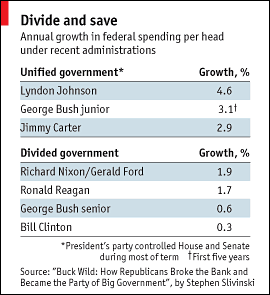
 This table from the current Economist helps explain why the markets think like that. To translate it into another equation: unified government = high federal spending = big government. And markets (unsurprisingly) don’t like big government - it sucks labour and capital away from entrepreneurial wealth creation.
Of course, the likes and dislikes of the money markets should not dictate political judgement (though it would be a foolish politician who completely ignored them). But they may well be right to divine that divided government is, generally, good government.
For example... Under a Democrat President, Bill Clinton, and a Republican Congress, the US budget deficit was brought under control. Yet under a Republican President, George W. Bush, and a Republican Congress it has escalated, in part thanks to pork-barrel projects like the $223m Alaskan ‘bridge to nowhere’.
This shouldn’t surprise us. After all, the Founding Fathers intentionally built extensive checks and balances into the US constitution in recognition that ‘power tends to corrupt, and absolute power corrupts absolutely’.
One of the greatest problems in the UK is that power is over-concentrated and over-centralised in the executive - and, de facto, in the office of the Prime Minister. There is almost no limit on his authority, as our legislature is weak. The Prime Minister has a built-in, whipped majority in the House of Commons, while the second chamber, the House of Lords, is deliberately left to moulder as an emasculated body with no democratic accountability, and little remaining hereditary droit de seigneur.Those who argue against proportional representation on the grounds that it produces ‘weak government’ are missing the fundamental point. A coalition government which embraces majority opinion is far more likely to produce good, stable government than one-party rule based on the consent of little more than one-third of the voting public.
The art of good politics is all about dialogue: a constructive dialectic leading to a workable synthesis. The tribally confrontational British political system is designed to make such dialogue as rare and unnatural an event as possible. If we’re lucky our Prime Ministers speak in monologues; more usually it’s a soliloquy.