"The great blogger." (Nick Clegg MP) - "Stephen consistently combines good writing with interesting content and new technology." (Lynne Featherstone MP) - "The most under-rated political blog in the UK." (Iain Dale) - Lib Dem Blog of the Year 2006
In years to come, many books and theses will come to be written about the2008 US Presidential election, the most open in 80 years, since neither the serving President nor Vice-President is contesting the position.
For those of us living through it, and especially for the political geeks among us who can enjoy watching an election without being directly involved, it’s a fascinating spectacle.
Six months ago, I made the (what then seemed risky) prediction that then Republican favourite Senator John McCain would fail to secure his party’s nomination. Unless he can perform a pretty remarkable turnaround, his last chance to become President is fast slipping through his fingers.
It just goes to show how those who lead the field at an early stage need to watch their step, as the photo (right) attests.
I have a small wager on Mitt Romney, former Republican governor in liberal Massachusetts. Though he currently trails in national polls, behind both Sen. McCain and Rudy Giuliani, he is ahead in the three states which vote first in the primaries, Iowa, New Hampshire and Nevada, and has been consistently raising more money than either.
But the man who might upset all calculations is New York’s Mayor, Michael Bloomberg, who has just renounced his Republican affiliation, and seems set for a crack at the White House as an independent.
This will place my New York friends, mainly Democrat-sympathising, in a quandary, as Mayor Bloomberg is highly rated by them as one of the greatest mayors the city has know - a social liberal with great business acumen who runs the city on a pragmatically consensual basis. That he won re-election as a Republican in New York with a 20% majority attests to his bipartisan appeal.
Might 2008 be the election when both Republicans and Democrats find themselves having to sit it out for (at least) four years?
Senator Barack Obama (D-Il) finally announced his Presidential candidacy today. You can watch his speech in full here.
I’m still not too sure whether the reality will match the hype. But if the reality matches the rhetoric the next couple of years are going to be a helluva ride.
His final, poetic paragraphs are stirring stuff:
As Lincoln organized the forces arrayed against slavery, he was heard to say: "Of strange, discordant, and even hostile elements, we gathered from the four winds, and formed and fought to battle through."
That is our purpose here today.
That's why I'm in this race.
Not just to hold an office, but to gather with you to transform a nation.
I want to win that next battle - for justice and opportunity.
I want to win that next battle - for better schools, and better jobs, and health care for all.
I want us to take up the unfinished business of perfecting our union, and building a better America.
And if you will join me in this improbable quest, if you feel destiny calling, and see as I see, a future of endless possibility stretching before us; if you sense, as I sense, that the time is now to shake off our slumber, and slough off our fear, and make good on the debt we owe past and future generations, then I'm ready to take up the cause, and march with you, and work with you.
Together, starting today, let us finish the work that needs to be done, and usher in a new birth of freedom on this Earth.
Is it just me, or is there more than a hint of Bartlet to such soaring rhetoric?
You've lost the Senate, you've lost the House, you're a lame duck President with plunging approval ratings - chances are you're a bit miffed. You gotta blame someone, and that person obviously can't be you. Here's your 'to do' list:
If Mr Bush does try to pin any of the blame on Karl Rove, it seems he'll get short shrift from his party, according to today's FT:
Republican analysts on Thursday said the jibe was unfair. The election was an indictment of Mr Bush’s Iraq policy, not political tactics. “Nobody thinks that Karl is in charge of the occupation of Iraq,” said Grover Norquist, head of Americans for Tax Reform, who has close ties to Mr Rove. “I haven’t heard any complaints about him. In a conference call with conservative groups no one faulted the turnout effort.”
Mr Norquist is an exemplar of the Republican right, as is clear from his penetrating analysis of the GOP's defeat in the key swing state of Pennsylvania:
“Bob Sherwood’s seat would have been overwhelmingly ours, if his mistress hadn’t whined about being throttled,” said Mr Norquist. Any lessons from the campaign? “Yes. The lesson should be, don’t throttle mistresses.”
... a mandate is about power, and power is a slippery, fluid, elusive commodity. ... There are other factors, too, which might mean Dubya's victory is as good as it gets for the Republicans. ...
Dubya's first term may well come back to haunt him in his second. Most obviously - let's hope not inevitably - Iraq could slip off the precipice on which its teetering, and descend into civil war. The US and its Allies would not be able simply to wash their hands of the bloodshed they've fomented. Active military re-involvement, not the disengagement for which even the neo-cons are now hoping (if only so they can flaunt their hawkish menace further afield), would be an unavoidable, and humiliating, outcome. ... thirdly, the domestic agenda is by no means assured. Dubya has, somehow, to attempt to curb his reckless spending habits, and to staunch the spiralling budget deficit.
Control of the White House, Congress and Senate present Dubya with immense leverage, a generational opportunity to carve the political landscape in his ideological image as clearly as Mount Rushmore. He remains the most polarising of politicians, squeaking both his presidential victories, governing as if they were landslides. His approval rating continues to hover at 50%, remarkably low for a freshly re-elected second term President. Most of his Party are already looking towards the 2006 mid-term elections. He has three years until he becomes a lame-duck President. He's enjoyed his day of glory. But the clock is now ticking.
It’s an odd equation, and yet one which seems to explain the response of the American money markets to yesterday’s political upheaval in the US. This from CNNMoney.com:
"I think the market had basically factored in that there was going to be a change in the political landscape," said Ted Weisberg, a New York Stock Exchange floor trader at Seaport Securities.
"Whether you have the Democrats controlling the House or controlling both houses, you still have a Republican leader in the White House and that still means gridlock," he added.
Gridlock would limit the power of either party to push through legislation perceived as partisan, an environment acceptable to the markets.
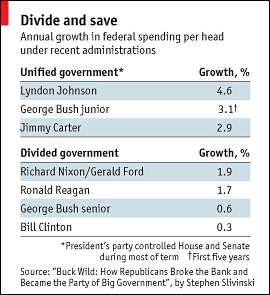
This table from the current Economist helps explain why the markets think like that. To translate it into another equation: unified government = high federal spending = big government. And markets (unsurprisingly) don’t like big government - it sucks labour and capital away from entrepreneurial wealth creation.
Of course, the likes and dislikes of the money markets should not dictate political judgement (though it would be a foolish politician who completely ignored them). But they may well be right to divine that divided government is, generally, good government.
For example... Under a Democrat President, Bill Clinton, and a Republican Congress, the US budget deficit was brought under control. Yet under a Republican President, George W. Bush, and a Republican Congress it has escalated, in part thanks to pork-barrel projects like the $223m Alaskan ‘bridge to nowhere’.
This shouldn’t surprise us. After all, the Founding Fathers intentionally built extensive checks and balances into the US constitution in recognition that ‘power tends to corrupt, and absolute power corrupts absolutely’.
One of the greatest problems in the UK is that power is over-concentrated and over-centralised in the executive - and, de facto, in the office of the Prime Minister. There is almost no limit on his authority, as our legislature is weak. The Prime Minister has a built-in, whipped majority in the House of Commons, while the second chamber, the House of Lords, is deliberately left to moulder as an emasculated body with no democratic accountability, and little remaining hereditary droit de seigneur.
Those who argue against proportional representation on the grounds that it produces ‘weak government’ are missing the fundamental point. A coalition government which embraces majority opinion is far more likely to produce good, stable government than one-party rule based on the consent of little more than one-third of the voting public.
The art of good politics is all about dialogue: a constructive dialectic leading to a workable synthesis. The tribally confrontational British political system is designed to make such dialogue as rare and unnatural an event as possible. If we’re lucky our Prime Ministers speak in monologues; more usually it’s a soliloquy.
Delighted that I can type the words Sen. Claire McCaskill (D-MO).
Still fingers crossed that it will shortly be Sen. George Allen (R-VA). (Fell asleep about 3am, exhausted by continually clicking refresh on the Virginia online election update.)
With polls about to close - and no exit polls yet leaked - time to put my credibility online...
House of Representatives: Democrats = 221 Republicans = 214
Senate: Democrats = 48 Republicans = 52
PS: I've remembered what I love about US elections - I haven't been up since 5am delivering leaflets, knocking-up potential voters for 12 solid hours, or scrutinising the count until 2am. I can just relax and enjoy the excitement like a normal person. (Well, a normal person with a slightly obsessional interest in elections, at any rate.)
When Simon Jenkins is good, he’s very, very good. Today is not one of his better days.
He’s posted to thegrauniad’s Comment Is Free a provocatively controversial article titled, ‘Bad at war, good at democracy’, which is deliberately aimed at getting a rise from lily-livered liberals like me. So here goes.
The following passage gives the flavour of Mr Jenkins’ glib assertions argument:
“Every time I visit America at election time I am left exhilarated by the sheer, pulverising potency of its democracy. … Yet ABC news this morning could announce judgment day with the downbeat message that it was "the nastiest mid-term election in history."
“Nasty is right. Within two minutes of turning on my television I hear "Andrew Cuomo is lying", Bob Menendez is supported by kickback hoodlums, worst calumny of all, Thomas Kean "supports George Bush". Almost everyone is in favour of killing babies, rupturing stem cells and torturing Iraqis. The corridors of power are awash in corruption, adultery, mendacity and sin. The torrent of abuse is relentless and, to those used to the bland hustings of European oligarchy, gloriously refreshing.
“Above all the negativity is good. The Karl Rove strategy of identifying electoral difference rather than consensus inflames democratic choice as it should be inflamed. Voters cannot make that choice if, as increasingly in Europe, candidates are bland mirrors of each other. … I love it.”
All of which OTT rhetoric conveys a dismal view of politics, in which the only honest arguments are those which have been amped-up to the max; where simplistic, reductive binary politics rule; where cheap tribal loyalties trump genuine co-operation when common agreement exists; where personality flaws are exaggerated wildly to distract from policy issues which matter a damn; and in which intelligent civic discourse is replaced by proud-to-be-ignorant shock-jock rants which demean us all.
The campaign ads which Mr Jenkins lauds don’t set out to enlighten, inform or inspire: their job is to confuse, panic and rile. The best arguments - the most spine-tingling rhetoric - are imbued with passion, not anger; are truthful, not warped; are authentic, not contrived.
Few of us reach such dizzy heights - but we can aspire, can’t we? “A man’s reach should exceed his grasp, or what’s a heaven for?” Do we really have to settle for Mr Jenkins’ conclusion that politics is a shitty business so we should all get down and dirty in the gutter?
It's not happened here (yet), but it can only be a matter of time. When it does, I have no doubt the Lib Dems' very own John Hemming will be straight on the case.
Robot phone calls are driving people nuts throughout the northeast [of the US]. The prank calls claim to be from one candidate (the Democrat) while they’re actually from the other (the Republican).
Prerecorded phone calls have been a pathetic part of campaigns for a generation, but these new robo-calls add a new element: Hang up, and the phone rings again. Hang up, and the phone rings again. Some of the robots are making seven or eight calls in a row to the same number.
The infuriated voter trying to eat dinner or beat his children ends up wanting to kill the candidate blamed for the call.
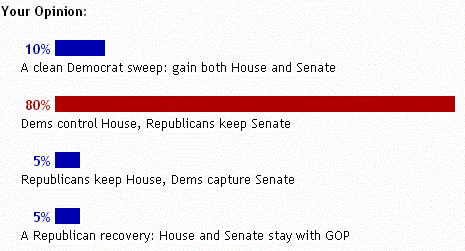
It'll be good, but not quite good enough - that appears to be your view on what the Democrats can hope to get out of tomorrow's US mid-terms.
A whopping 80% of those who have so far voted in the poll over at my other gaff reckon the Dems will do enough to win control of the House of Representatives, but fall short of snatching the Senate away from the Republicans.
There is, of course, one other scenario which my poll doesn't allow for - the Senate could be tied at 50 each. Indeed, that is the result predicted by the latest Polimetrix poll as reported on Political Wire, which would be a throwback to the position which pertained (for a few months) in 2001.
The Republicans would still retain control, but only on Veep Cheney's casting vote. (Which might at least keep in check his propensity to go human quail hunting.)
In four days’ time, 7th November, Americans will go the polls to elect 435 members of the House of Representatives, and 33 members (one-third) of the Senate. What will happen? That’s the question I’m asking over at m’other site, and you have four possible options:
A clean Democrat sweep: gain both House and Senate
Dems control House, Republicans keep Senate
Republicans keep House, Dems capture Senate
A Republican recovery: House and Senate stay with GOP
Can the Democrats capitalise on President Bush’s dismal popularity, and a Republican Party beleaguered by scandals? Or might Karl Rove’s much-vaunted tactical ability, and the GOP’s fearsome GOTV strategy, yet pull a rabbit out of the hat?
Democrats who are simply bursting to get their own back after the tight presidential races of 2000 and 2004 should perhaps be careful what they wish for. As Adam Nagourney noted in the New York Times six months ago:
As strange as it might seem, there are moments when losing is winning in politics. Even as Democrats are doing everything they can to win, and believe that victory is critical for future battles over real issues, some of the party's leading figures are also speculating that November could represent one of those moments.
From this perspective, it wouldn't be the worst thing in the world politically to watch the Republicans struggle through the last two years of the Bush presidency. There's the prospect of continued conflict in Iraq, high gas prices, corruption investigations, Republican infighting and a gridlocked Congress. Democrats would have a better chance of winning the presidency in 2008, by this reasoning, and for the future they enhance their stature at a time when Republicans are faltering.
Indeed, some Democrats worry that the worst-case scenario may be winning control of Congress by a slim margin, giving them responsibility without real authority. They might serve as a foil to Republicans and President Bush, who would be looking for someone to share the blame. Democrats need a net gain of 6 seats in the Senate, and 15 seats in the House.
"The most politically advantageous thing for the Democrats is to pick up 11, 12 seats in the House and 3 or 4 seats in the Senate but let the Republicans continue to be responsible for government," said Tony Coelho, a former House Democratic whip. "We are heading into this period of tremendous deficit, plus all the scandals, plus all the programs that have been cut. This way, they get blamed for everything."
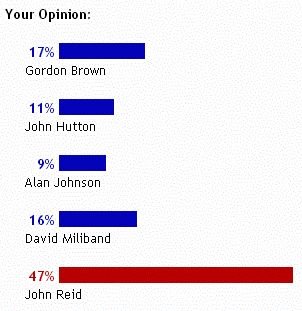
Result of last poll: as you can see, John Reid was by far your favoured Labour leader from a Lib Dem perspective (ie, the guy most likely to be bad for Labour and good for us): he polled 47% to Gordon Brown's 17%; trailing were David Miliband (16%), John Hutton (11%) and Alan Johnson (9%). Though it looks like it's all fairly academic now.
This clip has been seen 706,846 times since it was uploaded to YouTube just two days ago.
This is the moment - in fact, just 10 seconds - when Senator John F. Kerry torpedoed any extant hopes he might have had of running for the Presidency again in 2008, by appearing to imply that US troops are doofuses. (Though I’m sure he will have been buoyed by my colleague’s support of him.)
Mr Kerry’s office has now released the text of what the Massachusetts senator meant to say:
“I can't overstress the importance of a great education. Do you know where you end up if you don't study, if you aren't smart, if you're intellectually lazy? You end up getting us stuck in a war in Iraq. Just ask President Bush.”
It’s still a glib, wise-ass dig, which is fine if you’re David Letterman or a blogger, but the man who would have been JFK II is better than that.
However, it’s worked to the Democrats’ advantage. Not only has it guaranteed the last few days of mid-terms campaigning continues to be dominated by Iraq - a subject the President would prefer to dodge (like the draft) - but it ensures the uninspiring Mr Kerry is off the 2008 ticket.
Over 9,000 people have so far commented on that YouTube clip. But the sassiest take I’ve yet read was uttered by Vice-President Dick Cheney (though I don’t suppose for a moment he originated it):
"Senator Kerry said he was just making a joke and he botched it up. I guess we didn't get the nuance. Actually, he was for the joke before he was against it."
The latest Electoral Vote projection for the United States’ senate after the Fall mid-terms suggests a 50-50 split between Republicans and Democrats. (Which leaves me a little unsure how they’re categorising Democrat-turned-Independent Senator Joe Lieberman, who currently leads his Democrat challenger Ned Lamont 49-38% in the race for Connecticut.)
The picture is more decisive in the battle for control of the House: the Dems currently are tipped to hold 227 to the GOP’s 206, with two races statistically tied.
This week’s Economist focuses on the race in Missouri - the famous bellwether ‘show me’ state which has successfully backed every victorious Presidential candidate since 1960 - where incumbent Republican senator Jim Talent (a name in search of a trait) is trailing feisty Democrat state auditor Claire McCaskill, who unsuccessful bid for the gubernatorial mansion in 2004.
In the flesh, Mr Talent is amiable but an awkward speaker: on the stump after the debate he had to remind his audience to clap. But he can draw on a reservoir of support from rural and Christian voters, who typically deplore the Democrats' tolerance of abortion and gay marriage. “If we had a real Christian party, I'd go with that,” says Larry Atkins, a minister attending a Talent speech in Waynesville, a small town north-east of Springfield. But failing that, Mr Talent “is a good moral person.”
The race is a toss-up, according to the polls. The result depends on who gets out the vote, says Mr Talent. Ms McCaskill agrees. The Republicans think they are the best at this, she tells her supporters, “But this time we've got the passion on our side.” Unsurprisingly, given Missouri's importance to the balance of power, the national Democratic and Republican parties are pitching in with oodles of cash and attack ads.
Both sides profess confidence. Ms McCaskill claims to be winning converts in conservative rural areas. One couple, she says, told her they used to vote Republican but were planning to switch because they no longer felt middle class, having lost their health insurance. “Jim Talent will win,” says Missouri's Republican governor, Matt Blunt, stumping for him with bone-crushing handshakes on the county courthouse steps in Rolla, south-east Missouri. Behind him, an eight-year-old girl, urged on by her mother, is giving Mr Talent a hand-written extract from the Bible.
Two of the crunch campaign issues are Amendment 2, the Missouri Stem Cell Initiative - which would authorise stem-cell research within Missouri, and for Missourians to benefit from any cures produced - and Proposition B, which would raise the minimum wage to $6.50 an hour (that’s £3.45). Ms McCaskill supports both Amendment 2 (which Mr Talent opposes) and Proposition B (which Mr Talent has yet to take a position on).
The stakes have been upped considerably by the intervention of Michael J Fox, the symptoms of whose Parkinson’s Disease are painfully evident in this powerful advert recorded in support of Ms McCaskill’s Amendment 2 position:
And for those of us who too easily and too often stereotype the US stance on social issues according to our perception of scary-evangelical Christian Deep Southers, the Pew Research Centre report, Pragmatic Americans Liberal and Conservative on Social Issues (August 2006), is a reminder that things are rarely that simple:
Americans cannot be easily characterized as conservative or liberal on today's most pressing social questions. The public's point of view varies from issue to issue. They are conservative in opposing gay marriage and gay adoption, liberal in favoring embryonic stem cell research and a little of both on abortion. Along with favoring no clear ideological approach to most social issues, the public expresses a desire for a middle ground on the most divisive social concern of the day: abortion.
For ‘Americans’ substitute ‘Britons’ and that paragraph would, I suspect, accurately reflect views here, too. As George Bernard Shaw (probably) said, “Two nations divided by a common language”. It's a statement which is still more true than false.
I’ve been Editor of Liberal Democrat Voice – the #1 independent website for the Lib Dems – since 2007. I combine this with my professional life as Development Director for the Education Endowment Foundation.
 It just goes to show how those who lead the field at an early stage need to watch their step, as the photo (right) attests.