What I wrote at Lib Dem Voice

May 07, 2006

My top 10 newspaper front pages

The British Library is hosting an exhibition, Front Page: Celebrating 100 Years of the British Newspaper 1906-2006, opening on 25th May, and running through until October.

No matter that the internet now provides many of us with our primary source of news, newspaper front pages can, at their best, provide a memorably unrivalled expression of a national mood. Or, at their worst, they can encapsulate all that you might disdain in their political attitude. Or, at their most embarrassing, they can get it wrong big-time.

Here’s my top 10:

10: The Economist


The Economist, which for historical reasons I don’t pretend to understand still classifies itself as a newspaper, has one of the strongest marketing brands in the industry. It’s partly based on its savvy, sassy advertising, and partly on its pointed, pithy front covers - a trademark almost as valuable as Private Eye’s speech bubbles.

This example, from last year’s post-general election issue, captured perfectly - both in its headline and choice of picture - the winding Mr Blair was dealt by the British electorate.


9: Daily Mail

There’s something wonderfully old school about this Daily Mail cover, which, though it dates from 1918, seems somehow a timeless, aspic-preserved emblem of the paper’s xenophobic weltenschaung.


8: Bristol Evening Post

I loved the knowing under-statedness of the Bristol Evening Post’s announcement of Charles and Camilla’s decision to tie the knot - this is chief-subbing of the very best kind.


7: Daily Star

Bit of a cheat this one, as it’s not a front page - but it’s just too good not to include. The context...


Back in 2001, Chris Morris’s sublimely satirical Brass Eye paedophile special (one of the finest ever achievements of British television) caused a storm of outrage, with the tabloid press condemning Channel 4’s “unspeakably sick” exploitation of minors.

The rank hypocrisy and cant of the tabloids was graphically illustrated by this Daily Star juxtaposition: a nudge-nudge-phwoar-corr story about the then 15 year-old Charlotte Church, opposite some fake moral outrage railing against Brass Eye.

6: Daily Mirror

I went to bed about 3 am on 3rd November, 2004, utterly depressed. My early hopes that Senator Kerry would edge President Bush - infamously shared by top pollster, Mori’s Bob Worcester: “I'm Bob Worcester, it's 2am, and I am calling it: it's President Kerry!” - were soon dashed, as the exit polls were overtaken by the real results.


The Mirror’s front page is grossly unfair in it’s anti-Americanism, but somehow it got to the nub of the incredulity many of us felt that Dubya could have won his first election and second term.


5: The Guardian

You can taste the jubilant, bitter relief which inspired this headline.

When Jonathan Aitken armed himself with the “simple sword of truth and trusty shield of British fair play” to take the fight to The Guardian - and its allegations that he had enjoyed, and not declared, the hospitality of an Arab businessman while the UK’s defence procurement minister - he perhaps did not anticipate it would end his career in public life.

This was a front page that came to symbolise the fall of John Major’s limping, drowning, dismal government.

4: Chicago Daily Tribune


One of the most infamous newspaper cock-ups of all time - the Chicago Daily Tribune anticipated Bob Worcester’s red face by half a century, calling (along with most other media pundits) the 1948 US presidential election for Thomas Dewey. Governor Dewey lost to President Harry S Truman by over two million votes.


The New York Post had its own mini-Dewey moment a couple of years back, when it confidently proclaimed Senator Kerry had chosen Dick Gephardt as his Veep running mate for the 2004 election. That same day, John Edwards’ selection was announced.


3: Daily Express
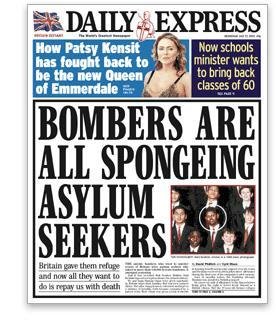
When I first saw this Daily Express front page, I assumed someone had photo-shopped it as a satirical piss-take; or, alternatively, that it had been accidentally generated by the Daily Mail-o-matic website.


But no, this is the genuine article, and symbolises the luridly shameful and racist depths to which this once decent newspaper is happy to sink. Truly sickening.


2: The Sun

To choose just one Sun front-page is actually quite tricky. Whatever else might be said about it as a newspaper, it’s sensationally cheeky headlines have proved extremely effective: from ‘Freddie Starr ate my hamster’, to ‘Gotcha!’ (the sinking of the Belgrano), to ‘Zip me up before you go go’ (George Michael’s arrest), to ‘Up yours! Delores’.


But this is perhaps the one that came to symbolise, not only the Currant Bun’s finger-on-the-zeitgeist, but also the political power it could wield (or at least be perceived to wield, which can sometimes amount to the same thing).

1: The Independent

My winner, though, is The Independent’s response to the publication of The Hutton Report in January, 2004. Clearing its entire broadsheet front page of text and images, it simply read, in small font, ‘Whitewash?’ (One of their readers wrote in to congratulate them on their boldness, but expressed surprise they had felt the need to qualify the headline with a question mark.)

These days, we are used to the Indy’s screaming, pleading front pages, which are too often at risk of becoming self-parodies. But this was among the first trenchant front pages it had run, at a time when its rivals were much more reluctant to brandish their opinions so visibly. Not only did it establish the Indy as Britain’s first quality ‘viewspaper’, but it provoked its competitors to retaliate in kind; an unfortunate development I think, yet its success cannot be ignored.

May 05, 2006

At the end of the day...

I hate to resort to cliché to describe the Lib Dems’ local election results, but I’ve had 6 hours sleep over the past two days, so cliché it will have to be: it’s a bit of a curate’s egg.

(Of course, the joy of local election results is that they are so variegated, such a patch-work quilt, that party activists can read whatever they like into them. But this is my take…)

One the positive side, we have achieved (so far) our aim of winning more councils (1) and more councillors (25). We took Richmond-upon-Thames from the Tories, and gained St Albans and South Lakeland from no overall control.

The BBC is projecting the Lib Dem share of the vote to be 27% - which would match our second highest ever local election performance, and would repeat our 2004 feat of relegating Labour to third place in the popularity stakes.

But we lost control of two councils - Islington and Milton Keynes - and sadly failed to make as much progress as we had hoped in a number of Councils where we were hoping to take control.

There will be many lessons we can learn from all this, but I suspect it’s better done after a good night’s sleep.

It is clear the Tories have had a good night; but it’s no more than that. Their projected share of the national vote is 40%, which compares to the 38% they achieved in 2000 and 2004 - which were swiftly followed by resounding general election defeats. (And it trails well behind the 47% that Tony Blair won in his first election as Labour leader, in 1995.)

Their London results are impressive, but they have largely failed in their efforts to break out of their southern comfort zone. Most big cities remain Tory-free zones, despite huge efforts from Tory central office to score a couple of beacon results.

It’ll take a lot more than this for the Tories to be likely contenders even to become the single largest party - let alone get anything near approaching a workable Commons majority.

For Labour, the results are poor, very poor: but they had largely factored this in, and will take some crumbs of comfort that it has not been worse. Many of their northern ‘heartlands’ did keep the faith; and, indeed, there are some local results which have bucked the national trend, and shown swings to Labour.

PS: back in March, I wrote a guest column for PoliticalBetting.com - a website that helps keep political geeks away from normal people - 'guesstimating' notional national shares (on the basis of ICM polling) of Conservative 39%, Lib Dem 29%, Labour 25%. (I said at the time I thought Labour and Lib Dems would be a little closer together than that.) The BBC reckons it will be Con 40%, Lib Dem 27% and Lab 26%.

PPS: there's a very good and fair summary of the results by London Tory activist Sean Fear over at the ConservativeHome website.

The view from Oxford

The Liberal Democrats are now the single largest party in Oxford - for the first time ever - after making two net gains from Labour in last night's City Council elections.

The make-up of the Council, compared with the pre-election standing of the parties (in brackets), is:

Lib Dem 19 (17) +2
Labour 17 (21) -4
Green 8 (7) +1
IWCA 4 (3) +1

So, Oxford continues to be a hung Council, which will doubtless make for some interesting times ahead... I plan to sleep on it.

The Lib Dems made three gains from Labour, in Barton & Sandhills (the seat of the outgoing Labour leader), Cowley, and Headington Hill & Northway (from third place, defeating a long-standing Labour councillor, and holding off a strong Tory challenge - very satisfying).

And, finally, I should mention my own ward, Headington, where my Lib Dem colleague, David Rundle, was re-elected with the largest majority (663) in Oxford, winning 59% of the vote.

May 02, 2006

'Black Wednesday': do you remember the first time?

Over at PoliticalBetting.com, Mike Smithson makes a fair point about the Tories’ ‘Black Wednesday’ on 16th September, 1992 - when the British Government withdrew sterling from the ERM, and the date from which most commentators mark the Party’s collapse in popularity.

As he notes, though the Tories took a hit, they were by no means holed below the waterline. In the following six months, the Tories averaged 37% in ICM’s monthly tracking polls, trailing Labour by just 2%.

Though the effective devaluation of the pound was held to be a disaster for the Government, it did not necessarily seem so at the time. For a start, the Tories did not kop all the blame - the Germans were regarded by many as the villains of the piece for refusing to lower their high interest rates.

(There is a parallel here with the ordure that Tony Blair attempted to heap on the French in March 2003, when Chirac threatened to veto a second UN resolution authorising the invasion of Iraq. All British governments, seemingly regardless of hue, will at some point in their time in office attempt to blame Johnny Foreigner for this country’s policy disasters.)

More importantly, sterling’s departure from the ERM enabled interest rates to find their natural level, and helped kick-start the sluggish recovery of the British economy which might have been the Tories’ salvation.

Much of the summer of 1993 was dominated by the obsession the Tories’ Europhobic MPs developed with the Maastricht Treaty, aided and abetted by an opportunistic Labour Party, happy to support the Social Chapter in public, but vote against it in Parliament.

Yet even this did not scupper the Tories’ hopes entirely. A year after ‘Black Wednesday’, in October and November 1993, John Major’s party could still muster 34-36% of the public, compared with Labour’s 38-39%. There was no evidence yet of the landslide victory which was just 3½ years away.

Over the next few months, the Tories drifted down to 30%, Labour picked up to 42%, and the Lib Dems - riding high on the back of stunning by-election victories from the Tories at Newbury and Christchurch - were polling 20-27%.

What undoubtedly transformed the face of British politics was the arrival of Tony Blair as Labour leader, in July 1994, following John Smith’s premature death.


Over the next six months, the Tories averaged 31%, soon-to-be-New Labour 48%, and the Lib Dems back down to their (then) more usual 17%. That pretty much remained the story for the next 2½ years, though Labour lost a little of their popular support to the Lib Dems and Others during the election campaign itself.

What does this all mean? Well, I’m certainly not suggesting Black Wednesday was irrelevant - far from it. Polling evidence suggests it seriously undermined the Tories’ strongest election-winning card: that though they might be bastards, they were competent bastards.


When Norman Lamont and Ken Clarke subsequently presided over the beginning of this country’s longest sustained period of economic growth, their party felt no electoral benefits - because the country reasoned the upturn resulted from policies stumbled upon by the Tory Party only once their main economic strategy, British membership of the ERM, had failed.

But what I am arguing is that ‘Black Wednesday’ - though perhaps guaranteeing the Tories would lose the next election - was certainly not sufficient in and of itself for Labour to win it. What undoubtedly won the 1997 election for Labour was the Tony Blair phenomenon.

But, like all bubbles, it was doomed to burst. Now that it has, it will be fascinating to see what becomes of (New) Labour. Though the party will certainly be better off without Mr Blair as leader, it’s hard to see they will be much better off with anyone else in his place. And that’s a conundrum which should trouble Labour’s high command.

April 30, 2006

What's a few trillion between friends anyway?

The Indy on Sunday today reports that when, last November, the Home Office’s accounts were audited

although the books balanced, when the auditors added up the figures they totalled £26 trillion. This, the report notes dryly, is "almost 2,000 times higher than the Home Office's gross expenditure for 2004-05 and approximately one and a half times higher than the estimated GDP of the entire planet. This suggests that something has gone seriously awry with Adelphi processing during 2004-05. We have yet to receive an explanation for what has happened."
Such robust accounting procedures perhaps help explain why Charles Clarke can describe as “very few” the 288 prisoners released without being considered for deportation after he became aware of his department’s failure to carry out basic checks.

It’s also reassuring to learn that the former permanent secretary to the Home Office, Sir John Gieve, is now the deputy governor of the Bank of England.

We can all rest easy, happily assured this country's governance is in safe hands.

April 29, 2006

If I'd been John Prescott's mistress...

... I'd be keeping pretty damn quiet about it. But, once again, the question has to be asked: what is it about the British nudge-nudge obsession with sex?

We have a home secretary presiding over a chaotic government department incapable of undertaking the most straightforward checks on released foreign prisoners, some of whom have gone onto commit further serious offences, and what does most of the national press lead on... bloody John Prescott, and his bedroom shenanigans.

And I'm not blaming the newspapers: our esteemed Deputy Prime Minister's sexploits have been mentioned more on the doorstep when canvassing than has Charles Clarke's ill-advised attempts to cling onto power.

I imagine tomorrow's Mail on Sunday, which has bagged an exclusive interview with Tracey Temple - "the other woman he wronged" - will be a sell-out. (Though I must question how anyone, no matter what depth of prurience they can usually find it in themselves to plumb, can possibly stomach reading about Mr Prescott's lustings.)

Somehow, I can't help feeling our collective sense of proportion is all whack.

Most impressive new Lib Dem MP - poll update

A week into voting, and the poll over at m'other gaff - to discover the most impressive Lib Dem MP of the 2005 intake - shows Lynne Featherstone in a commanding lead, on 30%, well ahead of her nearest challengers, Chris Huhne and Nick Clegg.

But the other seven shouldn't feel too disheartened - what with the elections and everything, I haven't time to put up another poll just now. So there's at least another week for it all to change.

(And, c'mon fans of Jeremy Browne and John Hemming... don't be shy.)

When chameleons attack!

I try not to do cheap politics, but, hey, there's an election on, and this story from Sky News is irresistible:

Conservative leader David Cameron asked for Sky News footage to be withdrawn from screen after a disagreement with one of the channel's senior reporters. ...

Sky correspondent Joey Jones was trailing Mr Cameron, with the agreement of his team, and took footage of him pressing the flesh in Kingston Upon Thames and Newcastle, before concluding his feature with a face-to-face interview.


But it was then, the Tory leader became uncomfortable with questions about why he wanted to change the party - and he broke away from the interview, becoming increasingly flustered, gesticulating and dismissive.

Mr Cameron admitted the day before that he woke up "every morning thinking what more can we do to change the Conservative party". But when Jones asked him if that meant he disliked the current party, the interview disintegrated. ...

[Three attempts later, DC replies] "The problem is...." He sighs. "I mean where is this interview going? We are going round and round and round. What are we doing here?" replied Mr Cameron. "Sorry, I thought we were doing a short interview. It's now turning into a half hour thing.....I thought it was a few pictures in different locations and...."


In less than 10 minutes the interview is brought to an end. Mr Cameron and his media team then ask that the footage where he stumbles, is not shown.

Jones said it was a "sour end" to their time together. "The likelihood is that despite his (David Cameron's) best efforts, the Tory showing next Thursday will be less than spectacular. If that's the case, the question as to whether he was wise to try and transform the Conservative party will reoccur with greater insistence and he will be well advised to get used to it."

It's not been a good 48 hours for Young Master Cameron. This tale of grumpiness follows hot on the heels of the revelations that Dave - that cheery eco-scamp - retains a chauffeur to deliver his shoes and a pressed shirt to work each day. Well, which of us doesn't?

As for today's bust-up... I imagine it had been a long day, and that young Dave was feeling over-tired. Nothing a good night's sleep can't put right.

Cruising for votes

Sometimes, y'know, canvassing can be fun:

Young lady: So how old are you, then?
Me: 29.
YL: Well, you're a sexy, young-looking 29.

I mean, that's good, isn't it? (Shallow, moi?)

April 27, 2006

What's so good about being independent anyway?

There was a silly article by Alice Miles in yesterday’s Times, but I got a bit distracted by Labour’s implosions. The title gives the gist of her argument: National parties are a waste of time. Let's hear it for the independents.

In fact, that’s about all she has to say, but she strings it out over the requisite thousand words by having a general moan about her local council, and a new roundabout. (Which was rather reminiscent of Julie Burchill’s tediously repetitive rants about Brighton City Council in thegrauniad’s Weekend magazine.)

For the rest, it is a typically lazy piece of emetic journalism, involving such tedious clichés as

  • Political parties “do not really develop policy”;
  • “Anyway, they broadly agree on everything”;
  • MPs only listen to focus groups, not their constituents; and
  • Only independents are capable of listening to, and fighting for, their residents.

It is fashionable and easy to knock political parties, and to laud independents for their free spirits. Now I’m sure there are many honourable examples of non-aligned politicians who are paragons of virtue.

But most of the ‘independents’ I’ve met are not in political parties because they are incapable of getting along with other people; or because their views are so madcap that there’s no political party which would have them; or because they’ve become obsessive conspiracy theorists, convinced the council/MP/universe is plotting against them.

Just because a candidate calls themself independent does not make it so. They will have views, perhaps even prejudices, just as many of us do. The difference is that an independent, by declining to stand under any label, conceals from the public what their political philosophy is.

It’s the ultimate spin: “no-one can be against independence of mind, therefore I shall be an Independent!” Yet it leaves the public none the wiser what that individual’s views might be on a range of issues, now or in the future: what are they for or against?

More importantly, even I - as a liberal committed to devolution of power to the most local viable level - recognise some issues have to be decided at a national level; that there will have to be trade-offs, compromises, negotiations. A national party enables these tough choices to be democratically made among friends who share core values. You debate, you argue, you learn.

If political parties did not exist, they would soon be invented.

When less is more

From this week's Economist leader on Labour's 'Black April':
Mr Blair and his team have sought to do too much, often too fast, without thinking through the implications of the reforms they advocate. Their apparently uncontrollable urge to meddle in everything, constantly seeking to occupy the visionary high ground, saps morale in public services and makes it almost impossible to manage in the here and now.

Interestingly, one bit of government works rather well, thanks to one of Labour's earliest reforms. Monetary policy may have done for Mr Major's government but in the hands of the independent Bank of England it has been trouble-free. That is because the Bank has been given a clear remit — the inflation target — and left to get on with meeting it.

The lesson is to do more by doing less. It seems unlikely that Labour can stomach such a self-denying ordinance, but the danger of its Black April is clear. As the Conservatives know to their cost, once a reputation for competence has been lost, it is virtually impossible to regain.

Mr Blair’s Black Wednesday

When do governments reach a tipping point? That moment when it all simultaneously implodes, slumps, disintegrates, splinters and collapses. Today's news could scarcely be any worse for Tony Blair:

  • Charles Clarke is in serious trouble because of the foreign prisoners’ deportation debacle;
  • Patricia Hewitt opens herself up to ridicule for claiming the NHS is experiencing its "best ever year", which doubtless provoked today’s heckling by health workers; and
  • John Prescott occupies the front page of the Daily Mirror with lusty tales that will bring a blush of anger to the cheeks of Pauline.

Until now, I’ve felt Mr Blair was an asset to the Labour Party, in spite of everything: he has been, without doubt, the most talented politician of his generation. A gifted communicator. An exceptional strategist. A political zeitgeist.

Of course, it all went wrong with Iraq: that is his legacy, and I think he now accepts that the catastrophically mistaken decision to invade on a false prospectus and without UN authorisation is what he will be remembered for. It is a tragic testament to the Prime Minister’s doomed talents.

But in the last few weeks, there’s been something indefinably stale in the air, sour to the taste, prickly to the touch. The ‘cash for peerages’ row was the start. It was not so much that what Mr Blair (or those who act in his name) has done is wrong or illegal - though it may turn out to be both - but that he just didn’t seem to care, couldn’t see what all the fuss was about, was exasperated by the need to explain such piddling facts of life to the press or public.

He shrugged his shoulders, stuck up two fingers, and turned his back on the problem. The political funding laws, he said, needed tightening; neglecting to note that they needed tightening because he couldn’t be trusted to observe their spirit, let alone their letter.

Today's performance at Prime Minister's Questions in defence of Charles Clarke was one of Mr Blair's weakest to date. He looked beleaguered and bewildered, defending Mr Clarke not because he felt he should, but because it was a virility test he must pass. And yet when it was his Home Secretary 's turn to explain his department's muddles to the House of Commons, Mr Blair deserted him. Giving out mixed signals is not what the old Tony Blair would have done.

(Here, by the way, is what Mr Clarke should have done: announced he would quit in two months' time, once he had done all he could to institute reforms in the Home Office. Imagine the statement:

"I accept personal responsibility for what happened on my watch as Home Secretary. This was a huge cock-up, and it is only right that the buck should stop with me. But it would be deeply irresponsible to leave the department immediately. I am setting myself two months to oversee the reforms which are necessary, so I can ensure my successor can hit the ground running. I will then retire to the back-benches knowing I have acted with honour, and left no-one in the lurch."

That would have rescued his reputation, and boosted his popularity. Oh, and been the right thing to do.)

That New Labour should be vulnerable to attack on the NHS would once have been unthinkable. Almost everyone recognises the health service has had a massive cash injection, that it is - for the first time in a generation - well-funded. Yet still there are huge deficits threatening hospital closures and likely job losses. Unsurprisingly the public concludes their money is being wasted.

The Prime Minister is right to point out that it is the Government's reforms which have brought this to light; that this waste is not new, but that health managers are now accountable for it. The old Mr Blair would have won that argument. (The old Mr Blair would also have had the sense not to put Patricia Hewitt - perhaps the least empathetic, most patronising minister in the cabinet - in such a sensitive role.)

The last two days' polls have suggested support for New Labour is crumbling: it is hovering at 30%, a figure not seen since the days when Neil Kinnock and Margaret Thatcher were slugging it out across the despatch box. Doubtless to the distress of many Conservatives, it is not Mr Cameron's shiny new Tory Party which seems to be benefiting, but the Liberal Democrats, up to 24-25%, unthinkable even two months ago.

The Tories are still coming to terms with quite how damaged their brand is. I have noted before that there is a certain symmetry between the optimism with which Michael Howard's ascension as Tory leader was greeted, and the paroxysms of ecstasy which Mr Cameron's election has induced.

Two years ago, the Tory Party was riding high in the polls, fully expecting triumphant local and European election results. Then something happened: they were out-flanked. Mr Blair pledged a referendum on the European constitution - a central plank of the Tories' election campaigns - and Ukip mopped up the "gadfly, fruitcake and closet racist" vote. Mr Howard never recovered.

How will Mr Cameron react to his Party's failure to make progress against a Government whose unpopularity must now trough alongside John Major's abysmal efforts in the mid-1990s? Will he continue to stick determinedly to a middle course which appears to be attracting few floating voters, but atrophying his base; or will he revert to type, and seek to plough the lonely right-wing rut his predecessors perfected?

Mr Blair is now finished, of that I am certain. He may limp along for months, perhaps years - after all, John Major held out long enough - but he is damaged beyond repair. His staying can no longer serve any useful purpose, either for his Party or the country. He is tired. He deserves a rest. And so do we.

April 26, 2006

There's no such thing as a free Luntz

The execrable Frank Luntz’s meretricious contributions to BBC’s Newsnight has prompted a flurry of comment...

Liberal Review has been investigating Mr Luntz’s checkered/chequered past, as well as
observing the similarities between Mr Luntz’s advice to US Republicans and the public profferings of Mr Cameron.

This has prompted LR’s editor, Rob Knight, to fire off an e-mail to Newsnight’s editor, Peter Barron, suggesting he dispense with Mr Luntz’s services if Newsnight is to maintain its reputation for credible impartiality.


But the last word must go to the Millennium Elephant, for his seriously funny take on Mr Luntz’s dark, political arts.

April 24, 2006

Gigging with Dave 'n' Chris

Explaining why he bought a Lexus ‘hybrid’, a less environmentally sound car than the Toyota Prius ‘hybrid’:

Mr Cameron argued that the official hybrid might not be big enough. "My problem is that often when I go on tour, I have a lot of people in the car with me and I found when I used a Prius it meant we had to have two cars rather than one, so I don't think it would be very good for the environment."
On
tour…?

I was then quite tickled to read Chris Huhne's statement:
"To suggest that a Prius is not adequate for a senior politician is utter nonsense. Sir Menzies Campbell received a tour around my constituency in my Prius only this morning. If it is good enough for Menzies Campbell, then it is good enough for David Cameron."
I'm sure Ming is touched by the generous comparison, Chris.

April 22, 2006

Many happy returns of the (yester)day

A quick post, both to commemorate HM The Queen’s 80th birthday (belatedly), and also to test the human condition:

  • Here’s a link to some scandalous, unsourced Royal gossip; or
  • There’s this link to the BBC’s official ‘The Queen at 80’ site.

Your choice…

April 21, 2006

The Worst President in History

Back in May 2004, Matthew Parris wrote a brilliant article, Why I will be rooting for a George Bush election victory:

What the President and his advisers are trying to do will be a colossal failure. But failure takes time to show itself beyond contradiction. The theory that liberal values and a capitalist economic system can be spread across the world by force of arms, and that the United States of America is competent to undertake this task, is the first big idea of the 21st Century. It should be tested to destruction. The opening American presidency of the new millennium — George W. Bush, 2001-2009 — should serve as an object lesson to the world for the decades to come. There must be no room left for argument. The President and his neoconservative court should be offered all the rope they need to hang themselves. When they do, when they fail, when America's dream of becoming the new Rome dies, there should be no possible excuse, no straw at which Republican apologists can clutch.

Throughout history, failed ideologues have protested that they were never really given the chance to put their ideas into practice. Their disciples remain, still believing, still evangelising for the next attempt. Let the former President George W. Bush find no such cult to puff his memory. Give him the chance to see this thing through to the end, so that nobody will be able to claim that it was the American people who let him down; that the voters’ nerve failed before he could finish the job. Let him finish the job. Then the failure can be pinned to him and to his project, not to any infirmity of the people’s purpose.
It was a piece which stuck in my memory, and came to mind again today when I read historian Sean Wilentz’s article in Rolling Stone, The Worst President in History:

George W. Bush's presidency appears headed for colossal historical disgrace. Barring a cataclysmic event on the order of the terrorist attacks of September 11th, after which the public might rally around the White House once again, there seems to be little the administration can do to avoid being ranked on the lowest tier of U.S. presidents. And that may be the best-case scenario. Many historians are now wondering whether Bush, in fact, will be remembered as the very worst president in all of American history.

Who do you think is the most impressive new Lib Dem MP?

In an homage to (otherwise known as blatantly ripping off) Iain Dale and Mike Ion - both of whom are running polls to find out the most impressive MPs from the 2005 intake among the Tories and Labour respectively - I'm conducting a similar exercise over at my other gaff for the new Lib Dem MPs.

The shortlisted 10, chosen pretty arbitrarily, but displayed alphabetically, are:
  • Jeremy Browne
  • Nick Clegg
  • Lynne Featherstone
  • Julia Goldsworthy
  • John Hemming
  • David Howarth
  • Chris Huhne
  • Susan Kramer
  • Jo Swinson
  • Jenny Willott
Seems like a sure-fire way to lose friends, but anyway...

Chris Huhne has clearly got quickest off the mark, coming from 'nowhere' to 2nd place in the leadership contest in under a year. Lynne Featherstone, Julia Goldsworthy and Susan Kramer are all stars, from whom we'll be hearing much more. Jeremy Browne is the MP I'm probably closest to ideologically.

But it's hard not to plump for Nick Clegg as the one to watch - he's got a tough, but high-profile, job as our Shadow Home Secretary, and it'll make or break his reputation as Leader-in-waiting.

So anyway, get over there, and remember to vote early, vote often. (Actually, you can only vote once, unless you do weird stuff to your cookies. Apparently.)

April 19, 2006

Out to Luntz

Here's a quickie: does anyone know why the hell BBC2's Newsnight continue to retain the American pollster, Frank Luntz?

He was at it again tonight, apparently "looking at how the British party leaders are doing". Or as I might less tendentiously phrase it, peddling his meretricious circus-act of orchestrated group-think.

It was his usual schtick... Play a few (carefully selected) telly clips of Blair, Cameron, Campbell and Brown. Out of context. Prefaced with leading questions. Whip up a whirligig of cliched generalities among 'swing' voters. Then watch Newsnight treat his conclusions with talismanic reverence.

Luntz may know sod-all about political science, but he's clearly very well versed in the political arts.

UPDATE: Martin Tod suggests some possible explanations.

Another Cameron flip-flop

You may remember that, a few months ago, the Lib Dems were in the doldrums and Mr Cameron was in the ascendant.

At that time, Dave thought it would be an awfully good wheeze to generate some easy publicity by urging Liberal Democrat voters, councillors and MPs to “come and join the new Conservative Party”. After all, he said, we basically pretty much agree sorta thing:
Issues that once divided Conservatives from Liberal Democrats are now issues where we both agree. Our attitude to devolution and the localisation of power. Iraq. The environment. I’m a liberal Conservative.
Mr Cameron’s attempt to pretend the Tories and Lib Dems were singing from the same hymn sheet on Iraq resulted in his embarrassing ‘flip-flop’ gaffe at Prime Minister’s Questions back in February.


Which is, perhaps, why now the LibDems4Cameron website has been amended somewhat… See if you can spot the seamless touch of nip ‘n’ tuck editing:
Issues that once divided Conservatives from Liberal Democrats are now issues where we both agree. Though we were on different sides of the argument over Iraq, we all want to see democracy established, security guaranteed and our troops home.
Better never than late, Dave.

April 18, 2006

Karma Cameron

I'm a man without conviction
I'm a man who doesn't know
How to sell a contradiction

So sang Boy George and Culture Club on tonight’s Labour Party local election broadcast.

I think it’s safe to say Labour are pretty pleased with their ‘Dave the Chameleon’ campaign: it has spawned not only tonight’s show, but also a website, a blog (that’s an ‘internet diary’, if you’re a Telegraph reader), a podcast and mobile ring-tones. It’s a real multi-media, cross-platform political sledging.

Some have likened this to the Tories’ (failed) attempt to taint Tony Blair with the infamous ‘Demon Eyes’ poster – indeed, the Torygraph portrays it as a major bitch-slap: ‘Labour labels Cameron a reptile’
.

I think it’s more canny than that. Depicting ‘Dave’ as an ineffectual, inexperienced, wishy-washy, crowd-pleaser will, Labour hopes, make a negative of the very attributes Mr Cameron is aiming to present: that he is a young, fresh-faced, moderate pragmatist. Translating Mr Cameron into a benign cartoon character feeds the nice-but-dim Tory Boy image that is the Conservative leader’s weak flank. (By contrast, the Tories’ ‘satanic’ attacks on Mr Blair were ludicrously OTT, and pointlessly vindictive.)

Will it work? Who knows? Mr Cameron’s real success so far is that the voters still do not know what to make of him. Messrs Hague, Duncan Smith and Howard all recorded small positive ratings in the early months of their leadership of the Conservatives – primarily because most voters suspended their judgments until they had seen them in action. The more known they became, the more voters disliked them.

Here’s the average of the Mori satisfaction ratings for the last four Tory leaders in their first three months:

William Hague: 18% (Satisfied), 22% (Dissatisfied) = -4% (Net satisfaction)
Iain Duncan Smith: 20%, 17% = +3%
Michael Howard
: 26%, 20% = +6%
David Cameron
: 31%, 17% = +14%

And here’s their final net satisfaction ratings as leaders:

William Hague = -22%
Iain Duncan Smith = -27%
Michael Howard = -20%

Mr Cameron has made a better start than his three predecessors: the question is, can he maintain it? His pre-Christmas honeymoon was accidentally interrupted by the Lib Dems’ leadership travails, which rather stole Mr Cameron’s thunder. By the time the media turned its attention away from Sir Menzies and co., Mr Cameron was no longer the novelty he once had been.

The combination of his notorious ‘flip-flop’ gaffe at Prime Minister’s Questions – followed by an under-whelmingly over-shrill Budget reply, a hesitant response to the ‘Cash for Peerages’ row, and stuttering opinion poll ratings – has served only to increase the pressure. Having risen without trace, the expectations of Mr Cameron among his party colleagues and the commentariat has been commensurately higher.

Mr Cameron’s conundrum is this…

To woo back moderate, centrist voters – who either remain loyal to New Labour, or else have moved to the Lib Dems – he must show that he is a caring, sharing sensitive kinda guy: hence the risibly inane injunction to Tories to show their ‘green’ credentials by picking up a piece of litter every day.

But to prove that the Tories have changed – and that he is not the only nice guy in the Tory village – he must take on his party and win, just as Neil Kinnock faced down Militant, and Mr Blair junked Clause IV. So far, though, Mr Cameron has shied away from confronting his party in anything more than the vaguest, voguest terms.

If he continues down this path of least resistance, he will become vulnerable to a pincer attack from Labour and the Lib Dems: that he is a weak and opportunistic leader controlled by his unchanged, unpleasant party.

Mr Cameron has to work out how to sell that contradiction, and fast.

April 11, 2006

These Italian elections, right... (updated)

... Anybody any idea what's going on? It's 9.57 pm, and looks like a dead-heat, except that everyone* thinks Berlusconi has pulled a rabbit out of the hat.

I'm scarcely wowed by Prodi, but how anyone can countenance voting Forza Italia is as beyond my comprehension as understanding those who supported Dubya.

(* except the punters on the Betfair markets. I laid Romano at 1.6, and backed Silvio at 3.45.)

UPDATE 11.47 pm: no closer to knowing. I still want Berlusconi to lose, but now feel conflicted by the profit I make if he wins (it's best to bet against your heart).

UPDATE 2.03 am: Prodi claiming victory. I'm happy to forfeit my (grubby) Berlusconi profits.

April 09, 2006

Labour adopts localism

From today's Observer:
Rebel Labour candidates, including the brother-in-law of a senior cabinet minister, are publicly distancing themselves from their own government in a frantic bid to salvage votes in next month's crucial local elections.

In some areas the party has also resorted to 'stealth' leaflets that do not appear to come from the party - including a letter to voters in north London purporting to come from a man living near by, urging them to vote for his 'old friend', the Labour candidate, despite reservations over the war on Iraq. Electoral register searches reveal nobody of that name listed at his supposed address.


This, a Downing Street source informs us, is because the Labour Party is a 'broad church' - 'We said we are fighting the campaign on a local basis, and we have been as good as our word'.

This strategy should not be in any way confused with Labour's tedious accusation that Lib Dems say one thing in one part of the country, and another in a different part (or 'localism', as it is often termed).

I've no problems with Labour adopting a localist agenda. It's just that it would be nice if it emerged from some form of ideology, rather than as an opportunistic band-aid to keep the party together.

A bad case of the sulks

Those who doubt Gordon Brown has the right temperament to become Prime Minister, will not have had their fears confounded by Andrew Rawnsley's account of what happened following Labour's ludicrously stage-managed media launch on Thursday:
More revealing about [Blair and Brown's] tortured relationship is what actually happened when the two men were forced into each other's company on the back seat of the limo. The Prime Minister tried to engage the Chancellor in conversation. I'm told that Mr Brown responded by taking out some papers and burying himself behind them, refusing to reply to every overture until Mr Blair finally gave up trying to make conversation. The journey passed in a bitter silence.

Y'know, it would be nice if our next Prime Minister could behave like a grown-up.

April 08, 2006

No to ‘superbosses’ (Yes to elected mayors)

It’s a very Tarzan proposal: showy, populist and silly.

Lord Heseltine, head of the Tories’ cities task force, has urged his party to shake-up local government by merging the twin council positions of chief executive and leader. Superficially, it’s a clever and attractive notion.

All politicians everywhere – especially in the lead-up to elections – pledge to cut red tape, wage a war on waste, and cast aside the dead hand of Town Hall bureaucracy (and many other clichés) in order to keep taxes low, spend more on services, and let a thousand flowers bloom.

So what could be better than to halve the salary bill right at the top? To scythe out one of those unpopular, superannuated busybodies who do little more than dream up new ways to increase your council tax or the cost of parking. Instead of two people oppressing local residents, we can give just one ‘superboss’ – Hezza’s buzzword – free reign (sic) to do as they wish, and save a salary. Isn’t life grand?

Of course, it’s not as simple as that.

For a start, it’s the chief execs who earn the big bucks, with six-figure salaries the norm; council leaders earn far less – last year, Oxford City’s Alex Hollingsworth received £10,733, Oxfordshire County Council’s Keith Mitchell £34,353. Now imagine if there were just one ‘superboss’: which salary do you think they would be paid – the big one or the small one? I think so too.

So milord Heseltine will excuse my scepticism that this reform will save ‘hard-working taxpaying families’ (another of those clichés) much of their hard-earned, taxed cash.

The jobs of chief executive and council leader are, in any case, quite different: the former is responsible for day-to-day management, the latter for setting policy objectives. To expect one ‘superboss’ to be able to balance both skills-sets is to demand the impossible. I can think of very few chief execs who would want to be put themselves through a gruelling electoral process; and I can think of even fewer council leaders I would trust with the minutiae of financial, personnel, and legal issues with which they would be expected to grapple.

What is perhaps more suprising is that this proposal has emanated from Lord Heseltine, an experienced businessman, whose wealth is estimated at £240 million. He will well recall the corporate governance reforms initiated by the 1992 Cadbury Report in the wake of the Polly Peck and Robert Maxwell scandals; and that one of the key recommendations was the separation of the roles of chief executive and chairman. (Indeed, Baron Heseltine of Thenford is the Chairman of Haymarket Group Limited, but not its CEO or Managing Director.)

It is quite true that Councils are not businesses; but they should still be run in a business-like fashion. Certainly their governance arrangements must be at least as robust.

It seems pretty clear that Hezza is preparing the Tories to become the new champions of elected mayors in our towns and cities: “I believe great cities should elect great leaders and hold them to account,” he says. It’s four years since Oxford held its referendum on whether to elect a mayor to run the city: the idea was rejected by 57% to 43%. I was one of those actively involved in the ‘No’ campaign, arguing (in a letter to the local paper) that an elected mayor would be

“a recipe for behind-closed-doors decision making – for less open government in which genuine debate can safely be ignored. A paid mayor could become a local dictator, able to use their steam-rollering powers to ignore the local councillors the public elects to represent their area.”

Here comes the mea culpa… I’ve changed my mind in the intervening four years. For sure, the system is no panacea, and there are potential perils in electing a local, corrupt big-shot (I’ve already name-checked Robert Maxwell).

But it’s become clear to me that what Oxford needs is a full-time political leader, able to devote him or herself fully to taking the organisation by the scruff of its neck, and who can be held directly accountable for their success or failure at the end of their term of office.

With city council elections held every other year, there is too often an unwillingness for our political groups to make the tough choices needed to ensure this city’s future success for fear there might be short-term electoral difficulties. A mayor would possess both the confidence inherent in having secured a democratic mandate, and also the time to be able to implement their manifesto, and in which residents could judge their achievements.

For too long, city council politics have been in the hands of amateur part-time leaders: some have been very good, some not so good. But all have been ham-strung by a political system that grants them responsibility without power, allows them to be in office but not in government.

The notion of ‘superbosses’ is a flimsy wheeze, an ill-considered distraction. But I think there might just be something in this elected mayor idea.

A few gallons short of a full tank

If you belonged to a political party that had just been accused by the Leader of HM Official Opposition of being peopled by "fruitcakes, loonies and closet racists, mostly", what might be your response to show up these remarks for the travesty you believe them to be?

Issue a rebuttal, sure. Perhaps threaten a libel suit. And then park an armoured personnel carrier outside the Tories' Spring conference... an wholly proportionate reponse which will, of course, dispel any suspicion that your party is a few euros short of a kilo.

Nigel Farage looks happy as a sandboy in his tank: a small boy sitting astride a big gun. Whisper it gently, but I think he might be over-compensating.

April 05, 2006

The next MP for Oxford East...

Congratulations to Steve Goddard, who was last night chosen to be Oxford East's prospective Parliamentary candidate - and therefore next MP - at the forthcoming general election.

The seat is one of the Lib Dems' top targets, with Labour clinging on by just 963 votes in 2005, having suffered a 20% swing to to the Lib Dems since 1997.

Steve was up against tough competition: both Julian Huppert and Liz Leffman proved excellent, worthy rivals. Talking with fellow party members at the hustings, we were all agreed what a tribute it was to the local party's progress in the last decade that such high quality hopefuls were submitting themselves for the seat. I hope all three become MPs - they certainly deserve to be.

Two party election hustings in two months... the next two months are going to seem quite tame in comparison. Oh, except for the minor matter of trying to gain control of Oxford City Council in a month's time.

Where are the Tories in Oxford East?

So much for the revival of Cameron's Conservatives...

Nominations for candidates contesting the City Council elections on Thursday, 4th May, closed last Monday, 3rd April. Liberal Democrats, Labour and Greens are all fielding a full slate of candidates across the city – the big surprise is the Conservative Party’s failure to field candidates in SEVEN of the 17 wards in the Oxford East constituency.

So, if you live in (in alphabetical order):

* Blackbird Leys;
* Cowley;
* Iffley Fields;
* Lye Valley;
* Marston;
* Northfield Brook; or
* St Mary’s (as I do)

then tough luck if you want to show your support for Cameron’s Conservatives.

This is bizarre because it’s not that hard to ensure you put up candidates across the city: you need only 24 people willing to submit themselves for election, and 240 electors willing to nominate them.


If you are at all serious about being an active political force in Oxford, then that’s surely not so difficult? After all, even the Greens manage it, as a much smaller party with far fewer local or national resources.

Now, of course, there’s a part of me which is pleased by this. That the Tories are in meltdown in Oxford East is likely to help the Lib Dem cause, as it means we are the only effective opposition to Labour across the city.

But I don’t believe it is good for democracy. Though I have never voted Tory in my life, and cannot conceive of ever doing so, it is clear there are people out there who have, and would like to. Simply depriving them of a candidate to enable them to express that view at the ballot box will not change their minds one iota.

It is for this exact same reason I am also in favour of proportional representation for elections, both local and national. In 2004, 18% of the residents in Oxford East voted Tory: not a single Tory councillor was elected. Such a democratic deficit is an utter disgrace, however convenient it might be for we non-Tories in Oxford.

April 03, 2006

Postcard from New York

What shapes a nation’s cultural and political values? I’m currently in New York, and trying to work out quite how the USA has grown up to be the same, and yet so different.

Of course, this city is a bastion of liberal, Democratic values. Though its mayor, Michael Bloomberg, might represent the same party as George W. Bush, he is an Eisenhower Republican, governing from the liberal centre; for instance, arguing in favour of gun control limits.

And it tends to be these proudly progressive places which we foreign interlopers see at close quarters, and extrapolate from – whether it’s Manhattan, Florida or California. But there is another America, one in which the deeply conservative Right is well entrenched, and which identifies so closely with President Bush.

On the flight over here, I read a chunk of ‘The Right Nation: why America is different’ by John Micklethwaite – the new editor of the Economist – and Adrian Wooldridge. They trace the growth of conservative values, from its early beginnings as a disregarded minority viewpoint, championed by a handful of right-wing zealots in the American Enterprise Institute think-tank, the National Review magazine, and the economic writings of Friedrich von Hayek.

Its nadir was 1964, when Barry Goldwater – John the Baptist to Dubya’s Jesus – was trounced by the widest margin ever recorded in a US Presidential election. His conqueror, Lyndon Johnson, that paragon of ‘big government’ liberalism – he famously declared in his election campaign, “We’re in favour of a lot of things, and against a mighty few” – signed his name to a raft of civil rights legislation, and lost the Dixiecrat South to the Democrat Party for the next 50 years.

Since the ascendancy of LBJ, liberalism has been on the permanent retreat in the US. Though Nixon, Ford and Bush pere are often regarded as under-reaching, pussy-footing ‘wets’, when placed side-by-side with the right-wing duumvirate of Reagan and Bush fils, they form a pretty impenetrable continuum of conservatism - interrupted only by Clinton, who was himself forced to tack right after the disastrous over-reach of his first two Presidential years. (Though the pathological passion of neo-cons to cut taxes and increase defence spending – resulting in huge budget deficits – has considerably undermined both Reagan’s and Bush 43’s claims to the mantle of fiscal responsibility which all Republicans would wish to claim.)

But this conservatism extends well beyond the acceptance of free markets which has, to one degree or another, pervaded all industrialized democracies. What has distinguished the USA’s rightward shift – perhaps bizarrely in a nation which has taken to its heart Will & Grace and Queer Eye – has been its growing social regression: the intolerance of gays (whether in the army, or as ‘married’ couples), compulsory school prayer, the teaching of creationism, the guerilla tactics of anti-abortion campaigners, the fetishisation of guns, fervent belief in the death penalty.

This is wholly counter-cultural to western Europe, with which after all the US shares so much common ground: a majority religion, Christianity; an economic market system; the English language; elections and representative democracy; and popular culture, whether films, music, art or literature. Yet the trend in Europe since the 1960s has been towards a slackening of socially conservative standards, which has gone hand-in-hand with a mounting secularization (though prompted rather more these days by passivity than the bloody anti-clericalism of the French revolution).

This divergence – the polarization of these two continents – might be possible to explain away if we look at Britain. We’re a densely populated island, increasingly urbanized, in which our public space is shared closely with our neighbours: the natural, sensible response is to be become more socialized, more tolerant, to maintain harmonious relationships.

In the more sprawling, more spacious US, it is perfectly possible for each and every individual to aspire to acquire their own private plot of land – the dream therefore is to become separate from your neighbours, to live more atomized lives in which society can be marginal, divorced from people, away from the complicated messiness which pervades the fabric of other people’s lives, and nurtures within us the understanding and empathy necessary for the creation of enlightened, civilized society.

Yet the argument does not hold fast for some nations in mainland Europe, for example France and Spain – large countries in which their respective citizens might be expected to harbour a desire for a life of individual self-assertion and arms-length society. They are, though, two countries which continue to cling to the era of big government which America jettisoned with the passing of LBJ.

Are our two continents going to drift further apart? Is the conservative, evangelical American way of life irreconcilable to the liberal, enlightenment European way of life? I hope and believe not. It’s interesting to observe the esteem in which Reagan continues to be held – an easygoing divorcé president who served his conservatism sunny side up. As Micklethwaite and Wooldridge comment: he “was an optimist in a party that had acquired a habit of pessimism”.

It was this trait the Americans took to their hearts, and which they felt they might find again with President Bush. It was a hope that has been dashed. As Clinton warned his fellow Americans in the run-up to the 2004 Bush-Kerry election: “If one candidate is trying to scare you, and the other’s trying to get you to think; if one is appealing to your fears, and the other is appealing to your hopes — it seems to me you ought to vote for the person who wants you to think and hope.” It was a line which might have worked but for the lacklustre and lugubrious candidature of John Kerry.

But it was a shrewd, calculating appeal to all that is best in the American psyche: a self-confidence in the abilities of the individual to carve out for him or herself a successful life. It is those progressive, optimistic virtues which I think best reflect the character of the America I know; and they are virtues with which every European, every continent, can identify.

March 31, 2006

Up for a gong

I'm not sure I've ever been nominated for an award before (unless you count school prize-giving, which wasn't really a nomination kinda thing), but today I learned that my other gaff - www.stephentall.org.uk - is up for a New Statesman 2006 New Media Award in the “Elected representative” category.

The full list of nominations for all catregories is here. And you can nominate your own preferred sites here. (Deadline is 31st May.)

The standard prize at my school was a £3 book token. Actually, I'd be quite happy with that.

March 30, 2006

Nice one, Vince

The existence of this post says much about me...

I touched down in New York three hours ago, it's currently 4.30 am BST (as both my body and computer clocks are telling me), and I'm writing about the result of the Liberal Democrat deputy leadership election.

So I'm going to confine myself to three quick points:

1. Well done, Vince. He deserves to win for this article alone - one of the best analyses yet of the Cameroon phenomenon.

2. Though I readily concede having two balding blokes in their 60s as our Leader and Deputy does not perhaps present the degree of plurality we might wish, I'm relieved we have someone of Vince's stature as back-up. (Though, for the record, I still think it's a real shame Susan Kramer didn't go for it.)

3. Whither Matthew Taylor? An excellent result to run Vince so close; and now what?

March 27, 2006

As seen on PoliticalBetting.com

Today marks the second anniversary of the political geeks' website par excellence, Political Betting. You can read my 'Monday Guest Slot' article by clicking here (or just scrolling down)...

Dealing with the new politics

It’s 80 days since Charles Kennedy quit as Liberal Democrat leader, plunging the party into its January mensis horribilis.

Opinion poll ratings dipped as low as 13%, the Daily Telegraph splashed its front page with a report that the party was in ‘freefall’, and several over-hyped and under-sourced rumours alleged three Lib Dem MPs were poised to defect to David Cameron’s shiny new Tories.

Then came the party’s shock by-election victory in Dunfermline (Gordon Brown’s own stamping ground), and in one bound the Lib Dems were free. The emphatic leadership contest result, a canny front-bench reshuffle, and healthier poll ratings, has ushered in a Menzies mirabilis.

How long will this fresh sense of optimism last?

Ming Campbell’s first electoral test as leader will come with this May’s local elections, and the party’s expectations – which just a couple of months ago might have extended no further than bare survival – are once again fixed firmly on reaching dizzier heights. To work out if this is the triumph of hope over experience, let’s have a look at the form-book.

The figures below show the projected national share of the parties’ votes in that year’s local elections compared with the ICM poll rating (in brackets) immediately prior to those elections:

1998: Con 33% (31%), Lab 37% (48%), Lib Dem 25% (16%)
2000: Con 38% (32%), Lab 30% (45%), Lib Dem 26% (15%)
2002: Con 34% (29%), Lab 33% (45%), Lib Dem 25% (18%)
2004: Con 38% (33%), Lab 26% (38%), Lib Dem 29% (22%)

The Tories have added between 2-6% to their ICM national rating in recent local elections; Labour have dropped 9-15%; and the Lib Dems have increased 4-11%.

If this pattern were to repeat itself in 2006 – using the most recent ICM poll (18th March), with the Tories on 34%, Labour 37% and the Lib Dems 21%, as our bench-mark – we might extrapolate the following shares of the vote this May:

Con 39%, Lab 25%, Lib Dem 29%.

The Tories would be content, though perhaps not ecstatic, with such a performance. It would certainly represent progress on 2002, when most of these seats were last fought, but would indicate that Mr Cameron’s pyrotechnics have yet to set alight the world outside the Westminster village.

Such a dire performance from Labour would create huge pressure on Mr Blair to announce his departure from Downing Street, so hastening Mr Brown’s translation from the Last Word of the Treasury to its First Lord.

For Sir Menzies and the Lib Dems, beating Labour and recording a high-20s percentage, would seem like an Olympic gold, Ashes triumph and World Cup glory rolled into one after what has been a truly torrid time. But, then, you have to go back to 1990, the Lib Dems’ nadir, to find a local election result (not combined with a general election) in which the party scored less than 20%.

The stubborn refusal of the third party to lie down and quietly die points to a wider trend: what has been termed the de-alignment of British politics.

If we look at the combined, average general election vote shares of the two big beasts of post-1945 politics, the Tories and Labour, and compare them with the combined, average vote shares of the Lib Dems and other parties for each of the last five decades, the fragmentation of voter loyalties is clear:

1950s: Con/Lab 92%, Lib Dem/Other 8%
1960s: Con/Lab 89%, Lib Dem/Other 11%
1970s: Con/Lab 80%, Lib Dem/Other 20%
1980s: Con/Lab 72%, Lib Dem/Other 28%
1990s: Con/Lab 75%, Lib Dem/Other 25%
2000s: Con/Lab 70%, Lib Dem/Other 30%

Voters no longer identify tribally with one political party based on their self-perception of class or religious interest (or their parents’ views). In 1964, according to the British Election Study, 48% of Tory voters identified strongly with their chosen party, compared with 51% for Labour. By 2001, the figures were 14% and 16% respectively.

As voter turn-out has declined, transforming the electorate into a selectorate, the remorseless march of the de-alignment process has continued apace. The cosy Tory/Labour duopoly is coming to an end.

And, however much Messrs Brown and Cameron might prefer to ignore such a reality, this is the new politics with which all parties are going to have to deal.

March 21, 2006

No (sort of) to state funding of political parties

The Labour Party appears hell-bent on carelessly tossing banana skins into its own path.

The latest incident is, of course, their not-quite-illegal-but-pretty-damn-dodgy ruse of soliciting £14 million in commercial loans from individual donors whose anonymity they protected by re-naming them Lord [insert title here], and offering these benefactors refuge in the Upper Chamber. Think of it as an Establishment witness protection scheme – but rather more grand, ermine-clad and corrupt.

This scandal – in which the Tories are as up to their necks in merde as Labour - has prompted calls for state funding of political parties. It’s a concept with which I have huge difficulties. It does not seem right to me that tax-payers should be expected to bail out political parties on the grounds that those who seek to govern the country cannot be trusted to obey the most basic principles of accountability and transparency.

Secondly, political parties are voluntary organisations, not agents of the state. I believe that the government of the day is accountable for ensuring public organisations are delivering value-for-money services to the tax-payers who have elected them. Government is not there to hand out tax-payers' cash to private organisations to use as they see fit.

If we, as tax-payers, do not believe a political party is spending our cash wisely, how would we protest; how would we alter a party's priorities; how would we measure the efficiency or productivity of its propaganda?

However, I do think that true citizenship depends upon an informed public making intelligent choices, and that the state has a responsibility to nurture a culture in which such free expression can thrive. Proper debate, open to challenge, resulting in balanced conclusions: that’s my democratic ideal.

So here's my Third Way suggestion for enabling political parties to communicate their views and beliefs to the public, while ensuring state funding of political parties is kept at arm's length.

At general elections, all candidates are allowed an election communication, often called a 'freepost' - that is, one leaflet which is delivered free of charge to every elector in the constituency in which the candidate is standing. Why not extend this system? Perhaps allow up to three freeposts in any election campaign (local or general) to any candidate from any party? And maybe throw in a couple of paid-for party election broadcasts too.

Let's help political parties to communicate with those they hope to represent. But let's not give them free money, provided by the tax-payer, to do with as they wish.

March 19, 2006

I turned 29 today

This means I have just 12 months to get done what I can still legitimately ascribe to the irresponsibilities of youth. I googled "things to do before you're 30", and it hasn't been helpful: I've only done two from the list I found, and most of them sound too stag-weekend-kerrazy to be any real fun.

It's a worry that my current personal c.v. is just too dull for me ever to be able to mount a serious-but-flawed Lib Dem leadership challenge. The clock is ticking...

(Today also marks a far more significant anniversary.)

March 17, 2006

Vitriol ain't what it used to be

Both thegrauniad and PoliticalBetting.com have got rather excited by this week's Economist leader, which they interpret as calling on Tony Blair to quit now. I've read the piece, and have to confess to not quite seeing it myself:
... Perhaps the most persistent problem for Mr Blair, however, is the growing perception that he is a lame-duck leader. He made it clear some time ago that he would not lead Labour into the next general election, which is due by mid-2010. Instead he is expected to hand over to his finance minister, Gordon Brown, at some point in the next four years. As time passes and Mr Blair suffers more setbacks — small or large — more MPs are calculating that his stock is falling while Mr Brown’s rises. Some will now look to local elections in May, when Labour is likely to suffer some painful losses, as a moment for Mr Blair to go. But would even that put an end to the government’s difficulties? Mr Brown, too, would face a dilemma over whether to push ahead with more public-service reform or appease Labour’s rebels.
All fair enough comment, for sure, but hardly a clarion resignation call - and a pale, pale shadow of Leo Amery's ringing, Cromwellian injunction to Neville Chamberlain in 1940:
You have sat too long here for any good you have been doing. Depart, I say, and let us have done with you. In the name of God, go.
But perhaps we can leave that kind of sentiment and vernacular to the almost contemporary Bob Marshall Andrews.

March 16, 2006

A bloke named Ken

I like Ken Clarke - how can you not like someone with that much bonhomie, good cheer and hail-fellow-well-metness? But one thing does confuse me... when journos attempt to present him as utterly unspun, a good bloke devoid of any artifice. This cliched thumbnail-portrait is happily trotted out again by Fraser Nelson in his interview with Ken for this week's Spectator.

His I-shoot-straight-from-the-hip-and-tell-it-like-it-is reputation gives him the freedom to slur his opponents, and very often his own side, by virtue of his seemingly undiscriminating blunt nature. (A trait shared with another anti-politician called Ken.)

Ken Clarke of course is canny enough to understand this, and to play on it. So when he proclaims "Ming is an old Tory!", and alleges the Cable-Laws-Clegg triumvirate "ought to be Tories", we can be sure the attack is a premeditated one carefully designed to undermine. But, because this is Ken Unplugged - rather than some pager-fed Tory apparatchik spouting press release platitudes - his remarks are accorded Status.

It's telling that the Spectator prays in aid Ken's view that the new Lib Dem leader is a covert Tory infiltrator by wheeling out the hoary old tale (bizarrely termed "remarkable" by Mr Nelson) that Ming was twice offered a cabinet post in John Major's Government. If true, and it may very well be, subsequent events seem to suggest that Ming must also have twice refused to join the Tories. Which suggests to me he's not actually an 'old Tory'.

But all this is merely an appetiser for Ken's main course: to promote the notion that the Lib Dems have no choice but to throw in their lot with the Tories in the event of a hung Parliament:
"... people will expect the Conservatives and Liberals to form a working government." Should Sir Menzies decline Cameron’s hand, he says, Lib Dem voters would despair. "The Liberals really would look as if they’d ignored the public’s message, either refusing to play ball with anybody or helping a defeated Labour party back into office."
Now I have no fixed view on the subject of coalitions. The Lib Dems have long campaigned for proportional representation which, if enacted, would make arrangements between parties a commonplace. To say that any such partnership must always be with the Labour Party, and never the Tories, seems to me to be an extraordinarily naive negotiating position to adopt.

But, for that very same reason, Ken's view does not persuade me. If Labour loses its majority, but the Tories fail to win one, will the public really expect the Lib Dems automatically to throw in their lot with the Tories? I don't think so.

But the imponderables are legion, the permutations various, and the futility of such speculation ceaseless. Which is why Ming is quite right to say in public that he deprecates any talk of hung Parliaments, and that the Lib Dems will campaign simply for maximum votes, and maximum seats. (And why in private it will be the subject that most occupies his campaign team between now and the next election.)

March 13, 2006

Read all about it

You can observe two inverse trends in newspapers today.

First, newspaper circulation is down: 13 million daily papers were sold in February 2003, compared with 12 million last month. And, secondly, as fewer and fewer newspapers are sold, so each and every newspaper will onanistically proclaim how many more copies they are now selling (usually by comparing the sales of the latest DVD freebie issue with a slow-news August bank-holiday edition) – and how much they welcome all readers, new and old.

So it’s intriguing to cast our eyes down the figures provided by the National Readership Survey, and reported in today’s Media Guardian
.

Readership figures (how many people each day read a particular paper) of course differ from circulation figures (how many copies are sold each day). Circulation is what is normally quoted, slightly bizarrely: after all, you would not judge the popularity of a TV show by the number of sets which are switched on, but by the number of viewers who watch.

We can assume the survey is reliable for two reasons. First, the NRS is a continuous survey based on interviews with a large, representative sample of 36,000 adults – which means a small margin of error. And, secondly, the figures are used by the media industry as the basis for negotiations to buy and sell advertising space: they simply cannot afford to get it wrong.

Below are the readership figures for the daily newspapers (Mon-Sat), followed by the Sundays. The year on year increase/decrease is given in brackets.

Dailies:

Sun = 8,140,000 (-8%)
Mail = 5,640,000 (-2%)
Mirror = 4,150,000 (-11%)
Torygraph = 2,160,000 (-1%)
Express = 1,980,000 (-7%)

Times = 1,810,000 (+9%)
Star = 1,780,000 (-9%)
Grauniad = 1,220,000 (+14%)
Indy = 705,000 (+10%)
FT = 391,000 (-10%)

Sundays:

News/World = 8,630,000 (-9%)
Mail = 6,310,000 (=)
Mirror = 4,570,000 (-6%)
Times = 3,550,000 (+9%)
Express = 2,230,000 (+1%)
Torygraph = 2,040,000 (=)

People = 1,980,000 (-11%)
Observer = 1,290,000 (+11%)

Star = 1,020,000 (-16%)
Indy = 788,000 (+18%)

Newspaper figures are rarely compared in this way. Most tables you will see in newspaper media supplements divide the ‘broadsheet’ (as was) and ‘tabloid’ markets, occasionally adding a third ‘mid-market’ category to cope with the Mail and Express. Increasingly, this seems to me an artificial division, as the red-top Sun and Mirror attempt to become more middle-brow to ward off the all-conquering Mail, while the qualities ‘dumb down’ in order to take on the Mail’s icy grip on middle England.

In any case, fusing the figures into one table, ranked in descending order of readership, points up some curiosities. First, of the 28 million adults who read a national daily newspaper (roughly 70% of the adult population in the UK) some 30% of them read The Sun. Indeed, more people read The Sun than read the Telegraph, Express, Times, Guardian and Independent combined. It’s an astonishing achievement (whatever you think of it).

Conversely, it’s pretty impressive how the Guardian continues to punch above its weight, considering it finishes eighth out of ten in this readership league table, with less than 5% of the daily newspaper readership. (Its far-sighted investment in its hugely popular website is probably the main explanation, rather than any intrinsic leftist bias among the commentariat.)

Secondly, that the popular newspapers are not necessarily those which are often termed the 'popular press': the Daily Star Sunday languishes between the Independent and Observer on the sabbath, and its daily sister paper fares little better the rest of the week. And the mid-market Mail has long since usurped the red-top Mirror as the UK’s chief rival to The Sun (though many might think the Mail a good deal more titillating and socially destructive than either).

Thirdly, that the only daily newspapers to record increases are those which have downsized in the last year: the Indy, Times and Guardian are up between 9-14% on the back of their re-designs. Which prompts two questions. First, will that growth be sustained, or will these prove to be short-lived spikes, delaying, but not halting, their inexorable decline? And, secondly, if they do continue to buck the trend, how long will the Telegraph be able to hold out against the ‘compact’ momentum?

Finally – while it’s debatable whether newspapers’ endorsements of political parties in reality has much effect (as opposed to the constant drip-drip of positive/negative news, which demonstrably does) – it’s interesting to tot up the numbers.

The Labour Party was supported by five daily newspapers at the 2005 general election (Sun, Mirror, Times, Guardian and FT), with a combined readership of 15,711,000 (56% of total readership). The Tories could count on just three (Mail, Telegraph and Express), with readerships of 9,780,000 (35%).


Rather quirkily, the Star and Independent have this much in common: both declined to endorse any one party (one out of utter disinterest, the other out of split loyalties). The Sundays, far less influential, were slightly more even (51% to 44%), owing to the Sunday Times’s tepid support for the Tories.

But these figures illustrate how important is Rupert Murdoch – whose 75th birthday it was last week-end – to Gordon Brown and David Cameron. (I suspect Ming Campbell has probably written off the chances of gaining this senior citizen’s vote.) The 56:35 split in daily newspaper readership figures in favour of Labour could easily be reversed if Mr Murdoch were to decide the Sun (and Times) should switch sides next time, and back the Tories.

Would it, or should it, matter? Perhaps not. But Mr Brown’s big problem in 2009, or whenever, will be to prove that he can renew a wounded and tired Labour Party, make it fit and fresh for government, and seize the national momentum. What he will not want is for it to appear that time is running out on him. Which is why The Sun backing Dave is Gordon’s worst nightmare.