"The great blogger." (Nick Clegg MP) - "Stephen consistently combines good writing with interesting content and new technology." (Lynne Featherstone MP) - "The most under-rated political blog in the UK." (Iain Dale) - Lib Dem Blog of the Year 2006
Here’s an interesting counterfactual to conjure with - how might the media coverage of Princess Diana’s death have been different in today’s ultra-connected world?
Confidential BBC documents show that nearly half the population (44 per cent) felt alienated by the blanket media coverage of the Princess's death and funeral, which they thought was excessive and over-emotional. …
A BBC debriefing paper on the coverage of the death of Diana, dated January 1998, stated: "One of the things that became clear about the death, and the immediate aftermath, was that there was a range of public reactions to the death. The BBC, perhaps, did not pick up quite quickly enough on these differences in reactions. We were not always precise enough in our use of language, especially when we started to use phrases such as 'the mood of the nation', 'the grief of the public'. There was no single public mood, rather there was a variety of moods."
The conclusions were based on audience research carried out in the months following the Princess's death on August 31, 1997 and funeral service at Westminster Abbey.
I was one of those who felt utterly disenfranchised by the mawkish response of media coverage, and repulsed by the moralising mob-rule of those hell-bent on dictating to the Windsors what should be their emotional response to this family tragedy.
Pundits commenting with hindsight often seek to separate the ‘public mood’ into two distinct phases: first, in the immediate aftermath, stunned, grief-stricken hysteria; and, then, in retrospect, a certain shared embarrassment at our collective national breakdown. (A breakdown from which the execrable Express has yet to recover.)
The BBC’s research shows quite how inaccurate such glib, hand-sweeping generalisations can be.
No sentient being could have been unmoved by the cruel despatch of a glamorous young woman in her prime; nor by the sad prospect of two young boys destined to grow up with ever-fading memories of a loving mother.
And those of us with any empathetic sensibilities will have also appreciated quite what a mixture of conflicted emotions must have intermingled in the hearts and minds of Prince Charles, the Queen and Prince Phillip. To lose someone you love is hard enough; to lose someone you used to love can be even harder.
At such times, you need space and privacy for your family to try and make sense of it all. What you absolutely do not need is a baying press demanding you expose your guilty grief to the masses to satisfy some mediaeval pain-lust which has momentarily taken grip of a minority, and been projected in real-time onto the soul of the nation.
In the claustrophobic week which smothered us all between Diana’s death and her funeral there was scant space for such reflections. Media coverage was driven not by those, like me, who spared a thought or prayer for her and her family, and then moved on; but by those who queued to exhibit their ersatz anguish in full view, to assert their über-humanity, and show the rest of us how grief ought to be done.
Back to my question: how might media coverage of such a momentous news story differ in today’s Internet world?
Well, the 44 per cent of us who had no voice, and began to wonder if we were the only ones with any sense of perspective, would have soon realised how widely shared was our reaction. Blogs, Internet forums, newspaper websites - all would have reflected the spectrum of public opinion.
That, in turn, might have prompted the media to take a step back, to look with rather more cool analytical detachment at the varied response of the public, rather than assume an entire nation had lapsed into a self-absorbed stasis of group-think emotional incontinence.
The job of journalism is to make that which is complex accessible to the public: to simplify, but not over-simplify, recognising that society is rarely so obliging as to supply easy answers.
Update: Iain Dale has posted an alternative take here.
Coming up tonight on UKTV Gold at 10pm: Only Fools and Horses Greatest Moments - “To celebrate 25 years of Britain’s most beloved sitcom, its creator, John Sullivan, has selected 40 moments from the show. Viewers are encouraged to vote for their favourite, which will be revealed in a Top 40 rundown in December.”
Hmmm, well I don’t want to spoil the moment, but I think we all know Del Boy falling through the bar will be number one.
Today's thegrauniad has produced its first viral video chart, which I heartily commend to you.
(Though with it comes the graphic realisation that liberals need worry no longer about the invasiveness of CCTV into our everyday lives - YouTube and MySpace are way ahead of the state.)
I could hardly bring myself to watch Seinfeld's Michael 'Kramer' Richards' truly bizarre racist rant. He has, single-handedly, made George 'Macaca' Allen look like the very model of a race relations guru.
And, regrettably, my favouorite video de jour is absent from the list - Gwen Stefani's Wind It Up. I love a good yodelling hip-hop mash-up:
Incidentally, I could instead of typing this be watching the Ashes' highlights on BBC2.
But I think it might be more comforting to put on one of my favourite DVDs instead...
Alan Milburn has always impressed me, not so much for his narcissist’s demeanour, but because he has never been afraid to state his argument even when he knows it’s the very opposite of what his party wants to hear.
He’s at it again in today’s Grauniad, pointing out the appalling educational inequalities in this country which are all too often tolerated in the name of educational equality:
At present, any parent can state which school they would prefer their child to attend. To break the cycle of educational disadvantage we need to give parents in the most disadvantaged areas more than preference. They should have choice. Many better-off parents already exercise such choice through indirect market mechanisms - most notably the buying of homes near good schools. Poor parents need a more direct mechanism. Countries as diverse as Denmark, Sweden and the USA have all in recent years pioneered different forms of parental choice. The evidence suggests both that choice programmes helped raise standards across all schools and that the most disadvantaged pupils benefited most. …
It is simply not right - and we should no longer tolerate the fact - that too many working class children are still let down by the schools system. Correcting that injustice means shifting the balance of power to put more choice in the hands of parents who the system currently disempowers. Those parents and their children need a direct route of the educational ghetto.
He is right: both in the problems he cites, and that a market mechanism will be the best way to empower those who are currently disempowered. (Though I’m unpersuaded by the specific measure he recommends: an educational credit available only to those in ‘failing schools’. Sounds like a nut to crack a sledgehammer.)
If one definition of liberalism is ‘equality of opportunity’ - a level playing field in which all are free to make of their lives what they will - then ensuring access for all to the best possible schooling isn’t merely an aspiration: it’s a fundamental pre-requisite.
Giving parents and their kids meaningful choice between schools with different specialisms is crucial to achieving that. What we desperately, urgently need to get beyond is the pat soundbite that “All parents want is a good local school.”
Though that may well be true, at least in part, it’s an argument that ignores how we achieve such a goal. Policies pursued by successive governments to date have signally failed.
And it is, in any case, misleading. Because while I have no doubt that parents would like to know there is one good local school, they would be still more delighted to have the choice between two or more good local schools.
Good public services depend on three factors:
Decent funding;
Local autonomy;
Competition between providers.
Lib Dems have long campaigned for the first two. We need now to have the guts to address the third, to campaign for choice.
Who can refuse once tagged by Iain Dale? Okay, let’s leave that question hanging... in the meantime here’s my list of:
Top 10 things I would never do
10. listen to the weather forecast and remember anything about it 5 minutes later; 9. wear white socks; 8. return a library book on time; 7. watch any programme involving Robert Kilroy-Slick (unless he’s being mocked); 6. look forward to turning 30; 5. I would never do without my wi-fi broadband; 4. listen to Quote Unquote; 3. eat an olive (despite friends’ insistence that I must like them really); 2. swear in front of my parents; 1. speak ill of a fellow liberal.
Number 11 of course is: inflict this meme on anyone else. But if you’re feeling short of blogging inspiration - or, like Iain, haven’t fulfilled your statutory five blog posts before lunchtime - then go the heck for it.
If you missed it because you were otherwise occupied - as if - you can Watch Again by clicking here, and choosing the show labelled ‘Local Government Finance (20/11/2006)’. Even if I have been credited as Stephen Toole… (I’ve been called worse.)
Credit where it’s due. Number 10’s e-petition website - Tony Blair’s new millennium answer to President Andrew Jackson’s ‘Big Block of Cheese Day’ - is a damn fine innovation.
No one really expects the Government to take any action as a result, but democracy is about letting off steam as well as changing things for the better.
Of course, one side-effect is that we can all expect to be petitioned by friends, colleagues (and random correspondents) to add our names to the petitions, and stake our positions publicly on a range of controversial issues.
Fortunately, the two I’ve so far been directly asked to sign I’ve been more than happy to support:
to Abolish the Department of Communities and Local Government and allow local people to decide in consultation with the local representatives they elect to do the job how best to run their localities.
No surprise I’m happy to lend my name to that one. If you’d like to as well then sign here.
Graham Marsden calls on the Prime Minister:
to abandon plans to make it a criminal offence to possess "violent pornography".
I hope those who believe in the liberal concept of free speech will agree that we should not legislate against ‘thought crime’ - about which I’ve written here and here.
The determination of The Times to stick one on the Lib Dems for accepting that donation from Michael Brown knows no bounds.
Despite repeated smear and innuendo - craftily spun to try and make the Lib Dems look as guilty as the debt-ridden, peerage-touting Labour and Tory parties - no one has yet been able to gainsay the Electoral Commission’s findings that the party followed proper procedures and acted in good faith.
Maybe we were naïve, maybe even a bit stupid, to accept his largesse. That’s a long, long way from being corrupt.
But, bless ‘em, The Times isn’t going to let it lie - to which end their journalists, in this case their chief political correspondent Anthony Browne, are quite happy to stoop to white lies. Here’s the opening paragraph of his piece in today’s Times:
The Liberal Democrats are facing a new threat of financial meltdown after the Government’s Asset Recovery Agency was called on to investigate the £2.4 million donated by the jailed millionaire Michael Brown.
To which my reaction on first reading was: gulp. It looks like I and others should get ready to write the party a cheque to make good the shortfall.
But then I read on to the final paragraph:
Sources at the agency suggest that it is unlikely to begin an immediate investigation. It would try to recover the money itself only if the police fail to secure a prosecution. Even if the agency does act to confiscate the money, it would try to reclaim the gift from Mr Brown himself.
So there you have it… The Tories have complained about the Lib Dems to a government agency, and their complaint has been swatted aside as irrelevant.
A total non-story.
Just a Tory party press release that found house-room in a sensationalist Daily Mail-style rag which once dared to call itself a paper of record.
Matthew Taylor's ill-considered denunciation of "shrill" blogs last week provoked anangryreaction from many bloggers, myself included. (And I accept that has its own irony.)
I don't imagine he'll listen to those of us citizens who "behave like teenagers", and are "not yet capable of self-government", but he might care to reflect on these words of Leonard Downie Jr, executive editor of the Washington Post, who was speaking yesterday at the launch of a new research institute in Oxford*:
I am not one of those old media journalists who fears or looks down on bloggers. I believe they have achieved a mutually beneficial relationship with the old media.
Most bloggers link to and comment on journalism elsewhere on the Internet, especially old media journalism, whose content many bloggers depend on and respect. They drive a large amount of reader traffic to newspaper Web sites. The blogger Matt Drudge, for example, is one of the largest drivers of reader traffic to washingtonpost.com.
Many newspaper Web sites, like ours, name the blogs who most often link to our journalism. This increases reader traffic for those blogger sites, and, in turn, they are more likely to link again to our site.
Some bloggers do original reporting, which, while often incomplete or overly opinionated, provides tips that newspaper reporters turn into solid stories, sometimes major stories. Bloggers also push old media journalists into covering issues they may otherwise ignore.
In the United States, many bloggers also serve as watchdogs for the old media, pouncing on our every mistake. This has made American journalists more accountable and responsible. It is now much more difficult to get away with plagiarism or journalism not firmly rooted in fact.
* declaration of interest... the launch event was at St Anne's College, where I work. You can read his speech in full here.
Here in Oxford the Lib Dem ‘recycling revolution’ is being rolled-out with the aim of doubling the city’s recycling rate. Good news for the environment and all that jazz… What I hadn’t appreciated was the limitless opportunities for self-expression that arming every citizen who wants one with a wheelie bin would provide.
It was my ward colleague, David Rundle, who first alerted me to the infinite creative possibilities of which Oxford’s denizens can now avail themselves by directing me to the website of the Wheelie Bin Cover Company. Tasteful, I’m sure you’ll agree.
(Reminded me of the brilliant Linda Smith’s description of her Brummie grandmother’s house: “everything that could possibly have a cover had a cover” - the Radio Times, toilet roll holder, etc.)
But Oxford residents, quite rightly, don’t want their creative juices staunched by corporate designs imposed upon them from above - they relish the freedom to explore the artistic side of their personalities, and good on them say I.
So I was delighted to be e-mailed this exemplum of the species (right) by one of my local residents, who runs the exemplary www.headington.org.uk.
She conveys - with admirably subversive pith, I feel - her sentiments about the proposed new ‘recycling revolution’, while at the same time promoting one of Oxford’s most famous landmarks, Bill Heine’s Headington Shark.
(She is wrong about the wheelie bins, by the way. But such differences of opinion over matters this weighty is just the kind of thing I imagine Voltaire had in mind when coining his famous aphorism.)
If you now feel inspired to personalise your wheelie bin, here’s the site you need: www.pimpmybin.co.uk. I imagine this one (left) might appeal to many in the Lib Dem blogging fraternity.
But for added meta-subversion, why not decorate your wheelie bin with a picture of… a wheelie bin? If that doesn’t freak out your neighbours nothing will.
It would be churlish not to congratulate Tom Cruise and Katie Holmes on their celebrity-studded wedding in Italy today.
It would be equally remiss not to use the opportunity to give this clip from South Park another richly deserved airing:
I understand the fact that it rained is a good sign - apparently there is an Italian saying, "The wet bride is the fortunate bride." To which there really is no answer.
Oh, for goodness’ sake… Everything I most dislike about the Labour Party, and which prompted me to quit its ranks seven years ago, are encapsulated in these words of Matthew Taylor, the Prime Minister’s ‘chief strategy advisor’:
"We have a citizenry which can be caricatured as being increasingly unwilling to be governed but not yet capable of self-government," Mr Taylor told the audience [at an e-democracy conference in London]. Like "teenagers", people were demanding, but "conflicted" about what they actually wanted, he argued.
The reason I left Labour was not that I had abandoned the cause of social justice - that is as important to me as it always was - but the realisation that ‘the left’ view social justice as something which government does to people, rather than something government enables people to achieve for themselves. The state will give power to the people, but only once they accept that it is on loan, and that it can be called-in by the government if it feels the people are abusing their freedom.
“Not yet capable of self-government” - perhaps the most astonishingly brazen (yet remarkably honest) descriptions of Labour’s core attitude towards us, the citizenry. Perhaps Mr Taylor would like to advance his frankness, and define what steps the public must take in order to come up to the mark, to show ourselves to this Labour Government to be worthy of being entrusted with the power to rule ourselves?
I suspect it would mean agreeing with what the Labour Party says and does. Only at that stage would we have proved ourselves to be sufficiently mature.
Mr Taylor’s argument continues:
"The internet has immense potential but we face a real problem if the main way in which that potential expresses itself is through allowing citizens to participate in a shrill discourse of demands. If you look at the way in which citizens are using technology and the way that is growing up, there are worrying signs that that is the case."
I love the patronising tone - “the internet has immense potential”… well, yes, it does. It also has an immense presence in the here and now. What really bothers Mr Taylor, I suspect, is that his government doesn’t have the ability to mould it, to tame it, to control it.
I imagine Mr Taylor and the Labour Party would prefer to see the Internet resemble a canal system, with varying water levels carefully regulated by ever-watchful lock-keepers. They believe themselves to be the true gateways to equality, enabling easy navigation, and that without them no journey is possible. Sadly - for them, but not for us - the Internet is a torrent, incapable of being dammed (although frequently damned) by over-officious patriarchs who consider they know better.
It’s true the medium veers towards the shrill, though most of the blogs I read - and those which are most widely read - present rational arguments, albeit with an earthy vocab, and from an unabashed vantage. Guido Fawkes is perhaps an exception, but to criticise his glibly partisan coverage is to miss the point - you might as well bemoan the lack of fair-minded balance in Private Eye’s HP Sauce column.
Besides, the readership of blogs pales into insignificance compared with the numbers who listen to radio phone-ins, which are - wholly, universally, and without exception - vacuous, vicious, and vomitous.
And finally:
"What is the big breakthrough, in terms of politics, on the web in the last few years? It's basically blogs which are, generally speaking, hostile and, generally speaking, basically see their job as every day exposing how venal, stupid, mendacious politicians are. [Can anyone point me to a more egregious example of poor sentence construction? “Basically”, “generally speaking” - both repeated twice… FFS.] The internet is being used as a tool of mobilisation, which is fantastic, but it only adds to the growing, incommensurate nature of the demands being made on government." … Part of the problem, he added, was the "net-head" culture itself, which was rooted in libertarianism and "anti-establishment" attitudes.
I’m unconvinced that blogs are “the big breakthrough” for politics on the web. They remain a minority interest, albeit punching well above their weight. As for being “hostile” (I assume he means to Labour), what was he expecting? Rank upon rank of virtual cheerleaders for one of the most authoritarian governments on record?
Blogs are often, by their very nature, obsessively monotonal. So what? Readers are sufficiently clued-up to decide for themselves both what to read, and what to believe of what they read. I offer opinions, tempered by facts. In that order. This blog does not exist to inform (though it may do), but to stimulate, and (occasionally) to persuade.
Mr Taylor may regard political blogs’ indulgence in ‘fisking’ as a destructive force (especially if he happens upon this article). But surely it is just that kind of robust, detailed, line-by-line deconstruction which shows the Internet at its best? Whatever your viewpoint, it’s hard to see how it detracts from the sum of human knowledge.
Indeed, Mr Taylor’s argument is a little muddled. If the ‘net-head’ culture is ‘rooted in libertarianism’, it’s hard to see how this “adds to the growing, incommensurate nature of the demands being made on government”. Unless Mr Taylor is complaining about that rare breed of libertarians which demands more government intervention.
What I think Mr Taylor’s argument is really about - though he’d deny this - is the resentment of those who’ve been accustomed to being at the centre of political debate, intrigue and gossip finding their club is no longer as exclusive as it once was.
Labour politics is ironically circular: in order to continue fighting the class war, the class war must never end. As a result, Labour politicians are imbued with an impregnable aura of self-righteousness: because it is their job to save the lower classes from themselves. It is the ultimate in infantilisation. That they do not, cannot, trust the public is why the public increasingly distrusts them.
The rest of us are growing-up. Perhaps the Labour Party might care to join us?
As I’m working late tomorrow night, it’s awfully thoughtful of the Lib Dems to upload the latest party political broadcast to YouTube. Saves me setting the video…
Best bit: using the strongest section from Ming Campbell’s conference speech:
And now Mr Cameron expresses his reservations about Britain’s foreign policy. Well I say to that – Where were you? Where were you when what was needed was not reservation but votes? I’ll tell you where you were. You, Mr Cameron, were in the government lobby backing military action against Iraq.
Quibble: just as Ming is determined to banish the words, ‘coalition’ and ‘hung Parliament’ from the Lib Dem lexicon, perhaps the party can take a self-denying ordinance in return? Please let us never again use the hackneyed phrase, ‘hard-working families’, when talking about how our policies will benefit the whole nation. I’m not a hard-working family; I’m a hard-working individual. And there are many more like me in Britain.
Anyway, for those of you who hark back to the good old days of PPBs, here’s one for the SDP/Liberal Alliance in 1987, fronted by John Cleese. Something of a period piece, it’s well worth watching for at least three reasons:
As a reminder of quite how much once separated the Tory and Labour parties (and therefore the need for the Alliance to act as a moderating influence);
To remember quite how long PPBs used to be - 10 minutes! Even the Queen’s Speech was shorter; and
To witness perhaps the last occasion when the Lib Dems banged on about proportional representation when given some free air-time.
Pop over to my other gaff, and you can register your view on the following question:
The Government has said (again) it will bring forward proposals to reform the House of Lords (again). What do you think should happen with the second chamber? Should it be…?
Wholly elected
80% elected, 20% appointed
50% elected, 50% appointed
20% elected, 80% appointed
Wholly appointed
My view... Those who make laws should be accountable to those who have to live by those laws. It is a nonsense that a reformed second chamber should be anything other than wholly elected if it is to have any democratic legitimacy.
There is no reason why this should pose a threat to the primacy of the House of Commons - its powers can be carefully defined, just as local councils’ powers are subject to national government.
That the Labour Party has still not legislated for an elected House of Lords after 10 years of government is an indictment of its decade of wasted opportunity.
If you agree the second chamber should be wholly elected, don't forget to visit Elect The Lords, and sign-up to show your support.
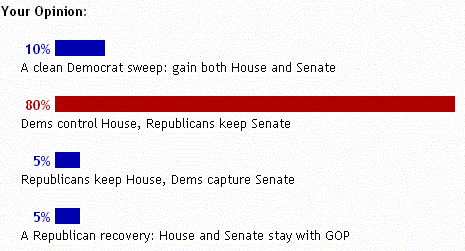
Result of last poll: only 25% of you predicted the Democrats would control both the House of Representatives and Senate (and some of those votes were cast after the results were known, which was slightly cheating). The vast majority wrongly guessed - like me - that the Dems would win the House but fail to take the Senate.
Lib Dems, especially those actively involved in community politics, tend to be quite suspicious of league tables.
To an extent understandably: local councils, schools and health authorities (for example) have all had to collect and publish data according to nationally-set criteria. And sometimes it’s a pointless waste of time.
But, as long as the limitations of the data on which such league tables are based are recognised, league tables are a helpful ready-reckoner which allow you to ask the right questions to drill-down, and better understand performance within an organisation.
It’s very much in that spirit that I present the following league table of Lib Dem Parliamentarians ranked according to the number of press releases issued during November. The list is in descending order of frequency, and alphabetically by surname where tied:
Lib Dem shadow cabinet:
Nick Clegg (Shadow Home Secretary) = 11 Chris Huhne (Shadow Environment Secretary) = 7 Menzies Campbell (Leader) = 6 Michael Moore (Shadow Foreign Secretary) = 6 Steve Webb (Shadow Health Secretary) = 6 Andrew Stunnell (Shadow Secretary of State for Communities and Local Government) = 5 David Laws (Shadow Secretary for Work and Pensions) = 4 Sarah Teather (Shadow Education and Skills Secretary) = 4 Vince Cable (Shadow Chancellor and Deputy Leader) = 3 Alistair Carmichael (Shadow Transport Secretary) = 2 Ed Davey (Shadow Trade and Industry Secretary) = 2 Don Foster (Shadow Culture, Media and Sport Secretary) = 2 Nick Harvey (Shadow Defence Secretary) = 2 Norman Lamb (Leader's Chief of Staff) = 2 David Heath (Shadow Leader of the House of Commons) = 1 Simon Hughes (Constitutional Affairs & Shadow Attorney General) = 1
Lib Dem spokespersons:
Sandra Gidley (Shadow Health spokesperson) = 2 Evan Harris (Spokesperson for Science) = 2 Susan Kramer (Shadow International Development Secretary) = 2 Danny Alexander (shadow spokesperson, Dept for Work & Pensions and spokesperson for disability-related issues) = 1 Tom Brake (Shadow Minister for Local Government and Community Cohesion) = 1 Lorely Burt (spokesperson for Women and Equality and spokesperson for DTI (Small Business)) = 1 Lord Garden (Peer) = 1 John Pugh (Shadow Health spokesperson) = 1
All the usual criticisms of this table can be made. It measures quantity not quality. It covers only a two-week period. Some shadow cabinet portfolios lend themselves more easily to press releases than others. Press releases are by no means the only measure of how well our Parliamentarians are performing.
All true enough. I am drawing no inferences by collating and publishing this table, simply reporting what I was interested enough to try and find out for myself.
But I will make one point. There are 24 Lib Dem shadow cabinet members, including the Leader, and sixteen of them feature in this table. That means one-third did not file a press release in the last two weeks.
The party website is one medium by which the party can communicate directly both with voters and with our members. I hope all our shadow cabinet can find something worthwhile saying about what they’re doing in their role at least once a fortnight - to prove we really are working hard all year round.
I don’t often write about my day job. Partly that’s because politics, and this blog, is a refuge from my work. Partly because it wouldn’t often be appropriate. Mainly because it would be dull for you to read, and for me to type. (All or some of which may apply to this post, too.)
I work as development director for St Anne’s College in the University of Oxford, responsible for fundraising, alumni relations and communications. I’m not an academic - I know my limits - but, as a fellow of the College who serves on its governing body, I am a member of the University’s Congregation, the ‘parliament of dons’ as it is usually referred to in the press. It’s not that exclusive a club - over 3,000 members - and I’ve never yet had cause to attend one of its meetings, as Congregation is a democratic ‘back-stop’, with most decisions delegated to the University’s Council.
But tomorrow afternoon I will be there, along with hundreds of other members of Congregation - many bussed in from the medical research facilities in and around my Council ward of Headington - to vote on proposed reforms to the University’s governance. To which your response might very well be, ‘So what?’
If so, I’d sympathise with you. I’m not sure quite why the internal rumblings of Oxford are of national interest. But if you read the papers today, and over the week-end, you’d be forgiven for thinking there is no bigger issue in higher education today. (And it can’t all be put down to the usual Oxbridge stranglehold on the media. Cambridge doesn’t score anything like the column inches Oxford does when it comes to negative publicity.)
The Financial Times carried no fewer than three articles today, analysing the issues at stake: here, here and here. The Times a meretwo; though The Sunday Times also covered the story. And The Sunday Telegraph and Economist couldn’t resist tossing in gobbets of their own.
Why the fuss? Well, partly it’s an old-fashioned bust-up, and I guess everyone loves one of those no matter what the institution. That it’s an ancient university like Oxford allows journalists to indulge their love of stories laced with plummy vocab like ‘cloisters’, ‘dreaming spires’ and ‘Sheldonian’.
On the one side you have the Vice-Chancellor, John Hood - a tough, taciturn outsider, who has taken the University by the scruff of its neck, and told a few home truths - and on the other side you have traditionalists pithily characterised by one of my colleagues (a proper academic) as ‘joylessly conservative’. Which side of the debate am I on? Go figure.
The dispute - and let no-one kid you it’s been anything other than a daggers-drawn, deeply personalised duel - centres on whether the University’s Council should comprise a bare majority of external lay members.
To the ‘Hoodies’ - as those of us who support the Vice-Chancellor are casually referred - this is, in part, about the public accountability of a private institution in receipt of public funding, and now accountable to the Charity Commission. Oxford has to demonstrate, unabashedly and transparently, that it is acting in the public interest. Ensuring there are lay members with ‘disinterested’ objectivity able to vouch for this is important to the University’s confidence in itself, as well as to public confidence.
More importantly, it is about ensuring the University has the appropriate skills to govern itself. Oxford has an annual turnover of £500m and an endowment of £3bn, employing 15,000 staff, and with 25,000 students. It is a complex and international institution. The idea that academics - who devote their lives to teaching and research - have the time, inclination or expertise to master the intricacies of (for example) its investments, risk management or IT strategies is unrealistic. Yet the University needs to ensure it can call on the advice of highly competent people who do understand these issues, and who are able to hold to account the Vice-Chancellor and his executive team.
For those ‘joyless conservatives’ worried this smacks of a takeover by outsiders insensitive to Oxford or to academia there are two very deliberate safeguards in place.
First, the external lay members of Council will be alumni of the University, some of them distinguished academics from other institutions. They will be elected by, and accountable to, Congregation, and their role will be to act as ‘critical friends’.
Secondly, Council cannot itself initiate any proposals – it can only respond to proposals made by the Academic Board, which is entirely comprised of internal members, 35 of them, representing the various parts of the University: the colleges, academic faculties, and university administrators. This body will be the key to the success (or not) of these reforms.
The central tension at Oxford is exemplified by tutorial fellows who are employed by both their college and their department, and often find themselves pulled, simultaneously, in different directions. The Academic Board is the place where a truly Collegiate University must come together to determine its academic strategy and priorities. That such a body doesn’t already exist can be seen either as an amusing quirk of history, or a gaping void in the University's structures.
I should declare, of course, that there is a fundraising angle to this: donors will not give to an institution they do not believe is well run. I think the governance reforms set out how the University can be better run, and therefore will spend its scarce resources more wisely. That makes my job, of soliciting gifts from St Anne’s alumni and friends, a little bit easier.
Oxford is, in domestic terms, a wealthy university; internationally it is dwarfed by Harvard, which commands a £13bn endowment. And as in Premiership football, so in premiership academia: the talent follows the money.
Oxford, like any other university which wants to succeed in the international market-place of higher education, needs to generate more cash in order to offer bursaries to the best students regardless of background; to be able to recruit and retain the best staff from all over the world; and to provide all who work here with first-class facilities. Anything less is failure.
Oxford is not a business, nor should it be run like one. But it needs to be business-like in its attitude. And that means knowing when to make its bloody mind up. Tomorrow would be a start.
PS: for the record, wearing academic gowns to Congregation is voluntary, and I shan’t be wearing mine. Though not on this occasion because of quibbles that it re-inforces a ‘them and us’ symbolism - all members are entitled to wear an academic gown, after all. It’s just that it’s pretty uncomfortable, gets caught in doors, and looks damn silly when riding a bike.
I don’t go to many civic ceremonies as a councillor - most are held during the working day - but the one I make every effort to attend is the Remembrance Sunday service held at the war memorial on St Giles, in the centre of Oxford.
(Incidentally, the one year I was absent, like so many of my colleagues, earned some little local notoriety in the Oxford Mail. Since when, attendance has much improved…)
It is, of course, important to honour those who lost or risked their lives defending the liberties that we too often take for granted today. One of the warmest rounds of applause during each year’s procession is reserved for the surviving veterans of the last world war.
In the last couple of years, there has been the added poignancy also of realising quite how many of our troops are currently in operational service - 22,700 of them are, as of now, located in:
Afghanistan (5,800);
Bosnia and Kosovo (900);
Iraq (7,200);
UN missions (300); and
Northern Ireland (8,500);
with a further 27,390 on non-operational service in Germany, Cyprus, the South Atlantic Islands, Gibraltar and Diego Garcia.
It seems only right and proper that, one day each year, I should think how lucky have been the post-war generations not to be conscripted into military service; and all the more appreciative of those who voluntarily sign up so that I don’t have to.
There is one decision I consciously make each year, though - and that is to dispense with the robe which, as a councillor, I am entitled to wear on such civic occasions. This is an entirely personal decision, but one I have stuck to since I was first elected, back in May 2000.
I dislike such ostentatious ceremony, the point of which appears to be to show that councillors are separate from (perhaps grander than) those we represent. For sure, it is part of the city’s tradition, and maybe the spectacle of civic dignitaries in funny clothes is what the public wants, what they expect. But I am uncomfortable with outward displays of hierarchy which appear to exist for their own sake, and which symbolise the ‘them and us’ perception of politics among the public.
So I dress smartly and appropriately, as this photo from today’s service demonstrates (I’m fourth from the right). But I shall continue to eschew my robe.
And of course I stay silent during the singing of the National Anthem - I have no problems with God saving the Queen (though others are probably in greater need), but have no wish to lie through my teeth in His name by asking that she is ‘Long to reign over us’.
As every thinking schoolboy should, I became a socialist and a republican aged 16. I soon realised my juvenile mistake, allowing my socialism to lapse, then be converted into liberalism. However, my republicanism remains entrenched (albeit pretty dormant).
It seemed that out of the battle I escaped Down some profound dull tunnel, long since scooped Through granites which Titanic wars had groined. Yet also there encumbered sleepers groaned, Too fast in thought or death to be bestirred. Then, as I probed them, one sprang up, and stared With piteous recognition in fixed eyes, Lifting distressful hands as if to bless. And by his smile, I knew that sullen hall; With a thousand fears that vision's face was grained; Yet no blood reached there from the upper ground, And no guns thumped, or down the flues made moan. "Strange, friend," I said, "Here is no cause to mourn." "None," said the other, "Save the undone years, The hopelessness. Whatever hope is yours, Was my life also; I went hunting wild After the wildest beauty in the world, Which lies not calm in eyes, or braided hair, But mocks the steady running of the hour, And if it grieves, grieves richlier than here. For by my glee might many men have laughed, And of my weeping something has been left, Which must die now. I mean the truth untold, The pity of war, the pity war distilled. Now men will go content with what we spoiled. Or, discontent, boil bloody, and be spilled. They will be swift with swiftness of the tigress, None will break ranks, though nations trek from progress. Courage was mine, and I had mystery; Wisdom was mine, and I had mastery; To miss the march of this retreating world Into vain citadels that are not walled. Then, when much blood had clogged their chariot-wheels I would go up and wash them from sweet wells, Even with truths that lie too deep for taint. I would have poured my spirit without stint But not through wounds; not on the cess of war. Foreheads of men have bled where no wounds were. I am the enemy you killed, my friend. I knew you in this dark; for so you frowned Yesterday through me as you jabbed and killed. I parried; but my hands were loath and cold. Let us sleep now ..."
It’s no surprise that Alan Johnson has ruled himself out as a Labour leadership contender, opting instead to run for the No. 2 post. What is surprising is his definition of the deputy leader’s role, according to the BBC:
The deputy must be "subordinate to and supportive of the leader, (carrying) out whatever duties the leader sees as being essential to securing a fourth term in office".
“Subordinate to”? What kind of freakin’ pussy-whipped cop-out is that?
I know the Labour Party is now a million miles from being a fraternity of comrades, and eagerly embraces reactionary authoritarianism in all its forms.
But Mr Johnson could at least keep up some pretence that Gordon Brown is not a control-freak convinced he’s more equal than others.
You've lost the Senate, you've lost the House, you're a lame duck President with plunging approval ratings - chances are you're a bit miffed. You gotta blame someone, and that person obviously can't be you. Here's your 'to do' list:
If Mr Bush does try to pin any of the blame on Karl Rove, it seems he'll get short shrift from his party, according to today's FT:
Republican analysts on Thursday said the jibe was unfair. The election was an indictment of Mr Bush’s Iraq policy, not political tactics. “Nobody thinks that Karl is in charge of the occupation of Iraq,” said Grover Norquist, head of Americans for Tax Reform, who has close ties to Mr Rove. “I haven’t heard any complaints about him. In a conference call with conservative groups no one faulted the turnout effort.”
Mr Norquist is an exemplar of the Republican right, as is clear from his penetrating analysis of the GOP's defeat in the key swing state of Pennsylvania:
“Bob Sherwood’s seat would have been overwhelmingly ours, if his mistress hadn’t whined about being throttled,” said Mr Norquist. Any lessons from the campaign? “Yes. The lesson should be, don’t throttle mistresses.”
... a mandate is about power, and power is a slippery, fluid, elusive commodity. ... There are other factors, too, which might mean Dubya's victory is as good as it gets for the Republicans. ...
Dubya's first term may well come back to haunt him in his second. Most obviously - let's hope not inevitably - Iraq could slip off the precipice on which its teetering, and descend into civil war. The US and its Allies would not be able simply to wash their hands of the bloodshed they've fomented. Active military re-involvement, not the disengagement for which even the neo-cons are now hoping (if only so they can flaunt their hawkish menace further afield), would be an unavoidable, and humiliating, outcome. ... thirdly, the domestic agenda is by no means assured. Dubya has, somehow, to attempt to curb his reckless spending habits, and to staunch the spiralling budget deficit.
Control of the White House, Congress and Senate present Dubya with immense leverage, a generational opportunity to carve the political landscape in his ideological image as clearly as Mount Rushmore. He remains the most polarising of politicians, squeaking both his presidential victories, governing as if they were landslides. His approval rating continues to hover at 50%, remarkably low for a freshly re-elected second term President. Most of his Party are already looking towards the 2006 mid-term elections. He has three years until he becomes a lame-duck President. He's enjoyed his day of glory. But the clock is now ticking.
It’s an odd equation, and yet one which seems to explain the response of the American money markets to yesterday’s political upheaval in the US. This from CNNMoney.com:
"I think the market had basically factored in that there was going to be a change in the political landscape," said Ted Weisberg, a New York Stock Exchange floor trader at Seaport Securities.
"Whether you have the Democrats controlling the House or controlling both houses, you still have a Republican leader in the White House and that still means gridlock," he added.
Gridlock would limit the power of either party to push through legislation perceived as partisan, an environment acceptable to the markets.
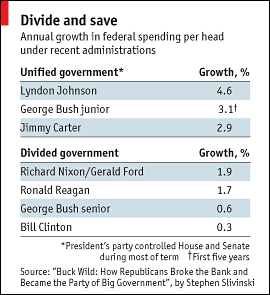
This table from the current Economist helps explain why the markets think like that. To translate it into another equation: unified government = high federal spending = big government. And markets (unsurprisingly) don’t like big government - it sucks labour and capital away from entrepreneurial wealth creation.
Of course, the likes and dislikes of the money markets should not dictate political judgement (though it would be a foolish politician who completely ignored them). But they may well be right to divine that divided government is, generally, good government.
For example... Under a Democrat President, Bill Clinton, and a Republican Congress, the US budget deficit was brought under control. Yet under a Republican President, George W. Bush, and a Republican Congress it has escalated, in part thanks to pork-barrel projects like the $223m Alaskan ‘bridge to nowhere’.
This shouldn’t surprise us. After all, the Founding Fathers intentionally built extensive checks and balances into the US constitution in recognition that ‘power tends to corrupt, and absolute power corrupts absolutely’.
One of the greatest problems in the UK is that power is over-concentrated and over-centralised in the executive - and, de facto, in the office of the Prime Minister. There is almost no limit on his authority, as our legislature is weak. The Prime Minister has a built-in, whipped majority in the House of Commons, while the second chamber, the House of Lords, is deliberately left to moulder as an emasculated body with no democratic accountability, and little remaining hereditary droit de seigneur.
Those who argue against proportional representation on the grounds that it produces ‘weak government’ are missing the fundamental point. A coalition government which embraces majority opinion is far more likely to produce good, stable government than one-party rule based on the consent of little more than one-third of the voting public.
The art of good politics is all about dialogue: a constructive dialectic leading to a workable synthesis. The tribally confrontational British political system is designed to make such dialogue as rare and unnatural an event as possible. If we’re lucky our Prime Ministers speak in monologues; more usually it’s a soliloquy.
Delighted that I can type the words Sen. Claire McCaskill (D-MO).
Still fingers crossed that it will shortly be Sen. George Allen (R-VA). (Fell asleep about 3am, exhausted by continually clicking refresh on the Virginia online election update.)
With polls about to close - and no exit polls yet leaked - time to put my credibility online...
House of Representatives: Democrats = 221 Republicans = 214
Senate: Democrats = 48 Republicans = 52
PS: I've remembered what I love about US elections - I haven't been up since 5am delivering leaflets, knocking-up potential voters for 12 solid hours, or scrutinising the count until 2am. I can just relax and enjoy the excitement like a normal person. (Well, a normal person with a slightly obsessional interest in elections, at any rate.)
When Simon Jenkins is good, he’s very, very good. Today is not one of his better days.
He’s posted to thegrauniad’s Comment Is Free a provocatively controversial article titled, ‘Bad at war, good at democracy’, which is deliberately aimed at getting a rise from lily-livered liberals like me. So here goes.
The following passage gives the flavour of Mr Jenkins’ glib assertions argument:
“Every time I visit America at election time I am left exhilarated by the sheer, pulverising potency of its democracy. … Yet ABC news this morning could announce judgment day with the downbeat message that it was "the nastiest mid-term election in history."
“Nasty is right. Within two minutes of turning on my television I hear "Andrew Cuomo is lying", Bob Menendez is supported by kickback hoodlums, worst calumny of all, Thomas Kean "supports George Bush". Almost everyone is in favour of killing babies, rupturing stem cells and torturing Iraqis. The corridors of power are awash in corruption, adultery, mendacity and sin. The torrent of abuse is relentless and, to those used to the bland hustings of European oligarchy, gloriously refreshing.
“Above all the negativity is good. The Karl Rove strategy of identifying electoral difference rather than consensus inflames democratic choice as it should be inflamed. Voters cannot make that choice if, as increasingly in Europe, candidates are bland mirrors of each other. … I love it.”
All of which OTT rhetoric conveys a dismal view of politics, in which the only honest arguments are those which have been amped-up to the max; where simplistic, reductive binary politics rule; where cheap tribal loyalties trump genuine co-operation when common agreement exists; where personality flaws are exaggerated wildly to distract from policy issues which matter a damn; and in which intelligent civic discourse is replaced by proud-to-be-ignorant shock-jock rants which demean us all.
The campaign ads which Mr Jenkins lauds don’t set out to enlighten, inform or inspire: their job is to confuse, panic and rile. The best arguments - the most spine-tingling rhetoric - are imbued with passion, not anger; are truthful, not warped; are authentic, not contrived.
Few of us reach such dizzy heights - but we can aspire, can’t we? “A man’s reach should exceed his grasp, or what’s a heaven for?” Do we really have to settle for Mr Jenkins’ conclusion that politics is a shitty business so we should all get down and dirty in the gutter?
It's not happened here (yet), but it can only be a matter of time. When it does, I have no doubt the Lib Dems' very own John Hemming will be straight on the case.
Robot phone calls are driving people nuts throughout the northeast [of the US]. The prank calls claim to be from one candidate (the Democrat) while they’re actually from the other (the Republican).
Prerecorded phone calls have been a pathetic part of campaigns for a generation, but these new robo-calls add a new element: Hang up, and the phone rings again. Hang up, and the phone rings again. Some of the robots are making seven or eight calls in a row to the same number.
The infuriated voter trying to eat dinner or beat his children ends up wanting to kill the candidate blamed for the call.
It'll be good, but not quite good enough - that appears to be your view on what the Democrats can hope to get out of tomorrow's US mid-terms.
A whopping 80% of those who have so far voted in the poll over at my other gaff reckon the Dems will do enough to win control of the House of Representatives, but fall short of snatching the Senate away from the Republicans.
There is, of course, one other scenario which my poll doesn't allow for - the Senate could be tied at 50 each. Indeed, that is the result predicted by the latest Polimetrix poll as reported on Political Wire, which would be a throwback to the position which pertained (for a few months) in 2001.
The Republicans would still retain control, but only on Veep Cheney's casting vote. (Which might at least keep in check his propensity to go human quail hunting.)
Greg Barker, Tory MP for Bexhill and Battle, hit the headlines last week after it was revealed that his marriage has broken-up, and he is having a gay affair with his interior designer.
What should be the liberal response to such a story? Well, decide for yourselves...
One of the following quotes is from Mary Verrell, the Lib Dem candidate at the last general election; the other is from the Battle Observer, the local newspaper. See if you can guess which is which:
Quote 1: "So who is this man, Gregory Barker, who Bexhill and Battle elected as their MP and who, whether we voted for him or not, is our representative in Parliament? Probably, not the one that many thought.
"His constituents have a right to know what sort of person he is, not as a matter of salacious gossip, but so that they have an honest picture of the man who represents Bexhill and Battle in the House, and who, we assume, will be asking for their vote again before very long. ...
"As to the plea for privacy Gregory Barker has chosen a life in the public eye. Of the 46,834 who voted in 2005, 24,629 chose to trust this man to speak for them, largely on the basis of his political persuasion, but additionally on the information fed to them in his election address and in the media."
Quote 2: "Greg Barker is undoubtedly the talk of the town in Bexhill. ... And why? Because of allegations about his private life. ... His private life indeed should be private.
"How the people of Bexhill - and indeed the whole constituency - will react to this is another matter. Open-minded people will say 'So what, who cares?' Others may not take such a sympathetic view. ... He obviously has problems in his personal life and he should be allowed to resolve them.
"How he decides to conduct his private life in future is his choice. If he has a homosexual relationship, then so be it. Equally, if he has a heterosexual relationship, then so be it."
Sad to say: the sanctimonious and censorious Quote 1 is the Lib Dem; the tolerant and liberal Quote 2 is the local rag.
However alluring the bandwagon, however tempting the opportunity to be quoted, I'd like to think our aspirant MPs would resist the urge to utter such judgemental bollocks.
In four days’ time, 7th November, Americans will go the polls to elect 435 members of the House of Representatives, and 33 members (one-third) of the Senate. What will happen? That’s the question I’m asking over at m’other site, and you have four possible options:
A clean Democrat sweep: gain both House and Senate
Dems control House, Republicans keep Senate
Republicans keep House, Dems capture Senate
A Republican recovery: House and Senate stay with GOP
Can the Democrats capitalise on President Bush’s dismal popularity, and a Republican Party beleaguered by scandals? Or might Karl Rove’s much-vaunted tactical ability, and the GOP’s fearsome GOTV strategy, yet pull a rabbit out of the hat?
Democrats who are simply bursting to get their own back after the tight presidential races of 2000 and 2004 should perhaps be careful what they wish for. As Adam Nagourney noted in the New York Times six months ago:
As strange as it might seem, there are moments when losing is winning in politics. Even as Democrats are doing everything they can to win, and believe that victory is critical for future battles over real issues, some of the party's leading figures are also speculating that November could represent one of those moments.
From this perspective, it wouldn't be the worst thing in the world politically to watch the Republicans struggle through the last two years of the Bush presidency. There's the prospect of continued conflict in Iraq, high gas prices, corruption investigations, Republican infighting and a gridlocked Congress. Democrats would have a better chance of winning the presidency in 2008, by this reasoning, and for the future they enhance their stature at a time when Republicans are faltering.
Indeed, some Democrats worry that the worst-case scenario may be winning control of Congress by a slim margin, giving them responsibility without real authority. They might serve as a foil to Republicans and President Bush, who would be looking for someone to share the blame. Democrats need a net gain of 6 seats in the Senate, and 15 seats in the House.
"The most politically advantageous thing for the Democrats is to pick up 11, 12 seats in the House and 3 or 4 seats in the Senate but let the Republicans continue to be responsible for government," said Tony Coelho, a former House Democratic whip. "We are heading into this period of tremendous deficit, plus all the scandals, plus all the programs that have been cut. This way, they get blamed for everything."
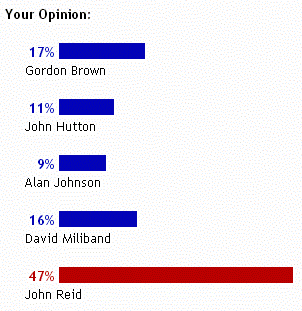
Result of last poll: as you can see, John Reid was by far your favoured Labour leader from a Lib Dem perspective (ie, the guy most likely to be bad for Labour and good for us): he polled 47% to Gordon Brown's 17%; trailing were David Miliband (16%), John Hutton (11%) and Alan Johnson (9%). Though it looks like it's all fairly academic now.
This clip has been seen 706,846 times since it was uploaded to YouTube just two days ago.
This is the moment - in fact, just 10 seconds - when Senator John F. Kerry torpedoed any extant hopes he might have had of running for the Presidency again in 2008, by appearing to imply that US troops are doofuses. (Though I’m sure he will have been buoyed by my colleague’s support of him.)
Mr Kerry’s office has now released the text of what the Massachusetts senator meant to say:
“I can't overstress the importance of a great education. Do you know where you end up if you don't study, if you aren't smart, if you're intellectually lazy? You end up getting us stuck in a war in Iraq. Just ask President Bush.”
It’s still a glib, wise-ass dig, which is fine if you’re David Letterman or a blogger, but the man who would have been JFK II is better than that.
However, it’s worked to the Democrats’ advantage. Not only has it guaranteed the last few days of mid-terms campaigning continues to be dominated by Iraq - a subject the President would prefer to dodge (like the draft) - but it ensures the uninspiring Mr Kerry is off the 2008 ticket.
Over 9,000 people have so far commented on that YouTube clip. But the sassiest take I’ve yet read was uttered by Vice-President Dick Cheney (though I don’t suppose for a moment he originated it):
"Senator Kerry said he was just making a joke and he botched it up. I guess we didn't get the nuance. Actually, he was for the joke before he was against it."
I guess it’s kind of impressive - every time you think the Labour Government can’t sink lower they plumb a new depth.
I’m hard-pressed to know in whom I hold most contempt. It could be the Foreign Secretary, Margaret Beckett (I still find that four-word sequence ludicrously far-fetched) who argued that a review of the Government’s catastrophic failure of leadership in Iraq would send “the wrong signal”:
“our words... will be heard a very long way away. They can be heard by our troops who are already in great danger in Iraq”.
This can be termed the ‘Dick Cheney defence’ - that somehow to criticise the Government undermines our troops and is, by definition, unpatriotic. The argument might have more validity had Mrs Beckett or any of her cabinet colleagues (bar two) understood their duty to challenge the evidence on which the war was predicated before voting to send British soldiers and Iraqi civilians to their deaths.
The idea that those who voted against the war - the Lib Dems and Nationalist MPs - are the ones now putting the lives of troops in danger is monumentally crass.
But at least Mrs Beckett can claim to be bound by collective responsibility. Backbench Labour MPs who chose not to back today’s motion have no such excuse: only 12 of them thought that the largest foreign policy failure since Suez might merit a Parliamentary inquiry to find out how so many of those in government - elected politicians and unelected advisors - could have committed such a tragic misjudgement.
The rest proved themselves to be either spectacularly supine (continuing their sworn fealty to this Government) or tediously tribal (vetoing the motion not because they disagreed with it, but because they disliked those arguing for it).
Their gutless complacency deserves to reap its reward at the next election.
Presiding over all this is Tony Blair, whose hold on power splutters like a candle in a draught. There are some who continue to argue that Mr Blair is a strong Prime Minister, that ‘sticking to his guns’ on Iraq proves his leadership credentials. They are wrong, confusing strength of judgement with stubborn obstinacy. True leadership requires making the right calls, and understanding how to take people with you.
Mr Blair got the biggest decision of his premiership wrong, and now is forced to cling to the wreckage of his reputation. He supported the invasion of the one member of the ‘Axis of Evil’ without WMD or imminent nuclear capability. As a result, the global community is ham-strung in dealing with either Iran or North Korea, both of which pose a greater threat to British national security than a contained Iraq did.
Mr Blair and the Labour Government have left Britain’s international reputation in tatters and committed our troops to an unwinnable war with scant regard to an exit strategy. Our country is less safe as a direct result of their actions. There can be no more serious indictment than that.
I’ve been Editor of Liberal Democrat Voice – the #1 independent website for the Lib Dems – since 2007. I combine this with my professional life as Development Director for the Education Endowment Foundation.