skip to main |
skip to sidebar
For the last few months, no opinion poll of voting intentions worthy of the name has been complete without the inevitable tagged-on question, ‘And how would you vote if Gordon Brown were Labour leader?’ To which the answer of Labour-inclined voters has invariably been: less likely than if Tony Blair were still Labour leader. Anthony Wells, at the indispensable Polling Report website, has recorded the figures of the pollsters’ beloved anticipatory question. None of the 26 polls conducted since David Cameron became Tory leader have projected a Labour lead on the presumption that Mr Brown succeeds Mr Blair. The average Tory lead in the nine polls conducted in 2007 would suggest Mr Cameron should be some 10.5% ahead the moment Mr Brown formally moves into No. 10. This has led to all sorts of silly speculation in the media that Mr Brown is a vote loser for Labour. And it has sparked an amusingly unmerited degree of triumphalism among Tories, who somehow imagine they will cruise to a general election victory merely by virtue of having elected a leader who manages, in contrast to most of his colleagues, to look and sound relatively normal.Yesterday’s opinion poll in The Observer, showing a 3% Labour lead just as Mr Brown accedes to the premiership, has poured a bucket of cold water over the heads of those who, rather foolishly, had taken too much to heart the pollsters’ misleading findings. As opinion pollsters will be the first to point out, their findings present only a snapshot of public opinion. Moreover, the question they ask to solicit the public’s views is a hypothetical one: how would you vote if there were a general election tomorrow.
Those who are asked the question (1) know there isn’t actually a general election tomorrow; and (2) have not been subjected to a month-long election campaign which will, in many cases, alter their voting intentions before they finally cast the only ballot that actually counts. This inevitably distorts the findings in quite unquantifiable ways. To add, as the newspapers who commission the polls insist the pollsters do, an extra layer of hypothesis - how do you believe you will vote in an imaginary general election when a man who is not yet Prime Minister becomes Prime Minister - is a step too far.
The public which answers this question knows full well that what they are really being asked is: what do you think of Gordon Brown? And those who are sceptical about him will take the pain-free opportunity to voice their objections in their answer. This, too, distorts the findings in quite unquantifiable ways.Finally, you must factor in the statistical fact that opinions polls can only predict with 95% probability to within a margin of error of +/-3% the headline figures which the newspapers will brandish on their front pages with cast-iron certainty. So the Observer poll which I’ve used as evidence in this article may just as well point to a Tory lead of 3% as it does a Labour lead of 3%. Or it could be one of the 5% of opinion polls which is complete bollocks outside the margin of error. You pays your money, you takes your choice...Like many observers of the British political scene, I expect Mr Brown to enjoy a poll bounce over the summer, and that Labour will continue to be tied with, or build a small lead over, the Tories. How long this lasts will, rightly, depend on the success or failure of Mr Brown’s government. In part, this will be because Labour has, contrary to all the pundits’ predictions (including my own), accomplished a bloodless transfer of power. It will also be because the media, believing their own rogue polls, and the Tories, believing their own anti-Brown propaganda, have so far lowered expectations of our PM-to-be that he cannot help but clear the low hurdles he has been set. Indeed, so successful has this ‘dampening down’ strategy been, it’s almost tempting to believe that Mr Brown, a man of native political cunning, may secretly have commissioned some of those polls himself.
Our current Prime Minister has long revelled in the soubriquet, ‘Lucky Tony’. The BBC’s political editor, Nick Robinson, today suggests that this mantle has now been passed to his successor, Gordon Brown. His rationale is simple: this week’s latest shambolic performance by the Labour Government could have happened in seven weeks’ time, getting the new Premier’s tenure off to the shakiest of all possible starts. Well, perhaps. I think Mr Robinson rather underestimates the incapacity of this Cabinet, and their potential for conjuring future folie des grandeurs. For while it’s a tad tricky to feel sympathetic towards health secretary, Patricia Hewitt - who would happily climb a step-ladder on the peak of Everest all the better to talk down to us - the rather hapless Ruth Kelly is perhaps a little more deserving of pity. Handed the poisoned chalice of making Home Improvement Plans work, she is being forced to sup long and hard no matter the taste is bitter. Meanwhile, the Government minister actually responsible for the HIPs fiasco, Yvette Cooper, is tipped for a big promotion in Mr Brown’s first cabinet, together with her husband, Ed Balls, a man who manages to make Ms Hewitt seem human. Lucky Gordon? Really?He is fortunate in one regard, however - Prime Minister Brown will have an unparalleled opportunity to re-mould his ministerial team as he wishes. Labour party leaders are usually hemmed in by two constraints when assembling their cabinet. First, the need to reward political rivals in order to show their magnanimity and to unite the party. But Mr Brown has no rivals - enemies, you betcha, but not rivals.
And, secondly, Labour leaders have to construct their first cabinet from those elected by the Parliamentary Party to the shadow cabinet. Look at Team Tony c.1997 - how many of those would have been there from Mr Blair’s personal choice? However, this party rule, rather quaintly, applies only to the first cabinet. After that, the leader can do as she or he wishes. So Mr Brown has a free hand, made even freer by the voluntary redundancies of those other two clunking fists, the Two Johns, Prescott and Reid.Of course, this is itself a double-edged sword - his allies will expect their reward, but he cannot possibly avoid disappointing some of the 308 Labour MPs who coronated him. And yet, as has become painfully obvious these last few months, there are precious few Labour MPs of real standing, who are also cabinet material. That Mr Brown is the sole leadership candidate after 10 years as Chancellor is a very real tribute to his talent and resilience. It is also a damning indictment of the paucity of quality within this Government. The lack of a viable alternative has assisted him in making it to the top of his party; conversely, it might not help him to stay there. He’s going to need all the luck he can get.
What would you do if you were David Miliband? He’s already getting a whole load of advice, some friendly, some not-so-friendly - it’s a moot point which he finds least helpful. His options appear limited. He can either contest the leadership of the Labour Party against Gordon Brown, so long the heir-presumptuous; or he can choose to keep his powder dry. When in doubt, flip through the history books.First point to note: Mr Miliband would be the least experienced British Prime Minister since 1945. There have been 11 post-war Prime Ministers, five of them appointed to the post while serving as members of the cabinet:
- Anthony Eden (translated from Foreign Secretary);
- Harold Macmillan (from the Chancellorship, had been Foreign Secretary);
- Alec Douglas Home (another Foreign Secretary);
- Jim Callaghan (yet another Foreign Secretary, though had also been Chancellor and Home Secretary); and
- John Major (who followed Macmillan’s career path).
The other six were elected to the post having served time as leader of HM’s Opposition, itself a pretty thorough preparation for the job to come:
- Clement Attlee (who had been Deputy Prime Minister);
- Winston Churchill (a former Prime Minister, who had also held more cabinet posts even than John Reid);
- Harold Wilson;
- Edward Heath;
- Margaret Thatcher; and
- Tony Blair.
All 11 of them had served at least a decade in Parliament.By contrast, Mr Miliband has been an MP for fewer than six years, serving in the cabinet for nigh-on two of them. Promotion to the First Lord of the Treasury in one bound would be quite an hubristic leap.Of course, it can be argued that such experience doesn’t matter a jot. “Look at David Cameron,” comes the cry. Well, we shall come to see how time treats the Tories’ young pretender; for now it suffices to say that I suspect even he is grateful his moment has not yet arrived, that he has a while longer to work out what he would wish to achieve in government.From this you might think my conclusion is obvious: Mr Miliband would be daft to stand. If only it were that simple! For there is always another consideration - what will happen if he doesn’t stand?The sensible analysis reads: let Gordon win the leadership and lose the election, allowing David to take over the reins as the Labour Party’s saviour.
That might seem rational now; but so, too, did the Blair-Brown ‘Granita Pact’ in 1994; as did David Davis standing aside for Michael Howard to assume the Tory leadership in 2003. I wonder if either now regrets their choice? And what of Michael Portillo’s failure of nerve when declining to challenge John Major in 1995? The standard-bearer of the Tory right was instead eclipsed by the vulcanesque John Redwood. Favourites have a habit of thinking their time is yet to come. But events have a habit of unravelling what once seemed seamless. When Chris Huhne stood for the Lib Dem leadership last year, he was initially dismissed as ‘Chris Who?’ But ‘Who’ had the last laugh - the freshly-minted Eastleigh MP scored 32% in the first round of voting, besting the better-known and vastly more experienced Simon Hughes, and emerging as the newly-crowned ‘activists’ darling’. Nick Clegg might be considered by the media as Ming Campbell’s natural successor, but Mr Huhne will stand in much better stead next time than if he hadn’t risked standing this time.Such are the considerations for Mr Miliband to ponder. My verdict? He’d be mad to stand. But he’d be madder not to. The real risk for him is that he might win. However, I don’t think he should worry too much about such an outside possibility.
Adrian Hamilton makes a fair point in today’s Independent:
The New Labour government will soon be 10 years old. But what may well be most remarkable about this administration as it approaches its birthday is not so much its longevity but how little heavyweight talent it has at the end. Think of almost any cabinet since the Second World War and even the weakest of governments - the later Wilson administrations, John Major's and Jim Callaghan's - had some pretty formidable figures round the table. You might think some overrated, others positively loathsome, but it is hard to deny that Tony Crossland, Denis Healey, Roy Jenkins and Dick Crossman from the Wilson government or Ken Clarke, Michael Heseltine and Chris Patten from Thatcher and Major's, were pretty formidable politicians, "big beasts" in the jungle that is Westminster.
Compare that with the present Cabinet and, if you exclude the PM and the Chancellor, it is hard to see a small duck never mind a large beast.
Of course, it’s a little too easy to look back in wonder and pick out exempla. Harold Wilson’s cabinets also included such yesterday’s men as Fred Peart, Michael Stewart and Richard Marsh (to name but three). Margaret Thatcher made space for dull worthies like David Waddington, John Moore and David Hunt.But the point remains: the top three posts - Chancellor, Foreign Secretary, Home Office - were occupied by, inter alia, Jenkins, Callaghan and Healey (under Wilson) and Lawson, Howe and Hurd (under Thatcher). All except Lawson ran for the leadership of their respective parties, and, if successful, would have become Prime Minister. Small wonder, then, that when Frank Field cast around for an alternative to Gordon Brown as Labour leader (in yesterday’s well-reported Grauniad article) he ducked naming an alternative until his last, four-word sentence: “Step forward, David Miliband.” If Mr Miliband’s your answer, a well-worn put-down is required: ‘What the hell was your question?’But then if you look at this page - the current Cabinet - you see Labour’s problem: who else is there? (Which is all the more remarkable considering this Government was originally elected with over 400 MPs.) Why this dearth of talent? Is politics failing now to attract the right calibre of candidates? Does the growing scrutiny of MPs’ lives filter out bright sparks with some vim and vigour about them? Has the increasing centralisation of Westminster politics overloaded cabinet ministers with tedious operational minutiae? Are our expectations unrealistically high?
‘Harman would be most popular deputy PM, says poll’, according to today’s thegrauniad. Here’s what the headline should have read:‘Harman most dis-liked deputy PM candidate, and would not help Labour’s re-election chances, says poll’.
(I accept I’ll never make it as a sub-editor.)
Here’s why…The YouGov poll begins by asking those surveyed how ‘warmly’ they feel towards each of the candidates on a scale of 0-10.
I’ve aggregated the scores, assuming that a 0-5 rating indicates a candidate is either not liked, or else the public is neutral towards them. A rating of 6-10 suggests a generally positive impression.It’s a simple way of working out who’s hot and who’s not. So let’s look at how the six short-listed candidates line up:- Hilary Benn: 36% (0-5), 17% (6-10) = -19% (net likeability)
- Hazel Blears: 42%, 6% = -36%
- Harriet Harman: 52%, 17% = -35%
- Peter Hain: 44%, 13% = -31%
- Alan Johnson: 37%, 13% = -24%
- Jon Cruddas: 23%, 4% = -19%
What the figures clearly show is that Harriet Harman is the most polarizing of the deputy leadership candidates. She ties with Hilary Benn as the most liked, with 17% of the public regarding each of them warmly. However, Hilary Benn is the least disliked (apart from Jon Cruddas, who no-one’s ever heard of), with 36%. Contrast this with Harriet Harman, whom a whopping 52% view negatively - she is, by some way, the most disliked of the deputy leadership candidates. Her net likeability rating, at -35%, avoids being the lowest only because Hazel Blears’ Panglossian chirpiness appears to have got on too many people’s nerves.It’s clear from these figures that the most liked - or, at any rate, least disliked - of the candidates is Hilary Benn.The second question asks ‘which potential deputy leader you think would be best alongside Gordon Brown’.
There are a number of choices, which again I’ve aggregated, according to which of the candidates would make the public ‘more likely’ or ‘less likely’ to vote Labour at the next election. I’ve also recorded the aggregate numbers of those who said it would make no difference - either because they definitely would or definitely would not vote Labour anyway, or because they didn’t know.- GB & Hilary Benn: 12% (more likely), 12% (less likely), 76% (no difference, don’t know)
- GB & Hazel Blears: 8%, 16%, 76%
- GB & Harriet Harman: 15%, 15%, 70%
- GB & Peter Hain: 9%, 15%, 75%
- GB & Alan Johnson: 8%, 17%, 75%
- GB & Jon Cruddas: 6%, 14%, 80%
My overwhelming sense from these figures is that Labour’s chances at the next election are not going to hinge on their choice of deputy leader - the vast majority of the public are entirely indifferent. And though we can expect more people to become interested once the prospective race becomes a reality, it still seems highly unlikely to sway folk one way or t’other.Interestingly, thegrauniad’s report - which I imagine borrows largely from Team Harman’s press release - says:The survey, commissioned from independent pollsters YouGov by the constitutional affairs minister herself, found that 15% of voters would be more inclined to vote Labour if she succeeded John Prescott.
Well, true enough. Strangely omitted from this paragraph is the balancing fact that 15% of voters would be less inclined to vote Labour if Harriet Harman were to succeed John Prescott. You’d have thought thegrauniad might have felt that merited reporting. Because what it shows is that electing Harriet Harman as deputy leader would make absolutely no difference to Labour’s prospects at the next election.In fairness to Ms Harman, her rivals are all vote-losers, whereas she is at least vote-neutral. All her rivals, that is, except that man Hilary Benn again.The last two questions are the most loaded ones - ‘do you agree that:- … a men-only leadership team would show that Labour is old-fashioned?’, and
- … it’s important to me that the next Deputy Prime Minister is someone I already know, not someone I’ve never heard of.’
Well, I think we can guess what answers Team Harman were hoping to garner. And, lo, so it came to pass. It appears the public don’t like to appear old-fashioned, but (perhaps a tad ironically) are comforted by the idea of someone familiar. Fortunately, the Labour Party has before it the perfect choice. Hilary Benn: generally well-regarded, with one of the most famous surnames in British politics. And he’s got a girl’s first-name, which assures Labour of a balanced ticket.And what’s even better is that there is an opinion poll showing him to be the most likeable of the candidates, and someone who won’t harm Labour’s electoral chances. It’s really awfully nice of Team Harman to fork out a few thousand quid to show why Labour should elect Hilary Benn as their next deputy leader.
It’s no surprise that Alan Johnson has ruled himself out as a Labour leadership contender, opting instead to run for the No. 2 post. What is surprising is his definition of the deputy leader’s role, according to the BBC:The deputy must be "subordinate to and supportive of the leader, (carrying) out whatever duties the leader sees as being essential to securing a fourth term in office".
“Subordinate to”? What kind of freakin’ pussy-whipped cop-out is that? I know the Labour Party is now a million miles from being a fraternity of comrades, and eagerly embraces reactionary authoritarianism in all its forms.
But Mr Johnson could at least keep up some pretence that Gordon Brown is not a control-freak convinced he’s more equal than others.
In four days’ time, 7th November, Americans will go the polls to elect 435 members of the House of Representatives, and 33 members (one-third) of the Senate. What will happen? That’s the question I’m asking over at m’other site, and you have four possible options: - A clean Democrat sweep: gain both House and Senate
- Dems control House, Republicans keep Senate
- Republicans keep House, Dems capture Senate
- A Republican recovery: House and Senate stay with GOP
Can the Democrats capitalise on President Bush’s dismal popularity, and a Republican Party beleaguered by scandals? Or might Karl Rove’s much-vaunted tactical ability, and the GOP’s fearsome GOTV strategy, yet pull a rabbit out of the hat?
Democrats who are simply bursting to get their own back after the tight presidential races of 2000 and 2004 should perhaps be careful what they wish for. As Adam Nagourney noted in the New York Times six months ago: As strange as it might seem, there are moments when losing is winning in politics. Even as Democrats are doing everything they can to win, and believe that victory is critical for future battles over real issues, some of the party's leading figures are also speculating that November could represent one of those moments.
From this perspective, it wouldn't be the worst thing in the world politically to watch the Republicans struggle through the last two years of the Bush presidency. There's the prospect of continued conflict in Iraq, high gas prices, corruption investigations, Republican infighting and a gridlocked Congress. Democrats would have a better chance of winning the presidency in 2008, by this reasoning, and for the future they enhance their stature at a time when Republicans are faltering.
Indeed, some Democrats worry that the worst-case scenario may be winning control of Congress by a slim margin, giving them responsibility without real authority. They might serve as a foil to Republicans and President Bush, who would be looking for someone to share the blame. Democrats need a net gain of 6 seats in the Senate, and 15 seats in the House.
"The most politically advantageous thing for the Democrats is to pick up 11, 12 seats in the House and 3 or 4 seats in the Senate but let the Republicans continue to be responsible for government," said Tony Coelho, a former House Democratic whip. "We are heading into this period of tremendous deficit, plus all the scandals, plus all the programs that have been cut. This way, they get blamed for everything."
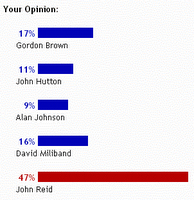 Result of last poll: as you can see, John Reid was by far your favoured Labour leader from a Lib Dem perspective (ie, the guy most likely to be bad for Labour and good for us): he polled 47% to Gordon Brown's 17%; trailing were David Miliband (16%), John Hutton (11%) and Alan Johnson (9%).
Though it looks like it's all fairly academic now.
Yesterday, The First Post’s Mole (hat-tip Guido) revealed that:John Reid, the bookies' favourite to challenge the Chancellor for Labour's top job, made it clear to Brown privately last week that he would not stand against him.
Despite encouraging signs during Labour's conference, Reid has realised that support for a serious challenge isn't there. Odds are that, having made his peace, Reid will remain Home Secretary when Brown moves in to No. 10.
Today, the Indy’s Pandora diary column reports:Allies of Brown said the story was “broadly right”, but cast doubt on the details. “They did meet last week,” my source says. “Reid signalled he’s not likely to run. But talk of a ‘deal’ is not correct. The Home Secretary thing is wrong.” Brown’s spokesman refused to comment “on private conversations”. Reid’s special advisors could not be reached.
It concludes:Were Reid’s camp to dispute the Brownite version of events, it could lead to a repeat of the Blair-Brown enmity. And even if Reid has promised Brown he won’t stand, you wouldn’t rule out The Doctor just yet…
John Reid has at least stormed into the lead in one poll. Sadly for him it’s the one I’m running at m’other gaff asking who you think would be the best Labour leader from a Liberal Democrat perspective? (Ie, who will be worst for them, and best for us.)
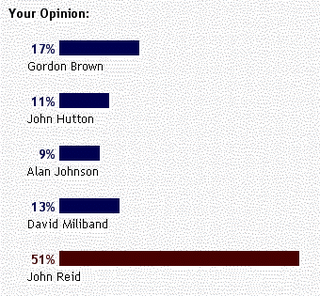 Currently Dr Reid is in the enviable position, with 51%, of winning on the first ballot.
To be honest, I’m not sure how to read this verdict. (And not just because I’ve a sneaky suspicion some people might deliberately have voted for the person they thought would be best for them and worst for us.) In one sense, I agree that - from a Lib Dem perspective - Dr Reid is the least likely to try and pitch his tent on our lawn. He doesn’t strike me as one of nature’s pluralists.
And while Labour home secretaries are for ever destined to be an easy target of liberal dismay, Dr Reid (like his predecessor-but-one, David Blunkett), seems to take strutting delight in trampling on freedoms to assert his macho credentials.
It is almost impossible to imagine the Lib Dems being able to contemplate any kind of electoral arrangement which propped up a minority Labour government led by Dr Reid.
However, that doesn’t mean I think Dr Reid will be the worst leadership option for Labour from a Labour perspective, for I’m pretty sure that a Reid win would strike fear into the Tories.
First, because a victory for an underdog is always harder to play. The Tories have had longer to think through their lines of attack on the heir-presumptive, Gordon Brown, many of which will be lapped up by the press.
But if he falters, the Tories will find themselves eclipsed by the attention-deficit disorder of our media, who would far prefer Dr Reid’s brazen novelty to Mr Brown’s grizzled staleness (and perhaps to Mr Cameron’s callow vacuity). And, secondly, because there will be many among the Tory faithful who will ponder nervously the fact that the authoritarian Dr Reid speaks their kind of language more effectively than the ‘liberal’ Mr Cameron.This year, the Tories are beaming up conference delegates’ text messages onto the big podium screens. One yesterday read: “If I ran prisons there would be no TVs in their rooms and no soft treatment from governors.”
Who’s more likely to deliver such a policy: Dr Reid or Mr Cameron?
A Reid-led Labour Party is far more likely to hold on in Labour/Tory marginals than if Mr Brown becomes Prime Minister. It’s a depressing reality.
Anyway, if you’ve not yet had the chance to cast your vote, there’s still time…
In less than a year’s time there will be a new leader of the Labour Party, and (for that matter) a new Prime Minister. There will be plenty of polls asking Labour members, and the general public, who they/we think will prove most effective. This poll isn’t asking that. I want to know who you think would be the best Labour leader from a Liberal Democrat perspective.
Put bluntly, I guess: who we selfishly think would make the worst Labour leader?Your choices are: Gordon Brown, Alan Johnson, David Miliband, John Hutton, and John Reid. (I’ve ignored John McDonnell for what I think are obvious reasons.)You should, of course, feel free to vote tactically in order to try and convince Labour members not to elect someone you think would actually be a good leader. Result of last poll:Chris Huhne was your choice (just) as the Lib Dem MP who impressed most at last week’s party conference. His 40% squeaked past Nick Clegg’s 36%. Ming Campbell followed on 15%, followed by Vince Cable (5%), Julia Goldsworthy (4%) and Evan Harris (1%).
I understand there’s a rumour that Tony Blair will, within the next few months, announce his intention to quit as leader of the Labour Party. (Don’t ask me where I glean this kind of gold-dust gossip: some of us are just incredibly well networked). As a result, Labour is beginning to consider who would be best positioned to lead them to an historic fourth election victory. So let’s look at The Man Who Would Be, Gordon Brown.For despite the ructions of the last month, he remains the near-certainty to be next Labour leader: he is not about to ‘do a David Davis’, and self-implode. Though his speech on Monday was drubbed by the force of Mr Blair’s majeure, it was by no means bad. And at least (unlike Mr Davis’s effort last year) the audience knew when he had finished. The more apt comparison (I suspect) is with Ming Campbell, who started off the favourite to win the Lib Dem leadership and finished the winner - but who emerged from the campaign a little battered, a little bruised, and with less authority than he went into it. Ming had been the party’s deputy leader prior to becoming acting leader; just as Mr Brown has been deputy prime minister in all but name. But there is no substitute for actually doing the job, for being exposed to the cruel, swirling vicissitudes as the captain.Mr Brown is a forceful, articulate, substantial advocate, with a firm sense of his own ‘moral compass’, though this appears to contrast sharply with his thin-skinned insecurities. As with any double-act, there is an unequal distribution of popularity - that the Blair-Brown partnership is no exception baffles and incenses Mr Brown in equal measure. (Perhaps it helps explain his preference for equality of outcome over equality of opportunity.) To look at Mr Brown’s face during Mr Blair’s sublime speech was to see writ large the eviscerating line, “Doesn’t he look tired?” What their speeches brutally exposed was that Mr Blair understands and exploits narrative (to pitch-perfection) in a way Mr Brown - the ultimate policy wonk - does not and cannot. The Chancellor thinks, writes and speaks in bullet-pointed, carefully sequenced paragraphs: they link, but do not flow. The Prime Minister speaks in staccato, often non-sequitur, sentences: they gush, with an irresistible force.The case against Mr Brown is simply stated. First, that he is not Mr Blair. But then neither is anyone else. (Indeed, Mr Blair is not always Mr Blair.) Secondly, that he is dour, unbearably Presbyterian, and dull. None of these strike me as unduly bad things - if (and when) the wheels come off Mr Cameron’s bandwagon, I suspect the public might appreciate the contrast with a credible, experienced grown-up. That is, after all, why I voted for Ming. Thirdly, that he is ‘psychologically flawed’, a man who makes enemies needlessly, and bears grudges shamelessly. Had he spent more time befriending the current Cabinet, Mr Blair would long since have been forced to stand aside in Mr Brown’s favour. If anything will prove Mr Brown’s undoing, it is this aloof non-collegiality. Fourthly, that he is ‘yesterday’s man’. The public, and therefore politics, has a short attention span. Mr Brown has been Shadow Chancellor and then Chancellor since 1992: a full 14 years under the spot-light (so no wonder he looks frazzled). There comes a point when the electorate says quite simply, “What’s next?”However, I do not under-estimate Mr Brown, whose leadership will present the Lib Dems with a real electoral test.
It has already been widely trailed that when he moves from the Treasury to become its First Lord, Mr Brown will proclaim ‘a new contract with the British people’: a written constitution, a commitment to a Parliamentary vote before declaration of war, an elected second chamber, perhaps even limited electoral reform. His passion for international aid is strong, and he will be keen to demonstrate this as prime minister. (Indeed, part of his antipathy towards the EU is based on its disgracefully illiberal protectionism, which keeps the developing world in poverty.) All are policies which have long been championed by the Lib Dems, and would be supported regardless of which party wants to introduce them. But clearly it erodes the party’s USP when others begin to implement what we have pledged to do. However, Mr Brown is not infallible. He will almost certainly have to stick by the ill-founded, ill-considered, and perhaps ill-fated plans to introduce national ID cards - if only to prove Labour’s increasingly authoritarian credentials to the right-wing press. Nor is it possible to imagine circumstances in which Mr Brown will undergo a Damascene conversion, and understand what it means to decentralise power from Whitehall to democratically accountable local bodies.
And he will - because he cannot help himself - persist with ensuring all tax and welfare policies are as Byzantinely complex as possible to ensure that only he understands them (along with the wealthy accountants of even wealthier people, who will know full well how to exploit the loopholes created by Mr Brown’s ever-expanding tangle of red tape).So what about the others…?Well, the Lib Dems would welcome the election of John Reid, whose rampant ego and brittle toughness would be exposed not just as desperately unattractive, but depressingly ineffectual. He would, however, be a real threat to the Tories, some of whose voters would prefer a hard-nut Glaswegian to a metrosexual Etonian.Alan Johnson is the wild-card of the pack. He has a neat turn of relaxed phrasing - witness today’s reflection on Mr Blair’s speech: “Old blue eyes will be back. He's got gigs in Downing Street and in the Palace of Westminster” - and a down-to-earth CV most Labour politicians would kill for (ie, he once had a real job). The spiv-Brylcreamed, ‘I’m All Right Jack’ union-hack stereotype belies a politician who has proved he can walk the New Labour talk, steering the controversial ‘top-up’ tuition fees bill through the House of Commons. But he has yet to prove he can either sparkle (like Mr Blair), or tub-thump (like Mr Brown), or scare the living bejeesus out of anyone with a soul (like Dr Reid).And as for David Miliband… “Breathes there the man with soul so dead”? Neither the Tories nor Lib Dems could be that lucky. So Gordon it will be. But, y’know, life’s unfair. If Mr Blair had never been prime minister, Mr Brown’s job would be so much easier. The trouble is that Mr Blair, the consummate politician of his generation, has raised the bar higher than Mr Brown can hope to clear. Even if Mr Brown can out-vault his political opponents he will never be able to beat his greatest ever political rival, The Man Who Is.